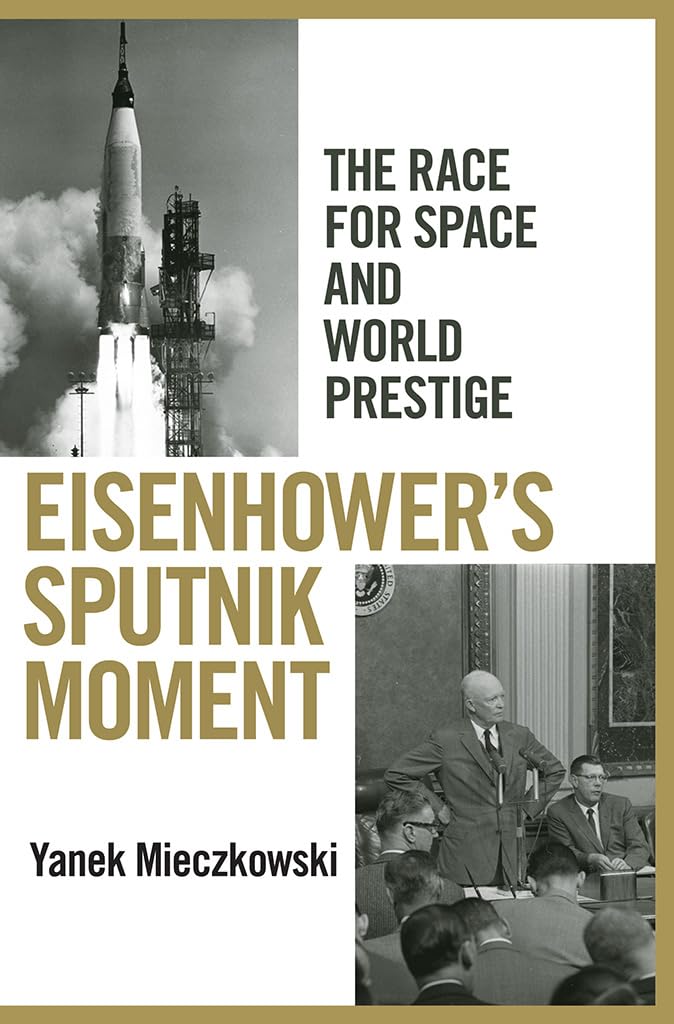
Eisenhower's Sputnik Moment: The Race for Space and World Prestige
$29.15
| Brand | Yanek Mieczkowski |
| Merchant | Amazon |
| Category | Books |
| Availability | In Stock Scarce |
| SKU | 0801451507 |
| Age Group | ADULT |
| Condition | NEW |
| Gender | UNISEX |
| Material | Cellulose-based or similar non-woven material |
About this item
Eisenhower's Sputnik Moment: The Race for Space and World Prestige
In a critical Cold War moment, Dwight D. Eisenhower's presidency suddenly changed when the Soviet Union launched Sputnik, the world's first satellite. What Ike called "a small ball" became a source of Russian pride and propaganda, and it wounded him politically, as critics charged that he responded sluggishly to the challenge of space exploration. Yet Eisenhower refused to panic after Sputnik―and he did more than just stay calm. He helped to guide the United States into the Space Age, even though Americans have given greater credit to John F. Kennedy for that achievement. In Eisenhower's Sputnik Moment, Yanek Mieczkowski examines the early history of America's space program, reassessing Eisenhower's leadership. He details how Eisenhower approved breakthrough satellites, supported a new civilian space agency, signed a landmark science education law, and fostered improved relations with scientists. These feats made Eisenhower's post-Sputnik years not the flop that critics alleged but a time of remarkable progress, even as he endured the setbacks of recession, medical illness, and a humiliating first U.S. attempt to launch a satellite. Eisenhower's principled stands enabled him to resist intense pressure to boost federal spending, and he instead pursued his priorities―a balanced budget, prosperous economy, and sturdy national defense. Yet Sputnik also altered the world's power dynamics, sweeping Eisenhower in directions that were new―even alien―to him, and he misjudged the importance of space in the Cold War's "prestige race." By contrast, Kennedy capitalized on the issue in the 1960 election, and after taking office he urged a manned mission to the moon, leaving Eisenhower to grumble over the young president's aggressive approach. Offering a fast-paced account of this Cold War episode, Mieczkowski demonstrates that Eisenhower built an impressive record in space and on earth, all the while offering warnings about America's stature and strengths that still hold true today. Eisenhower's Sputnik Moment recognizes the President's strength of leadership in the supposed furore immediately after the first Sputnik launch. Indeed the author cleverly uses the Sputnik lens to provide a critique of Eisenhower's overall leadership style.. Mieczkowski's work is highly readable and attractive to historians beyond those simply interested in space.. This work is another important building block in helping historians understand the thirty-fourth President as a rather more nuanced leader. ― Journal of American Studies Mieczkowski deftly explodes the myth of an alleged 'missile gap' between the Soviet Union and the US. He overturns as well equally fallacious perceptions that the US lagged behind the Soviet Union in the technology of launch vehicles, intercontinental missiles, and Earth satellites. Readers will gain a much-needed appreciation of how Eisenhower and his military-civilian-academic team planned and built the administrative and technical infrastructure enabling the US to enter the space age. Mieczkowski's book is thoroughly rooted in primary sources and numerous memoirs, and extends earlier scholarship by space historians R. Cargill Hall, Roger Launius, and Walter McDougall. Summing Up: Highly recommended. ― Choice Yanek Mieczkowski's assessment of Dwight D. Eisenhower's reponse to the Soviet technological feat also has important implications for broader debates over Eisenhower's presidential leadership, the creation of national security organizations, and assessments of the space race. Revealing how this episode altered the course of Eisenhower's presidency, Mieczkowski argues that it also produced some significant, albeit overlooked, accomplishments. All readers will be rewarded with Mieczkowski's superbly written narrative, enlivened with rich anecdotes and lively biographical sketches. Mieczkowski reaffirms that Eisenhower's 'Sputnik moment' remains a complicated aspect of his presidential legacy, which holds spectacular failures and missed opportunities as well as the quiet victories that the author portrays so well. ― The Journal of American History Yanek Mieczkowski's study of Eisenhower during the Sputnik period is a very wonderful contribution to history. In particular, Eisenhower has not been given enough credit for a lot of things. His leadership and his technical knowledge on how to catch up to the Russians got us to the moon. Most of the credit for this goes to Kennedy, but Eisenhower's Sputnik Moment shows who was really responsible for developing our space program. A lot of Ike's major contributions have just never been credited to him; I want to thank Mieczkowski for his valuable work. Yanek Mieczkowski is Professor of History at Dowling College. He is the author of Gerald Ford and the Challenges of the 1970s and The Routledge Historical Atlas of Presidential Elections.
| Brand | Yanek Mieczkowski |
| Merchant | Amazon |
| Category | Books |
| Availability | In Stock Scarce |
| SKU | 0801451507 |
| Age Group | ADULT |
| Condition | NEW |
| Gender | UNISEX |
| Material | Cellulose-based or similar non-woven material |
Similar Products





![Great Dialogues of Plato (08) by Plato [Mass Market Paperback (2008)]](https://m.media-amazon.com/images/I/31bhLvMntNL._UX200_SCLZZZZZZZ__.jpg)



Compare with similar items

Hang on. let me overthink this: Hang on.... |

Advances in Parasitology... |

Totality in Tincup... |

Daddy's Clever Little Princess A To Z Ac... |
|
|---|---|---|---|---|
| Price | $5.99 | $260.00 | $8.99 | $7.99 |
| Brand | ahmed ahmed | John R. Baker | Cess Teresina | BDSM Publishing |
| Merchant | Amazon | Amazon | Amazon | Amazon |
| Availability | In Stock | In Stock | In Stock | In Stock |