
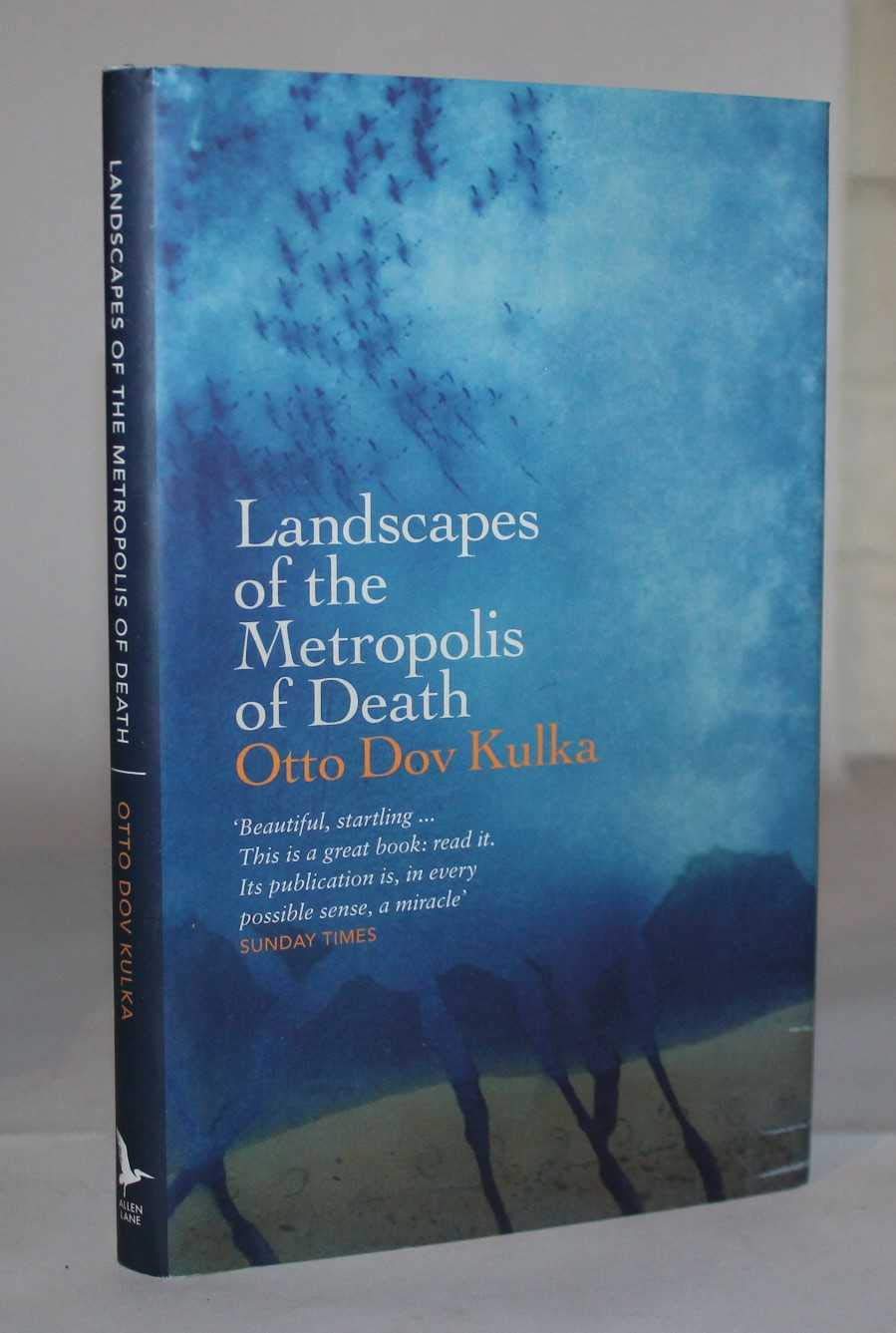
Landscapes of the Metropolis of Death: Reflections on Memory and Imagination
$25.99
| Brand | Otto Dov Kulka |
| Merchant | Amazon |
| Category | Books |
| Availability | In Stock Scarce |
| SKU | 0674072898 |
| Age Group | ADULT |
| Condition | NEW |
| Gender | UNISEX |
| Google Product Category | Media > Books |
| Product Type | Books > Subjects > History > World > Jewish > Holocaust |
About this item
Landscapes of the Metropolis of Death: Reflections on Memory and Imagination
Historian Otto Dov Kulka has dedicated his life to studying and writing about Nazism and the Holocaust. Until now he has always set to one side his personal experiences as a child inmate at Auschwitz. Breaking years of silence, Kulka brings together the personal and historical, in a devastating, at times poetic, account of the concentration camps and the private mythology one man constructed around his experiences. Auschwitz is for the author a vast repository of images, memories, and reveries: “the Metropolis of Death” over which rules the immutable Law of Death. Between 1991 and 2001, Kulka made audio recordings of these memories as they welled up, and in Landscapes of the Metropolis of Death he sifts through these fragments, attempting to make sense of them. He describes the Family Camp’s children’s choir in which he and others performed “Ode to Joy” within yards of the crematoria, his final, indelible parting from his mother when the camp was liquidated, and the “black stains” along the roadside during the winter death march. Amidst so much death Kulka finds moments of haunting, almost unbearable beauty (for beauty, too, Kulka says, is an inescapable law). As the author maps his interior world, readers gain a new sense of what it was to experience the Shoah from inside the camps―both at the time, and long afterward. Landscapes of the Metropolis of Death is a unique and powerful experiment in how one man has tried to understand his past, and our shared history. “ Landscapes of the Metropolis of Death is a work of inner truth, depicted through images, memories, and feelings. It is thus pervaded by a sense of paradox: a meticulous historian reflecting upon the intangible; a collection of exquisite, often individual pieces about a single harsh event, and a very readable book about an unimaginable event. Above all, this is a book that enriches the reader, to an extent much belied by its slim appearance... Underpinning every page is a sense of the historian ruefully shaking his head over the power of memory... The adult Kulka attempts to come to terms with his memories, but at the heart of the book is the child Kulka. It is he who experienced the events, and he invented his own language in his dreams of the camp. It was his Auschwitz, in the way he lived it and understood it, as a child. He knew that death was the only certainty in the camp--'the immutable law of death,' as he puts it--but he ultimately he survived, twice, through chance. The adult relives the death and the survival repeatedly, seemingly unable to accept that he was exempted from the overriding logic of Auschwitz. 'However much I know that I must be caught,' Kulka writes, 'I always know, too, that I must be spared.' It is the dialogue between the child and the man that makes this volume so compelling. There is often an unspoken trade-off in Holocaust books. We are curiously reading about the horrors, but we are also providing the service of remembrance. But Landscapes of the Metropolis of Death is a very different kind of Holocaust book. There is no blatant horror. Kulka imparts the unspeakable crimes through beautiful little segments of dreams and imagination. There are three poems, published here for the first time, from an unknown young woman who thrust them into the hands of a Kapo as she went into the gas chamber. The Kapo gave them to Kulka's father. And throughout the pages there are photographs of the past and the present, the people and the places. In just 144 pages a vast emotional terrain is revealed, and made real. It is a metropolis of death, as lived throughout a life.” ― Ilana Bet-El , The Daily Beast “It is almost unclassifiable...It tries to penetrate the maze of established fact and personal experience in order to arrive at what seems unreachable...Nothing else I have read comes close to this profound examination of what the Holocaust means. Kulka looks everywhere for loopholes in the immutability of death. His journey strikes me as a quest similar to the attempt to describe the face of God or the structure of the universe. They are too vast and too mysterious. Not that this stops us, or this author, from trying.” ― Linda Grant , New Statesman “This is a great book: read it. And be grateful...So startling and so beautiful.” ― Bryan Appleyard , Sunday Times “[An] astonishing book...In its essence this is not so much a book about Auschwitz as one about coming to terms with the shock of survival. Like the 11-year-old Kulka , who came within a few hundred meters of the crematoria, assuming that he would perish there, the writing hovers around the incineration, as he puts it, 'like a moth circles a flame.' ...What, ultimately, makes Kulka's book unlike any other first-hand account written about the camps is the authenticity of its vision of an 11-year-old boy...Whether or not setting all this down has done anything to relieve the unrelenting grip the 'metropolis of death' holds on his mind, or whether i
| Brand | Otto Dov Kulka |
| Merchant | Amazon |
| Category | Books |
| Availability | In Stock Scarce |
| SKU | 0674072898 |
| Age Group | ADULT |
| Condition | NEW |
| Gender | UNISEX |
| Google Product Category | Media > Books |
| Product Type | Books > Subjects > History > World > Jewish > Holocaust |
Similar Products










Compare with similar items

Are you kitten me: Cat lover journal not... |

Look Deep Into Nature And You Will Under... |

Medical Billing & Coding Demystified, 2n... |

A Scar of Bravery... |
|
|---|---|---|---|---|
| Price | $6.99 | $6.14 | $24.00 | $14.99 |
| Brand | Sens publications | BirdsOfTheWorld Publisher | BURGOS | Darniqua Bowen |
| Merchant | Amazon | Amazon | Amazon | Amazon |
| Availability | In Stock | In Stock | In Stock | In Stock |