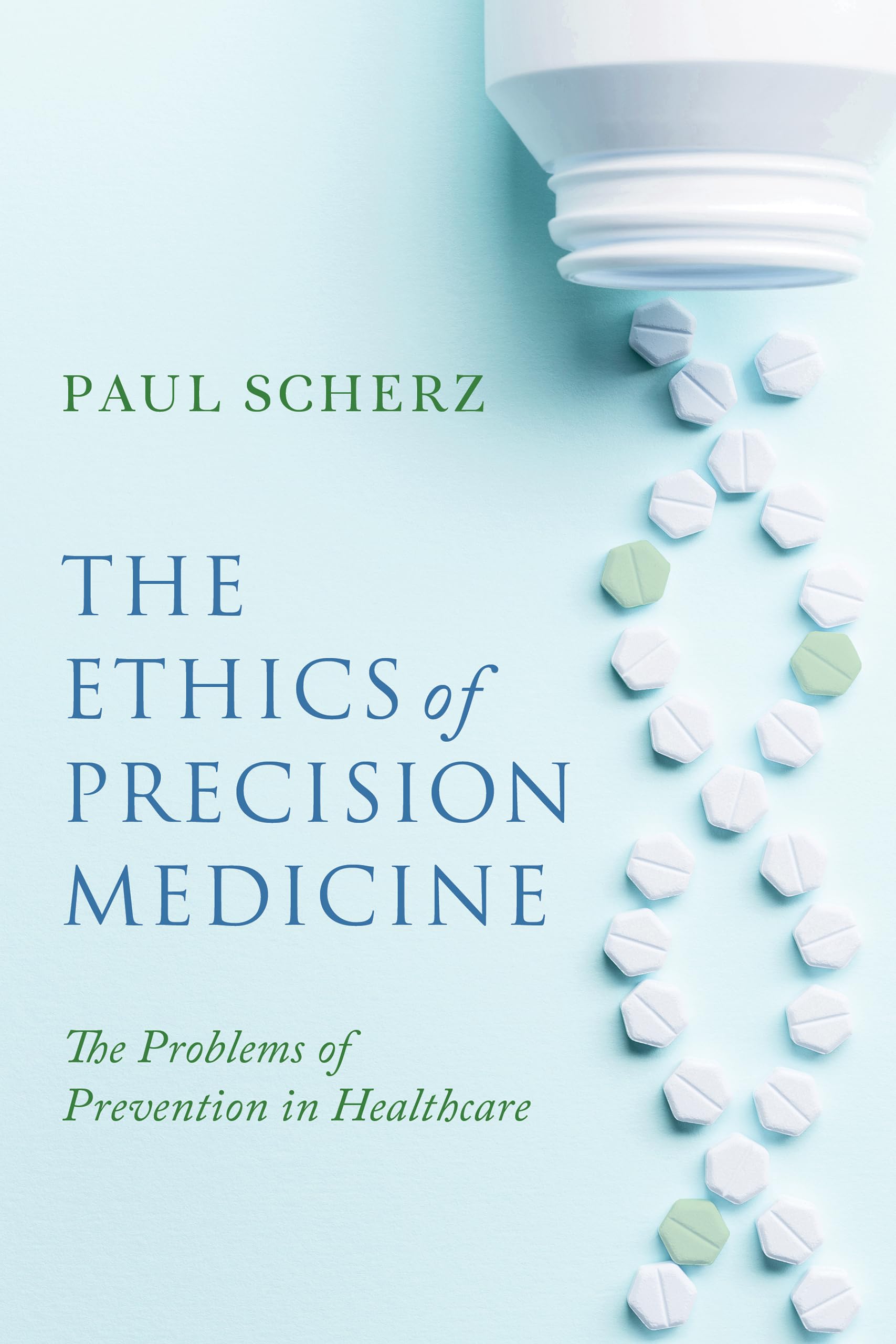
The Ethics of Precision Medicine: The Problems of Prevention in Healthcare (Notre Dame Studies in Medical Ethics and Bioethics)
$40.00
| Brand | Paul Scherz |
| Merchant | Amazon |
| Category | Books |
| Availability | In Stock Scarce |
| SKU | 0268209057 |
| Age Group | ADULT |
| Condition | NEW |
| Gender | UNISEX |
About this item
The Ethics of Precision Medicine: The Problems of Prevention in Healthcare (Notre Dame Studies in Medical Ethics and Bioethics)
Paul Scherz explores the ethical challenges raised by precision medicine and its focus on medical risk as opposed to current disease. Genetic technologies and artificial intelligence are rapidly changing the landscape of medical practice and patient care. In the emerging field of precision medicine, a patient’s risk factors―especially genetic risk factors―are incorporated into an all-encompassing plan to prevent future disease. But identifying at-risk individuals through technologies such as wearable devices and direct-to-consumer genetic sequencing can undermine the overall experience of health. The potential for overdiagnosis and overtreatment grows as patients are prescribed medications and receive prophylactic surgeries that carry inherent risks. Also, as the medical industry shifts its attention from individuals to trends in the general population, the one-to-one practitioner-patient relationship becomes strained. Using the lens of virtue ethics and theological bioethics, The Ethics of Precision Medicine offers suggestions for better implementing precision medicine to treat those currently suffering from or at high risk of disease, while also recognizing that effectively preventing disease depends, ultimately, on addressing the social determinants of health. The book provides a new perspective on the problems of contemporary healthcare, proposing practical steps that individuals and institutions can take to ensure that the advanced technologies of precision medicine can be used to promote human flourishing. “ The Ethics of Precision Medicine offers a way of distinguishing high risk that medicine can reduce without undue adverse consequences from the much broader category of risk that is part of being human.” ―Farr Curlin, co-author of The Way of Medicine " The Ethics of Precision Medicine is an insightful book and a healthy corrective for folks like myself who were almost entirely blind to the risks of precision medicine. There are great risks in trying to minimize all risks." ― Word on Fire "While Scherz’s book would be well received by bioethicists and moral philosophers focused on questions at the intersection of technology, economics, and clinical decision-making, the project’s compactness and accessibility renders it the rare bioethics work that might serve as a clarion call for clinicians themselves―and one especially germane in the current AI-driven and healthcare debt-obsessed cultural moment." ― Theoretical Medicine and Bioethics "Interesting and provocative . . . Scherz makes similar claims about preventive medicine: the focus on risk moves the anxiety and alienation of illness―the sense that one’s body has betrayed one, and that more betrayal is in store―to the realm of experienced health." ― Public Discourse "...a well-researched, deep, and probing exploration of an area of medicine that often escapes critique in mainstream medical and bioethical discourse." ― The Review of Metaphysics Paul Scherz is the Our Lady of Guadalupe Professor of Theology at the University of Notre Dame. He is the author and editor of several books, including The Evening of Life: The Challenges of Aging and Dying Well . Traditionally, medicine aimed at health, seeking primarily to make sick people healthy again. Health, however, is a difficult concept to define, because a person does not have a distinct experience of health. Health is an absence: it is an absence of negative bodily experiences, since when a person is healthy, there are no dissonances or pains that draw his attention. Health is “a state of unawareness where the subject and his body are one.” Because of this inattention, “our enjoyment of good health is constantly concealed from us.” Ancient doctors spoke of health as a harmony, or balance. Usually, they drew on theories of the balance of the humors, but these theories involve the same sense of nothing being noticeably out of order. Fredrik Svenaeus has called it a feeling of being at home in the body, meaning that we do not feel out of place in our body. Even more reductionist, medical understandings of disease define health in contrast to dysfunction or an abnormal range of values. In all of these understandings, disease is the primary experience. Health is merely disease’s absence. Pain or the failure of the body draws one’s attention. Otherwise, the body freely manifests a person’s action into the world, seemingly transparent to the person’s will. The body is one’s tool for engaging the world, as Aristotle suggests in describing it as an organic body, a body made of tools. Describing the body as a tool does not instrumentalize it, but instead recalls the experience of the craftsman whose commonly used tools become almost an extension of the self; or the blind person’s cane; or the short-sighted person’s glasses. These tools are absorbed into the experience of the body and ultimately disappear from awareness. The craftsman only notices his tools when they break or malfunction. Th
| Brand | Paul Scherz |
| Merchant | Amazon |
| Category | Books |
| Availability | In Stock Scarce |
| SKU | 0268209057 |
| Age Group | ADULT |
| Condition | NEW |
| Gender | UNISEX |









Compare with similar items

Understanding Logical Fallacies: A Guide... |

Graphic Image Story of Football Coffee T... |

Ethiopian bible missing books: Orthodox ... |

3D Paper Model Craft Book a Raven.: A cu... |
|
|---|---|---|---|---|
| Price | $7.99 | $135.00 | $16.99 | $12.81 |
| Brand | V. J. Hovakim | Graphic Image | Samuel Tekle | Priit Kannela |
| Merchant | Amazon | bedbathbeyond | Amazon | Amazon |
| Availability | In Stock | In Stock | In Stock | In Stock |
![MOCCA Strong Magnetic for iPhone 16 Pro Phone Case, [Compatible with Magsafe][16FT Mil-Grade Drop Protection] Slim Thin Translucent Matte Protective](https://m.media-amazon.com/images/I/61iphNIn98L.jpg)