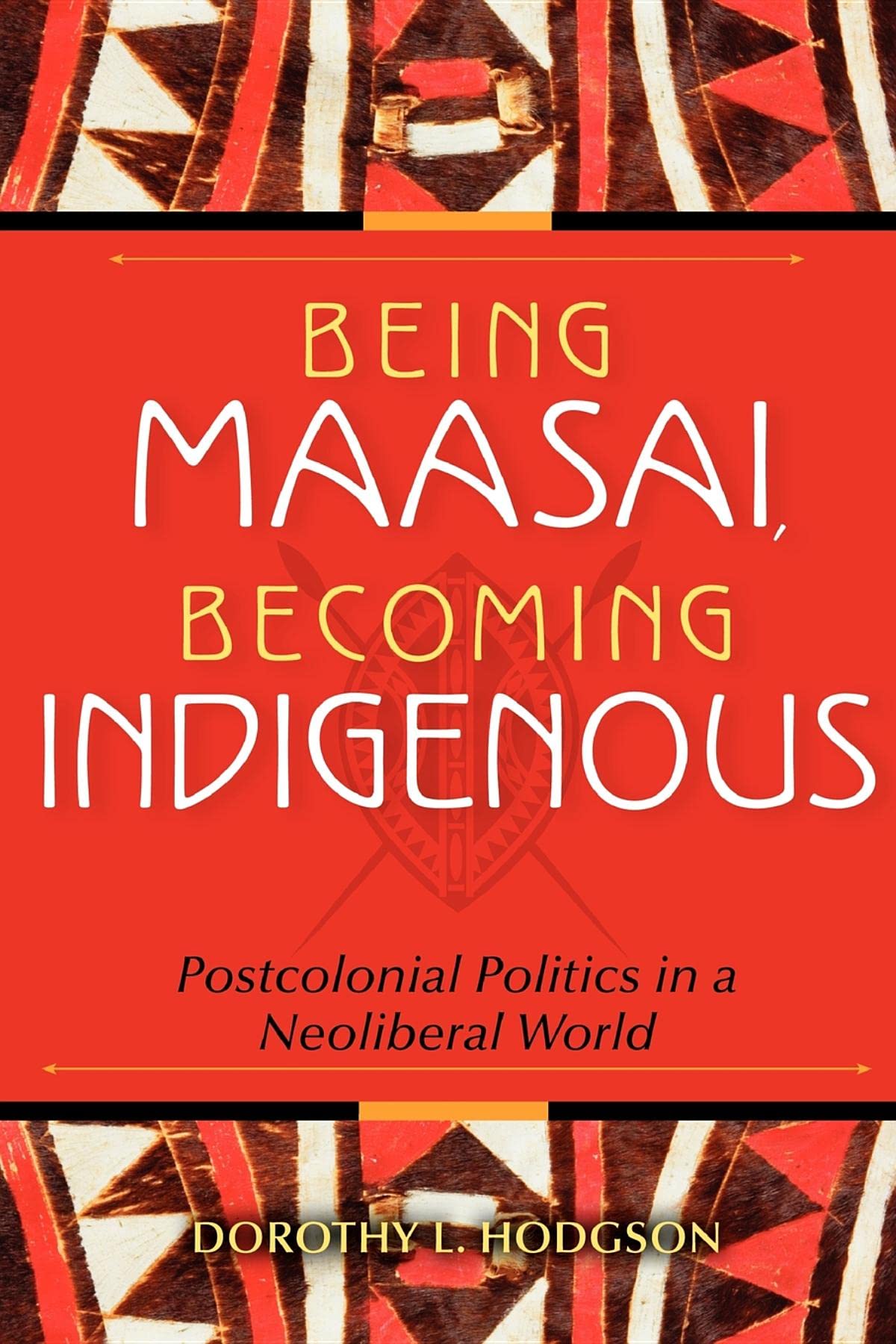
Being Maasai, Becoming Indigenous: Postcolonial Politics in a Neoliberal World
$28.00
| Brand | Dorothy L. Hodgson |
| Merchant | Amazon |
| Category | Books |
| Availability | Unknown Availability |
| SKU | 0253223059 |
| Age Group | ADULT |
| Condition | NEW |
| Gender | UNISEX |
| Google Product Category | Media > Books |
| Product Type | Books > Subjects > History > Africa > East Africa |
About this item
Being Maasai, Becoming Indigenous: Postcolonial Politics in a Neoliberal World
What happens to marginalized groups from Africa when they ally with the indigenous peoples' movement? Who claims to be indigenous and why? Dorothy L. Hodgson explores how indigenous identity, both in concept and in practice, plays out in the context of economic liberalization, transnational capitalism, state restructuring, and political democratization. Hodgson brings her long experience with Maasai to her understanding of the shifting contours of their contemporary struggles for recognition, representation, rights, and resources. Being Maasai, Becoming Indigenous is a deep and sensitive reflection on the possibilities and limits of transnational advocacy and the dilemmas of political action, civil society, and change in Maasai communities. "Rather than rewriting her previous books, anthropologist Hodgson (Rutgers), already well known for her work on the Maasai of Tanzania (Once Intrepid Warriors, CH, Mar'02, 39-4053; The Church of Women, CH, Jan'06, 43-2875), takes readers in a new direction. In this instance, her concern is with how the Maasai have been converted by themselves (and others) in the postcolonial era from romantic traditionalists into an 'indigenous' people replete with numerous NGOs, a strong political rights agenda, and significant financial support from powerful global financial institutions. Hodgson documents this fascinating transformation in informative chapters with data collected in the halls of United Nations headquarters, hotel conference sites in Arusha, and remote countryside locations. A brief conclusion considers what the future might hold for these fascinating people and the worldwide indigenous peoples' movement . . . Summing Up: Highly recommended. Graduate students/faculty. ― Choice"―W. Arens, Stony Brook University, February 2012 "Hodgson . . . investigate[s] . . . the political struggles of groups such as the Maasai to assert their rights to resources and political recognition. [S]he is successful in this endeavor as readers gain an understanding of the motivations, limitations, conflicts, and ironies that constrain and facilitate this movement."― Intnl Journal African Historical Studies IJAHS "[S]erves as an important reminder of the ongoing struggle for political representation and recognition of rights and resources faced by marginalized pastoralist communities throughout Africa."― Bulletin of S.O.A.S. "In this excellent book, Hodgson examines how and why, in the late twentieth and early twenty first centuries, Maasai activists in Tanzania positioned and then repositioned themselves as indigenous and then as pastoralists in their struggles for representation, recognition, resources, and rights."― PoLAR "Dorothy Hodgson has taken a complex subject and presented it in an engaging and highly readable account. I recommend her book to anthropologists, historians, and anyone interested in how modern Africans deal with the legacies of colonialism. Scholars teaching graduate and postcolonial survey courses will find it especially useful."― African Studies Quarterly "The book is a wonderful achievement and evident in it is the author's genuine hopefulness and sensitivity about the goals and future of Maasai in Tanzania. For this reader, ethnographic description of Maasai distributed throughout the chapters working in ways to scaffold larger arguments was done extremely effectively. This adds to the book's readability and careful assembling of the author's arguments. It deserves a wide readership in anthropology, African studies and Indigenous studies."― Pastoralism "[P]rovide[s] invaluable insight into the regional context, as well as useful analyses for those researching ethnic conflict and policy implications in other parts of the world."― Leeds African Studies Bulletin "The discovery of indigeneity and the intersection of the local and global are no longer new; nor is the study of NGOs and development. But few accounts are as ethnographically informed and assured―and readable and absorbing―as Hodgson's."― Journal of Southern African Studies "[This] book . . . comprehensively and accurately portrays a struggle for rights and resources that addresses quintessentially what it means to be ethnically marginal and postcolonial in the early 21st century."― Anthropological Quarterly "This book is at once a fascinating ethnographic work in its own right, an object lesson for anyone with an interest in the socio-political context of development issues, and an immensely useful practical guide for anyone working in this particular region. . . I [Katherine Homewood] personally will use the insights from this book for years to come."― African Affairs "Hodgson looks at why some marginalised groups in Africa decide to identify themselves as 'indigenous', and what 'indigenous identity' means in an environment of economic liberalisation, transnational capitalism, state restructuring and political democratisation."― Survival "Highly recommended."― Choice "Hodgson's book
| Brand | Dorothy L. Hodgson |
| Merchant | Amazon |
| Category | Books |
| Availability | Unknown Availability |
| SKU | 0253223059 |
| Age Group | ADULT |
| Condition | NEW |
| Gender | UNISEX |
| Google Product Category | Media > Books |
| Product Type | Books > Subjects > History > Africa > East Africa |
Similar Products








Compare with similar items

The Portable Napoleonic Wargame... |
Ultimate Teacher's Guide to Food Waste M... |

Dog Lovers Word Search for Adults Large ... |

Composition Notebook College Ruled: Moun... |
|
|---|---|---|---|---|
| Price | $11.86 | $19.99 | $6.99 | $7.98 |
| Brand | Bob Cordery | Robert C. Brears | Sunset Odissey | ZAI Publishing |
| Merchant | Amazon | Amazon | Amazon | Amazon |
| Availability | In Stock | In Stock | In Stock | In Stock |