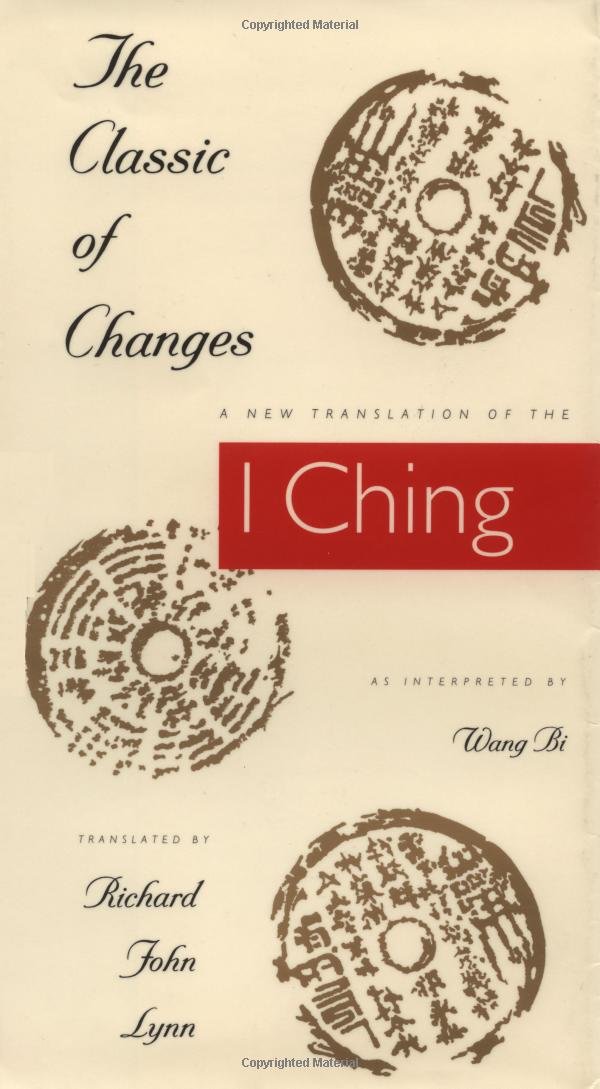
The Classic of Changes: A New Translation of the "I Ching" as Interpreted by Wang Bi
$82.74
| Brand | Richard John Lynn |
| Merchant | Amazon |
| Category | Books |
| Availability | In Stock Scarce |
| SKU | 0231082940 |
| Age Group | ADULT |
| Condition | NEW |
| Gender | UNISEX |
| Google Product Category | Media > Books |
| Product Type | Books > Subjects > Politics & Social Sciences > Philosophy > History & Schools of Thought > Eastern |
About this item
The Classic of Changes: A New Translation of the "I Ching" as Interpreted by Wang Bi
Used in China as a book of divination and source of wisdom for more than three thousand years, the I Ching has been taken up by millions of English-language speakers in the nineteenth century. The first translation ever to appear in English that includes one of the major Chinese philosophical commentaries, the Columbia I Ching presents the classic book of changes for the world today. Richard Lynn's introduction to this new translation explains the organization of The Classic of Changes through the history of its various parts, and describes how the text was and still is used as a manual of divination with both the stalk and coin methods. For the fortune-telling novice, he provides a chart of trigrams and hexagrams; an index of terms, names, and concepts; and a glossary and bibliography. Lynn presents for the first time in English the fascinating commentary on the I Ching written by Wang Bi (226-249), who was the main interpreter of the work for some seven hundred years. Wang Bi interpreted the I Ching as a book of moral and political wisdom, arguing that the text should not be read literally, but rather as an expression of abstract ideas. Lynn places Wang Bi's commentary in historical context. The I Ching or Book of Changes is a Chinese manual for divination (also called a book of wisdom), compiled in the ninth century B.C.E. A person consulting the I Ching is said to be able to see into the true nature of the universe, and, by acting according to its dictates, avoid personal failures and disasters. Most available editions of the I Ching are based on the James Legge translation, a work produced over 140 years ago and characterized by romanticized and idiomatic Victorian English. Although not more accurate or revealing than the Legge, this new translation is welcome because of its crisp usage of modern-day English. Lynn supplies a chart of trigrams and hexagrams, a glossary, and a list of proper names. Of special interest to students of classical Chinese text is a commentary by Wang Bi, a third-century A.D. Chinese scholar. Highly recommended for public and academic libraries. Glenn Masuchika, Chaminade Univ. Lib., Honolulu Copyright 1994 Reed Business Information, Inc. This is the best I Ching that has so far appeared. ― Times Literary Supplement (London) This new translation is welcome because of its crisp usage of modern-day English... Highly recommended. ― Library Journal Familiar with current historical and textual research, having no truck with 'ageless wisdoms' and leery of spirituality, Richard Lynn's translation of the I Ching as retranslated, explicated and interpreted by the young scholar Wang Bi and his followers, feels a world apart from that of Wilhelm. ― London Review of Books [Lynn]'s provided us with the materials from which to reconstruct Wang Bi's vision of the text. The result is clearly written and presented―the best entry into an I Ching world that we have so far. ― Shambala Sun Lynn has... produce[d] a translation of whose accuracy one can be optimally confident... [T]his is a solidly and attractively produced volume. ― Religion For beginners and devotees alike, Columbia's I Ching is the clearest and most authoritative translation of this ancient classic. -- Kidder Smith, Bowdoin College ― Philosophy East & West The first new translation of this work to appear in more than twenty-five years, the Columbia I Ching presents the classic book of changes for the world of today. Used in China as a book of divination and source of wisdom for more than three thousand years by scholars and general readers alike, it has influenced Western intellectuals and artists from Carl Jung to John Cage, bringing this most important work of the Confucian canon immense popular appeal. Finally, after decades of inaccurate translations and outdated, expurgated pocket editions, here is an I Ching that catches up with its readers. Richard Lynn's introduction explains the organization of The Classic of Changes through the history of its various parts, and describes how the text was and is still used as a manual of divination with both the stalk and coin methods. For the fortune-telling initiate, he provides a chart of trigrams and hexagrams; an index of terms, names, and concepts; a glossary and bibliography; and thoughts on his method of translation. Lynn presents for the first time in English the fascinating commentary of Wang Bi (226-249), who was the principal definer of the work for some seven hundred years. Wang Bi interpreted the I Ching as a book of moral and political wisdom, arguing that the text should not be read literally, but rather as an expression of abstract ideas. Lynn places Wang Bi's commentary in historical context and examines the interpretation of this common source for both Confucian and Taoist philosophy before and after Wang Bi's time. Columbia's I Ching offers devotees the most authoritative and lucid translation they have yet to encounter, while givi
| Brand | Richard John Lynn |
| Merchant | Amazon |
| Category | Books |
| Availability | In Stock Scarce |
| SKU | 0231082940 |
| Age Group | ADULT |
| Condition | NEW |
| Gender | UNISEX |
| Google Product Category | Media > Books |
| Product Type | Books > Subjects > Politics & Social Sciences > Philosophy > History & Schools of Thought > Eastern |
Similar Products








Compare with similar items

Earthers (The Silver Ships)... |
From Trophy Towns to City-States: Urban ... |
Life Advice From The Ancient Greek Philo... |

Functional Fitness for Women: Simple, St... |
|
|---|---|---|---|---|
| Price | $13.95 | $54.98 | $15.50 | $13.99 |
| Brand | S. H. Jucha | Jesper Majbom Madsen | Spyros Kyriazos | R.M. Godlewski |
| Merchant | Amazon | Amazon | Amazon | Amazon |
| Availability | In Stock | In Stock Scarce | In Stock | In Stock |