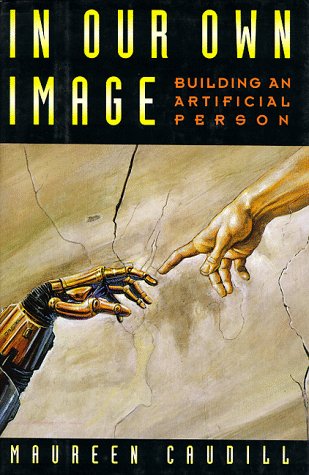
In Our Own Image: Building an Artificial Person
$8.89
| Brand | Maureen Caudill |
| Merchant | Amazon |
| Category | Books |
| Availability | In Stock Scarce |
| SKU | 019507338X |
| Age Group | ADULT |
| Condition | NEW |
| Gender | UNISEX |
About this item
In Our Own Image: Building an Artificial Person
From Arnold Schwarzenegger's Terminator, to C-3PO of the Star Wars trilogy, to the comic robot-butler in Woody Allen's Sleeper , the "android" has long been a familiar figure on the American imaginative landscape. But how far removed from reality are such fictitious creations? Will there ever be an intelligent robot in our future? Neural networks expert Maureen Caudill says yes. In fact, she argues that the development of intelligent androids is a mere twenty years away. In Our Own Image reveals just how far we've come in developing an intelligent robot, describes what technical obstacles must still be cleared, and--perhaps most interesting of all--outlines the potentially massive social disruptions and tangled moral and legal dilemmas these "human machines" will cause. In a sweeping look at state-of-the-art breakthroughs in artificial intelligence, robotics, computer science, psychology, and neural networks, Caudill shows how these fields have advanced machine vision, language recognition, problem solving, memory, and other requisites of intelligent robots. She describes foot-long mechanical ants that can follow you around a room, robots that can crack eggs, shear sheep, play ping-pong, tighten wing-nuts, and other feats of dexterity. (One robot, WABOT-2, developed in Japan, can read simple sheet music and played the electric organ with the NHK Symphony Orchestra of Japan.) electric organ.) And she concludes that as our ability to make faster, smaller, cheaper computers blends with our ability to mimic the behavior of the human mind, the first truly intelligent machines come closer to fruition. But once an android has been perfected, Caudill warns, there will likely be some unexpected--and perhaps unpleasant--social changes. Androids may compete with human workers for jobs--and robots won't take vacations, won't have family problems, and might never leave the firm. Androids may also entangle our legal system in complex, difficult questions: Can an individual own an intelligent android? What rights should it have in society? Does ownership of an android imply the right to turn it off--the right to "kill" it? And does such ownership brand us as slaveholders? The existence of intelligent androids will provoke these and other questions. Caudill concludes that we will soon be forced to come up with answers if we are to learn to share the world with another intelligent species--one of our own creation. In this summary of the current state of android research, Caudill reveals the rapid progress being achieved in developing the technology needed to build an android. She also asks three stirring questions: Will androids have minds? Will they be alive? What will be their impact on human society? For Caudill, the answer to the first two questions is a resounding "Yes." She has no certain answer to the third question, except the assurance that our reaction to androids will redefine our measure of ourselves, depending on whether we treat them as slaves or as equal partners. Caudill knows her topic well and strives comprehensively to cover all aspects of android development. At the same time, she wants to bring uninitiated readers up to a level of expertise so they can appreciate this development. One result is an uneven treatment of terms and concepts. Also, Caudill's casual, sometimes cute, writing style annoys more than it entertains. There are also recurring mini-polemics on psychology, mind, evolution, society, and neural networks. Despite these flaws, Caudill's book provides good evidence that androids can become reality. Recommended for most collections. -Doug Kranch, Ambassador Coll. Lib., Big Sandy, Tex. Copyright 1992 Reed Business Information, Inc. The Age of the Robots is here, according to neural-networks consultant Caudill, who paints the current state of robotic research in glowing terms--and then warns that our ersatz spawn may prove to be an albatross around our neck. Two technologies are at work in the creation of an android: artificial intelligence, ``the attempt to make computers behave intelligently''; and neural networks, ``information-processing systems...that mimic our current understanding of the brain.'' Both are in fine mettle, as Caudill shows in what amounts to a book- length recipe for robots. Androids must be able to see, move, talk, remember, plan, solve problems, and learn from experience. Even now, the technology of vision is nearly licked. As for mobility, the first robots will tootle around on wheels, but two-legged locomotion is just a two-step behind. A ``human-like robotic finger'' exists, and today's robots can solve problems that no self-respecting human would entertain (``Delilah is a cat...all cats are furry,'' etc.). Soon robots will speak as fluently as Star War's C-3PO. And so on. Having delivered the high-tech goods, Caudill then performs some astounding leaps of logic and erects, on gossamer philosophical underpinnings, a claim that robots will possess what we kn
| Brand | Maureen Caudill |
| Merchant | Amazon |
| Category | Books |
| Availability | In Stock Scarce |
| SKU | 019507338X |
| Age Group | ADULT |
| Condition | NEW |
| Gender | UNISEX |








Compare with similar items

The Little Book of Localization: A Guide... |

Stoner Cutie: Cute and Simple Stoner Col... |

Superheroes in Action - Coloring Book fo... |

Changes in Religious and Spiritual Pract... |
|
|---|---|---|---|---|
| Price | $7.99 | $9.99 | $5.99 | $21.58 |
| Brand | Sören Eberhardt | Hella Coloring | Jalba Radu | Dr. Anthony B. Atwam (PhD |
| Merchant | Amazon | Amazon | Amazon | Amazon |
| Availability | In Stock | In Stock | In Stock | In Stock |