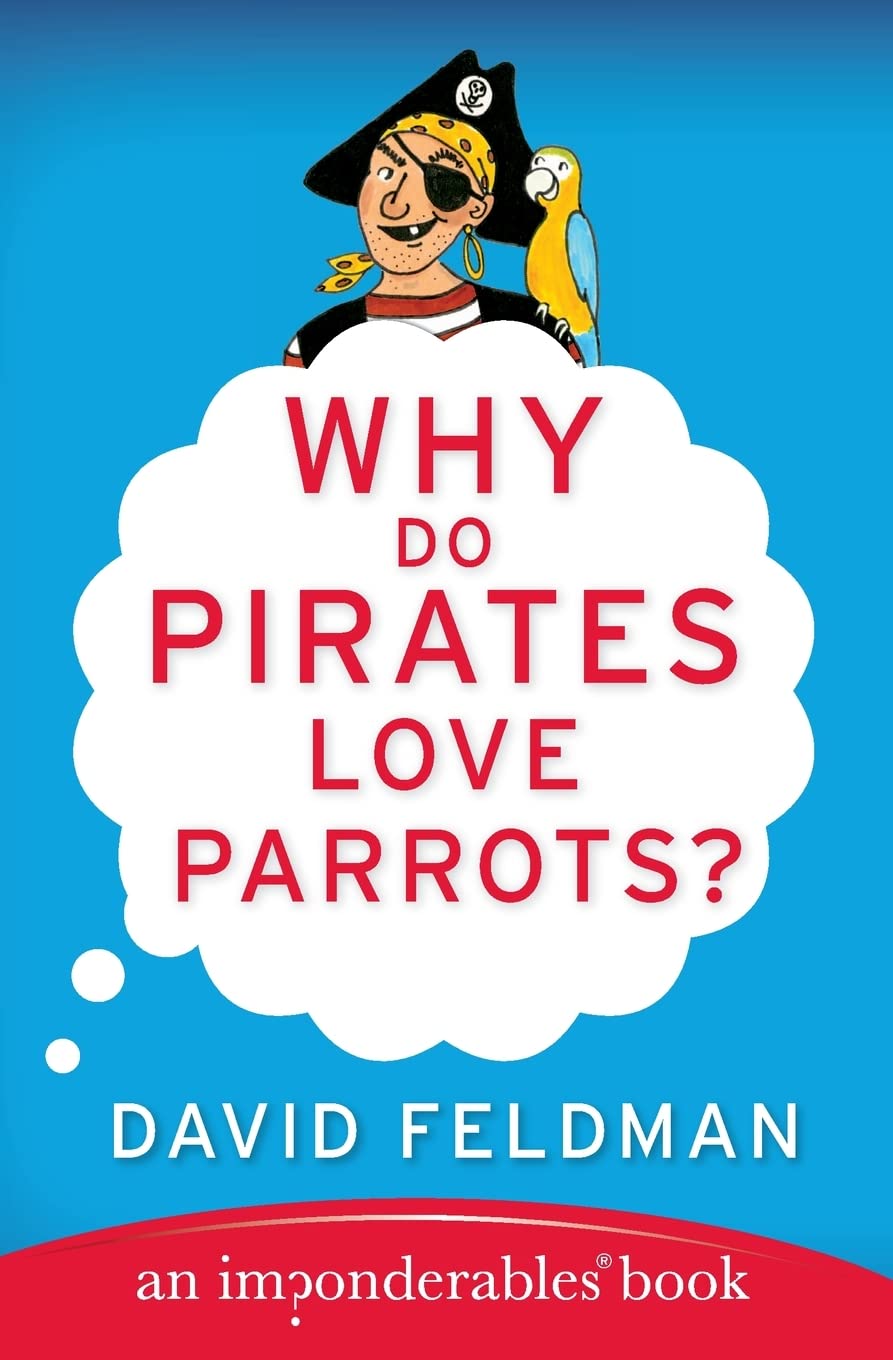
Why Do Pirates Love Parrots?: An Imponderables (R) Book – Demystifying Perplexing Everyday Questions with Charmingly Illustrated Answers (
$13.93
| Brand | David Feldman |
| Merchant | Amazon |
| Category | Books |
| Availability | In Stock Scarce |
| SKU | 0060888431 |
| Age Group | ADULT |
| Condition | NEW |
| Gender | UNISEX |
About this item
Why Do Pirates Love Parrots?: An Imponderables (R) Book – Demystifying Perplexing Everyday Questions with Charmingly Illustrated Answers (
Ponder, if you will . . . Is yawning contagious? Do starfish have faces? Why do they put crinkly paper into pairs of men's socks? Why is it that cans of Diet Coke float, but cans of regular Coke don't? Pop culture guru David Feldman demystifies these questions and much more in Why Do Pirates Love Parrots? One of the Imponderables ® —the unchallenged source of answers to civilization's most perplexing conundrums—and charmingly illustrated by Kassie Schwan, this book provides you with knowledge about everyday life that encyclopedias, dictionaries, and almanacs just don't cover. And think about it: Where else are you going to find out how they get the paper tag into a Hershey's Kiss? Ponder, if you will . . . Is yawning contagious? Do starfish have faces? Why do they put crinkly paper into pairs of men's socks? Why is it that cans of Diet Coke float, but cans of regular Coke don't? Pop culture guru David Feldman demystifies these questions and much more in Why Do Pirates Love Parrots? One of the Imponderables ® —the unchallenged source of answers to civilization's most perplexing conundrums—and charmingly illustrated by Kassie Schwan, this book provides you with knowledge about everyday life that encyclopedias, dictionaries, and almanacs just don't cover. And think about it: Where else are you going to find out how they get the paper tag into a Hershey's Kiss? David Feldman is the author of ten previous volumes of Imponderables ® . He has a master's degree in popular culture from Bowling Green State University in Ohio and consults and lectures on the media. He lives in New York City. Why Do Pirates Love Parrots? An Imponderables (R) Book By David Feldman HarperCollins Publishers, Inc. Copyright © 2007 David Feldman All right reserved. ISBN: 9780060888435 Chapter One Why Did Pirates Love Parrots? Our image of the colorful parrot astride the peg-legged, patch-eyed pirate might come from cartoons and comic strips, but the inspiration was surely Robert Louis Stevenson's Treasure Islan d, published in 1883. The beloved pet of cook Long John Silver, the parrot squawks "Pieces of eight!" with annoying regularity, and becomes the "watchbird" for the pirates after the miscreants take over the treasure hunters' fort on the island. Stevenson admitted that he borrowed the idea of the parrot from Daniel Defoe's Robinson Crusoe . After being stranded on the island, Crusoe knocks a young parrot out of a tree. He teaches the bird to speak its own name ("Poll"), "the first word I ever heard spoken in the island by any mouth but my own." But did pirates really carry parrots on their ships in real life? The evidence suggests yes. Kenneth J. Kinkor, director of project research at the Expedition Whydah Sea-Lab and Learning Center in Provincetown, Massachusetts, told Imponderables that "Many pirates kept parrots and other animals, as many sailors did." Kinkor says that parrots were most common among the Central American pirates who spent some time ashore, logging in places not under direct control of Spain, such as Belize, that possessed large parrot populations. David Cordingly, former curator of the National Maritime Museum in Greenwich, England wrote in his book, Under the Black Flag , It was common for seamen who traveled in the tropics to bring back birds and animals as souvenirs of their travels. Parrots were particularly popular because they were colorful, they could be taught to speak, and they were easier to look after on board ship than monkeys and other wild animals. Call us cynical, but pirates never struck us as the most sentimental of men. Perhaps some parrots were kept onboard as pets or mascots, but might there have been other, less humanitarian considerations? In the most-often cited contemporaneous account of the pirate world, Captain William Dampier's A Voyage Around the World , written in 1697, Dampier claims that his band of privateers (pirates who are authorized by a country to commandeer ships sailing other states' flags) ate parrots along with other birds, while cruising off of Venezuela. No pirate would get fat from eating parrots, so our bet is that the primary purpose of carrying parrots was financial. In his research on pirates, David Cordingly found government records from Elizabethan times indicating that pirates gave parrots to well-placed employees of government officials, presumably as bribes. But other folks were willing to put down hard cash to buy parrots. Dampier discusses his shipmates buying "an abundance" of cockatoos and parakeets, presumably to sell or trade. Pirates had a ready venue to sell their booty, for there were established bird markets in London and Paris in the eighteenth century, and exotic birds from the New World presumably were attractive purchases for the wealthy and status-seeking. Indeed, Cissie Fairchild wrote an entire book, Elephant Slaves and Pampered Parrots: Exotic Animals in Eighteenth-Century Paris , about the bustling trade in ex
| Brand | David Feldman |
| Merchant | Amazon |
| Category | Books |
| Availability | In Stock Scarce |
| SKU | 0060888431 |
| Age Group | ADULT |
| Condition | NEW |
| Gender | UNISEX |
Similar Products









Compare with similar items

Voyage of Faith... |

If You’re a Kid Like Gavin: The True Sto... |

BEYOND THE CC LOGO: INSIDER’S GUIDE TO B... |

ADVentura Barbarroja's Invasion - Box of... |
|
|---|---|---|---|---|
| Price | $19.99 | $4.73 | $9.99 | $270.00 |
| Brand | Mira Histed | Gavin Grimm | REBECCA BARTON DUGAN | ADVentura |
| Merchant | Amazon | Amazon | Amazon | Thompson cigar |
| Availability | In Stock | In Stock | In Stock | In Stock |