
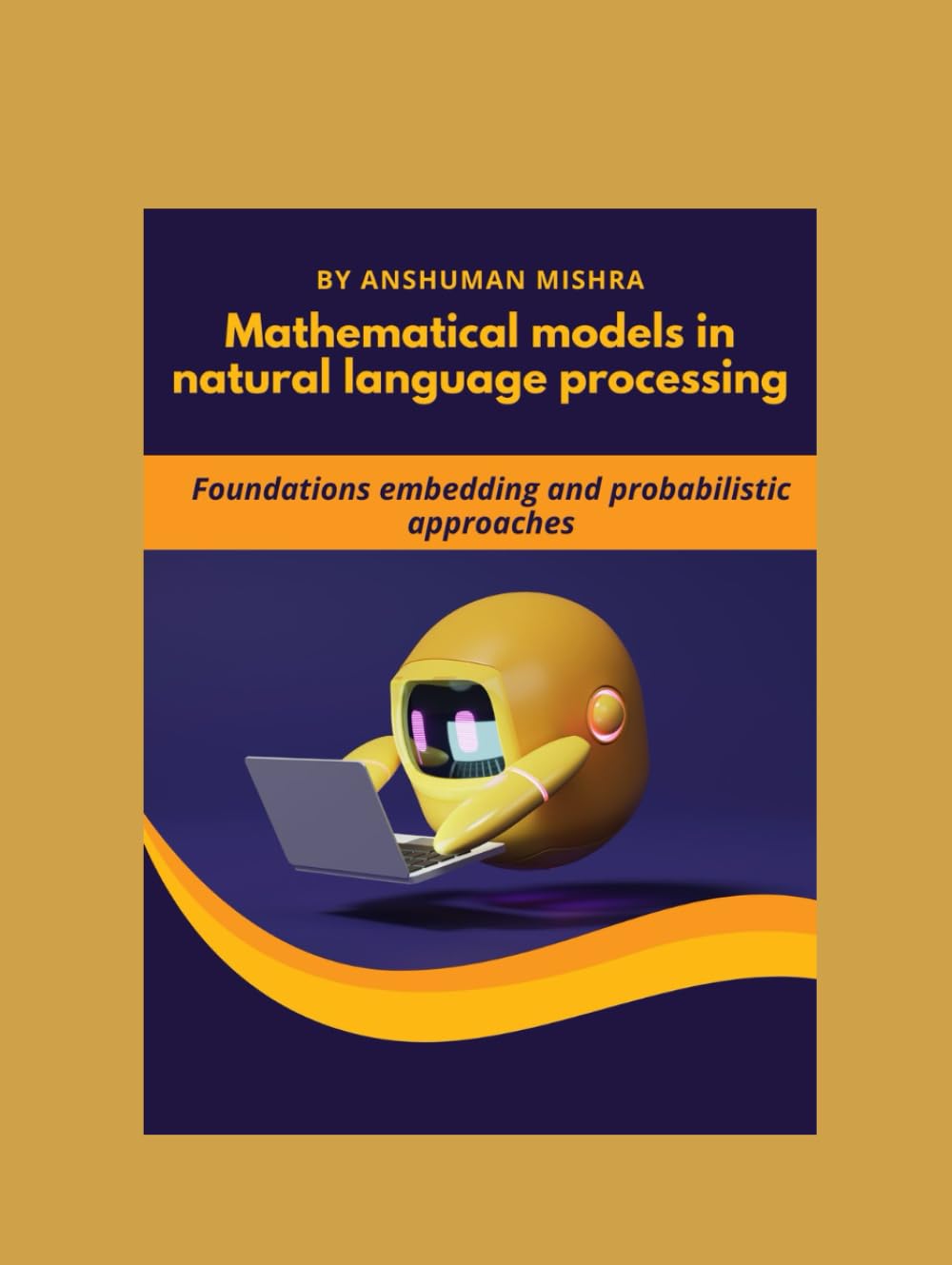
Mathematical models in natural language processing: Foundations embedding and probabilistic approaches (Maths and AI Together)
$22.99
| Brand | Anshuman Mishra |
| Merchant | Amazon |
| Category | Books |
| Availability | In Stock |
| SKU | B0FPM6C56R |
| Age Group | ADULT |
| Condition | NEW |
| Gender | UNISEX |
| Google Product Category | Media > Books |
| Product Type | Books > Subjects > Computers & Technology > Computer Science > AI & Machine Learning > Intelligence & Semantics |
About this item
Mathematical models in natural language processing: Foundations embedding and probabilistic approaches (Maths and AI Together)
Natural Language Processing (NLP) has evolved from a rule-based linguistic discipline into one of the most dynamic, mathematically grounded areas in artificial intelligence. In today’s world, NLP powers everything from search engines, chatbots, and virtual assistants to machine translation, recommendation systems, and advanced generative AI tools. While the applications of NLP are highly visible, the mathematical foundations that enable these systems often remain opaque to students, practitioners, and even researchers entering the field. This book, “Mathematical Models in Natural Language Processing: Foundations, Embeddings, and Probabilistic Approaches,” is a focused attempt to bridge this gap by providing a structured, rigorous, yet intuitive exploration of the mathematics that underpins modern NLP systems. The motivation behind this work is not just to present algorithms or code snippets, but to uncover the underlying mathematical principles—vector spaces, probability distributions, optimization methods, and embeddings—that make these systems work. We believe that anyone who wishes to master NLP must go beyond treating machine learning libraries as black boxes and instead develop a deep mathematical intuition. In this book, we combine theoretical explanations with practical perspectives, ensuring that the reader not only understands the “how” but also the “why” behind each model and method. The chapters progress naturally from classical statistical models like n-grams to sophisticated neural embeddings and probabilistic generative models, giving the reader a strong conceptual framework that is both historically grounded and future-ready. Motivation for Writing the Book The rapid growth of NLP over the past decade has created a massive demand for professionals who can design, analyze, and optimize models that process human language. With the rise of deep learning, large language models (LLMs), and transformer-based architectures, the field has reached unprecedented heights, but many learners face a steep entry barrier because they lack the mathematical fluency required to fully grasp these models. Most existing books on NLP fall into one of two categories: Purely Linguistic: Focused on syntax, semantics, and grammar, with minimal emphasis on computation or mathematics. - Purely Practical: Heavily code-oriented, teaching how to use libraries like spaCy, HuggingFace Transformers, or TensorFlow without fully explaining the theory. While these resources have their place, they leave a significant gap for those who want to understand how embeddings are derived, why probabilistic models behave the way they do, or how optimization impacts training. Our motivation, therefore, was to create a book that does three things simultaneously: Mathematical Clarity: Present each concept—from cosine similarity in vector spaces to Kneser-Ney smoothing in n-gram models—with full mathematical rigor but in an approachable way. - Historical and Conceptual Continuity: Show how ideas evolved—from early symbolic approaches to probabilistic modeling, and later to distributed representations and transformers—so readers can appreciate the field’s intellectual journey. - Practical Relevance: Include examples and case studies that connect theory to real-world applications, helping students and practitioners apply their knowledge to build robust NLP systems. Ultimately, our goal is to empower readers with the ability to analyze, critique, and innovate in NLP, rather than merely follow recipes. By understanding the mathematical models that form the foundation of NLP, one becomes better equipped to design new architectures, fine-tune embeddings, interpret results, and address challenges like bias, fairness, and scalability.
| Brand | Anshuman Mishra |
| Merchant | Amazon |
| Category | Books |
| Availability | In Stock |
| SKU | B0FPM6C56R |
| Age Group | ADULT |
| Condition | NEW |
| Gender | UNISEX |
| Google Product Category | Media > Books |
| Product Type | Books > Subjects > Computers & Technology > Computer Science > AI & Machine Learning > Intelligence & Semantics |
Similar Products










Compare with similar items

The Bollywood Lovers' Club... |

Pug Lover Notebook and Journal: 120-Page... |

Wisdom of the Owl,'Handcrafted Recycled ... |

Retro Valentine Sweethearts Coloring Boo... |
|
|---|---|---|---|---|
| Price | $16.99 | $9.99 | $19.99 | $11.99 |
| Brand | James Goldberg | Amber Ashley | NOVICA | Cloudix Studio |
| Merchant | Amazon | Amazon | Novica | Amazon |
| Availability | In Stock | In Stock | In Stock | In Stock |