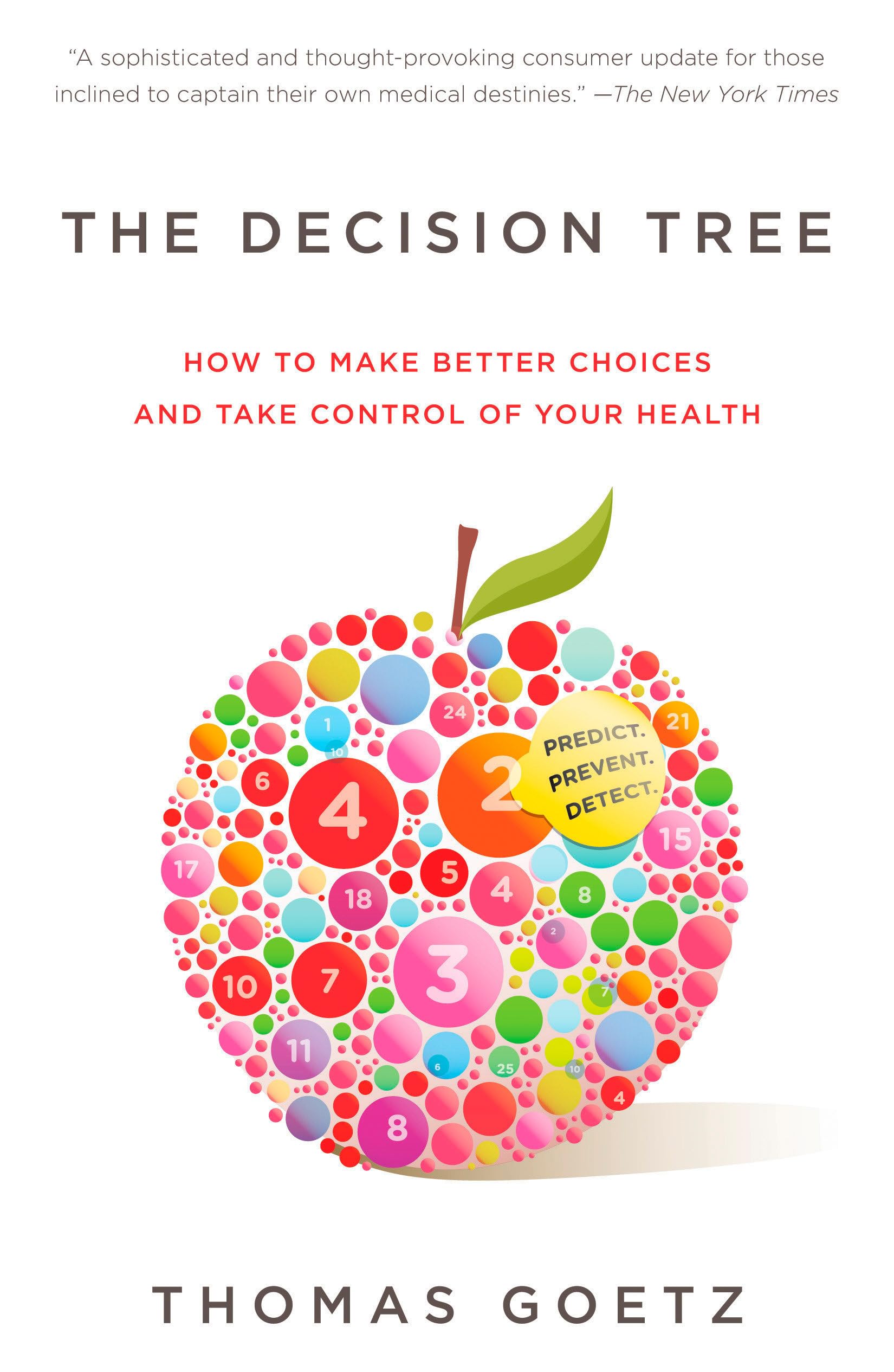
The Decision Tree: How to make better choices and take control of your health
$15.99
| Brand | Thomas Goetz |
| Merchant | Amazon |
| Category | Books |
| Availability | In Stock Scarce |
| SKU | 1605291684 |
| Color | White |
| Age Group | ADULT |
| Condition | NEW |
| Gender | UNISEX |
| Google Product Category | Media > Books |
| Product Type | Books > Subjects > Health, Fitness & Dieting > Diseases & Physical Ailments > Genetic |
About this item
The Decision Tree: How to make better choices and take control of your health
For all the talk about personalized medicine, our health care system remains a top-down, doctor-driven system where individuals are too often bit players in their own health decisions. In The Decision Tree , Thomas Goetz proposes a new strategy for thinking about health, one that applies cutting-edge technology to put us at the center of the equation and explains how the new frontier of health care can impact each of our lives. "Mr. Goetz has compiled a sophisticated and thought-provoking consumer update for those inclined to captain their own medical destinies." May 25, 2010 --New York Times "[Goetz] provides useful suggestions on how individuals can use data, the Web and technology to make better medical decisions and manage their own care. "Wellness Reading List: 5 Top Picks of 2010" Dec 21, 2010 --Wall Street Journal THOMAS GOETZ is the executive editor of Wired magazine. He holds a masters in English Literature from the University of Virginia and a master's in public health from the University of California, Berkeley. He lives in San Francisco with his wife and two boys. 1 Living by Numbers How a Lot of Science and a Little Self-Awareness Can Give You Control of Your Health I. AVIATION HAS KITTY HAWK. Biology has the Galapagos Islands. And medicine, or more specifically preventive medicine, has Framingham, Massachusetts. A small city of 65,000 people about 20 miles due west of Boston, Framingham appears at first an indistinct patch of New England suburbia. Take Exit 13 off the Massachusetts Turnpike, and you'll drive past the usual temples of American sprawl: a Shopper's World shopping center (among the first malls built in the United States), a Super Stop & Shop grocery store, and a Lowe's, all built in the same squat, stuccoed style and painted in the same tan-to-taupe palette that characterizes the rest of American consumerland. As you drive along Highway 9 toward Framingham's center, it's easy to miss the original town. Even the arrow on the sign that points toward "Downtown Framingham" makes only a half-hearted gesture in the right direction, as if it can't decide whether or not to recommend the place. But make the turn, and the town starts to hint at its more dignified origins; pass the requisite Revolutionary War statue, and you'll reach the stately brick and stone buildings of what must have once been a thriving town center. These days, though, like many neglected downtowns outdone by the interstate, Framingham's center is dotted with empty storefronts and tinged with sad neglect. None of this hints at why Framingham actually matters. In the years after World War II, when the town was a far smaller place with a population of just around 28,000, Framingham became the epicenter of what would become one of the great experiments in medicine--an experiment that is still running quietly today. In 1948, the National Heart Institute chose Framingham as the place that would reveal the causes of heart disease. At the time, the idea of studying a disease by studying a population was an altogether novel concept, and an urgent one. In the first decades of the 20th century, most infectious diseases were eliminated from the United States and other industrialized nations. Cholera, diphtheria, typhoid, malaria, tuberculosis--all the diseases that had plagued mankind for centuries were largely banished from our shores as vaccines, antibiotics, and sanitation did their work. The result was profound: The average life span for an American male increased from 46 years in 1900 to 61 by 1940, while the average for women increased from 48 to 65. But as remarkable as the elimination of infectious disease was, it didn't eliminate disease entirely. In fact, it revealed a new, unknown sort of disease, one that seemed to fester beneath the surface until it struck. A stunning 36 percent of Americans died of just two conditions in 1940: heart disease and stroke. But unlike with tuberculosis, it wasn't possible to lay the blame on a single pathogen. Medicine in postwar America had almost no idea what caused heart attacks or strokes or the other fatal events related to heart disease. They just happened. It was as if by eliminating epidemics of infectious diseases, medicine had unwittingly allowed new epidemics to kill thousands of other people. By singling out Framingham, the National Heart Institute (known today as the National Heart, Lung, and Blood Institute) was taking a bold step: It would investigate heart disease as thoroughly, ambitiously, and successfully as the nation had fought World War II. Framingham then was just as much an Everytown, USA, as it is today. It had a mix of ethnic backgrounds: Irish, Greek, Polish, Italian. Its inhabitants smoked, worked in factories (GM opened a new plant in town in 1948), and, like other Americans, considered meat and potatoes a balanced diet. And when television came to town in 1948, they began to watch TV as well. They were, in other words, entirely typical citizens
| Brand | Thomas Goetz |
| Merchant | Amazon |
| Category | Books |
| Availability | In Stock Scarce |
| SKU | 1605291684 |
| Color | White |
| Age Group | ADULT |
| Condition | NEW |
| Gender | UNISEX |
| Google Product Category | Media > Books |
| Product Type | Books > Subjects > Health, Fitness & Dieting > Diseases & Physical Ailments > Genetic |
Similar Products






Compare with similar items

Buckland's Book of Saxon Witchcraft... |

El secreto del Búho mentiroso (Spanish E... |

Spent: A Comic Novel – A Masterful Polit... |

The Bend in the Break... |
|
|---|---|---|---|---|
| Price | $18.95 | $19.95 | $16.00 | $4.50 |
| Brand | Raymond Buckland | Natacha Cuadra-Leibur | Alison Bechdel | Elise T. Bloom |
| Merchant | Amazon | Amazon | Amazon | Amazon |
| Availability | In Stock Scarce | In Stock | In Stock | In Stock |