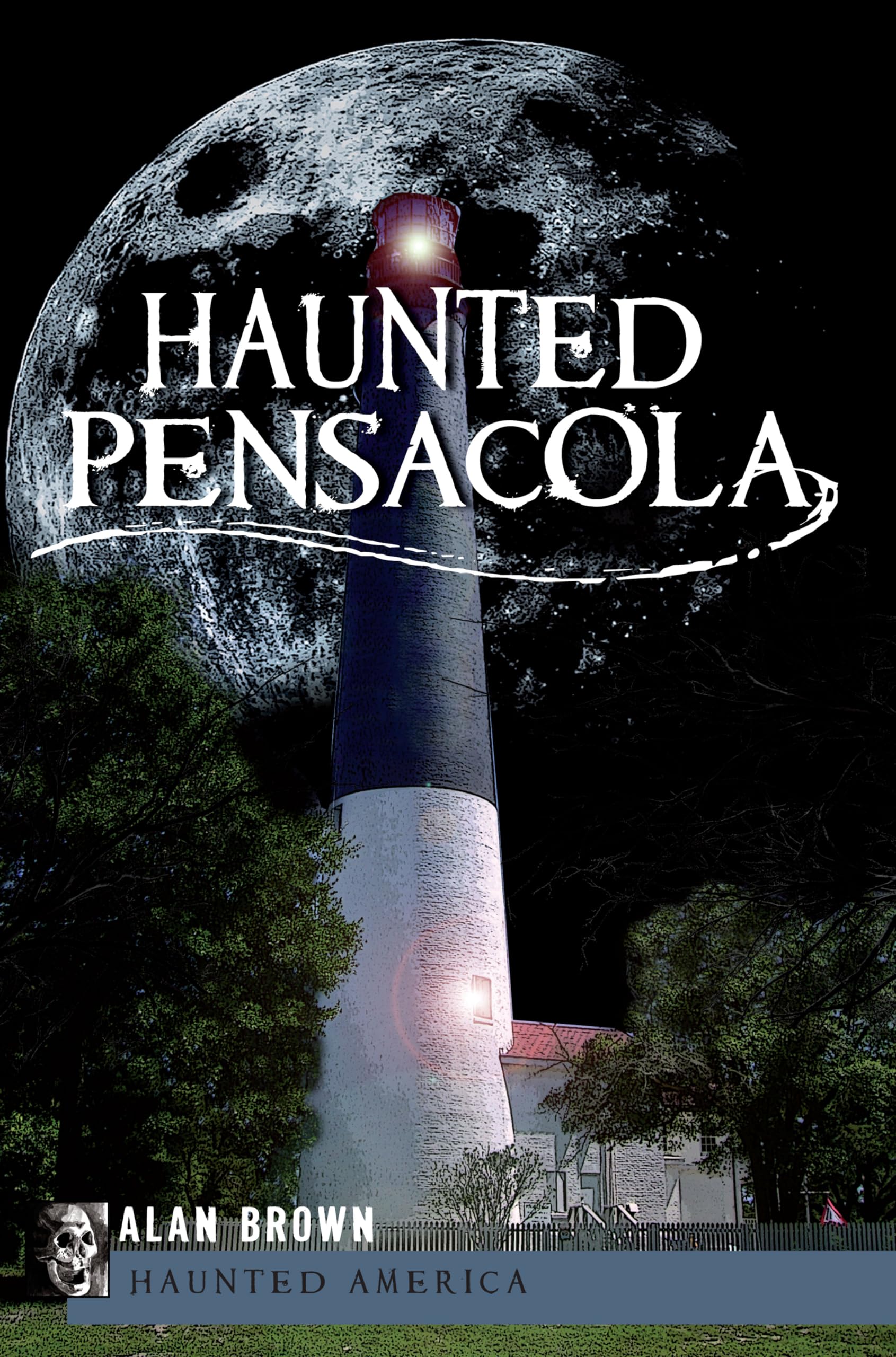
Haunted Pensacola (Haunted America)
$17.46
| Brand | Alan Brown |
| Merchant | Amazon |
| Category | Books |
| Availability | In Stock Scarce |
| SKU | 1596293012 |
| Age Group | ADULT |
| Condition | NEW |
| Gender | UNISEX |
| Google Product Category | Media > Books |
| Product Type | Books > Subjects > History > Americas > United States > State & Local |
About this item
Haunted Pensacola (Haunted America)
A haunting collection of spooky tales from one of America's first cities, Pensacola. Pensacola may boast the world's whitest beaches, but the sands of time reveal a dark history in America's first settlement. It's no surprise that one of the nation's oldest cities is also among the most haunted, with culturally diverse spirits from the ages of the Spanish founders and British settlers through the turbulent era of the Civil War. Author and expert Alan Brown presents a survey of unexplained mysteries at Pensacola's eerie landmarks. The infamous haunted lighthouse, the ghosts of St. Michael's Cemetery and the tale of the headless woman of Ramona Street are just a few of the chilling stories recounted in Haunted Pensacola. Alan Brown was born in Alton, Illinois. After attending Millikin University, Southern Illinois University and the University of Illinois, he taught high school in Springfield, Illinois. In 1986, he began teaching English at the University of West Alabama. After living in the South for a year, Brown became interested in the folklore of the South and began collecting it on his own. People talk in the Midwest, "? Brown said, "but not like they do in the South. I guess this is why southerners are great storytellers."? When he is not teaching freshman composition or American literature, Dr. Brown writes books on his favorite topic: ghost stories. Haunted Birmingham is his tenth collection of southern ghost tales. As much as he loves old stories that send shivers up the spine, Brown's first love is his wife, Marilyn, and his two daughters, Andrea and Vanessa." Haunted Pensacola By Alan Brown The History Press Copyright © 2010 Alan Brown All rights reserved. ISBN: 978-1-59629-301-4 Contents Acknowledgements, Introduction, The Arbona Building, The Axelson House, The Barkley House, The Dorr House, The First National Bank Building, Fort Barrancas, Fort Pickens, The Ghost Boy of Government Street, The Gray House, The Headless Lady of Ramona Street, The Lear-Rocheblave House, The Line, Naval Air Station Pensacola, Naval Hospital Pensacola, Noble Manor Bed-and-Breakfast, Old Christ Church, Old Sacred Heart Hospital, Pensacola Cultural Center, Pensacola Lighthouse, The Quayside Art Gallery, The Saenger Theater, St. Michael's Cemetery, Seville Quarter, The Tivoli High House, T.T. Wentworth Museum, The United States Customs House and Post Office, Unity Church, The Victorian Bed-and-Breakfast, The William Fordham House, Works Cited, About the Author, CHAPTER 1 THE ARBONA BUILDING The Pensacola Historical Society had its inception during a meeting at city hall on February 14, 1933. The society was incorporated as a nonprofit educational organization on March 25, 1933. The Dorothy Wallace House at 137 West Romana Street became the first home of the Pensacola Historical Society's museum in 1938. The museum closed in 1944 as the number of visitors declined, but it reopened in the chamber of commerce offices after the Pensacola Historical Society was reorganized in 1952. Eight years later, the society moved into Old Christ Church after the library moved out of the building. In 1991, the museum was moved to the Arbona Building at 115 East Zaragoza Street. The museum had not been open very long before volunteers discovered that the original owner of the building had never really left. Eugenio Arbona first came to the South in 1885 when he got a job as a bartender in Mobile. After he and a friend murdered a cigar maker named Encino Hernandez, the two men were sent to prison in Watumpka, Alabama. When the Civil War broke out, Arbona was released after serving only ten years of his sentence. He then moved to Georgia, where he met his future wife, Fannie White. Following their marriage, Arbona and his new bride moved to Watumpka, where he had business contacts. In 1879, the Arbonas moved to their new home at 115 East Zaragoza Street in Pensacola. When their house burned down, Arbona rebuilt it on the same site in 1885. Arbona opened a saloon on the first floor; he, his wife and their five children lived on the second floor. After two years, Eugenio and Fannie divorced. Before leaving for Spain, he signed over the saloon to Fannie. Fannie and her children took over the operation of the saloon and were very successful because hers was the only establishment in town that served cold beer. When Eugenio returned from Spain, he demanded that Fannie sign it all back over to him, but she refused. Incensed at having his plans thwarted, he returned to Spain, where he committed suicide on July 15, 1890. Fannie's children continued running the saloon until the 1940s, when the last surviving brother and sister died. Fannie Arbona continued living on the second floor until her death in 1955. A grocer named T.T. Todd bought the saloon and converted it into a grocery store. To accommodate his growing business, Todd decided to expand the building. While the workmen were e
| Brand | Alan Brown |
| Merchant | Amazon |
| Category | Books |
| Availability | In Stock Scarce |
| SKU | 1596293012 |
| Age Group | ADULT |
| Condition | NEW |
| Gender | UNISEX |
| Google Product Category | Media > Books |
| Product Type | Books > Subjects > History > Americas > United States > State & Local |
Similar Products








Compare with similar items
Evergreen Academy (Society of Magical Bo... |

Cute Gift for Grandma Grandmother Blesse... |
Relaxed Workbook: Find out helpful teach... |
Unfinished... |
|
|---|---|---|---|---|
| Price | $17.99 | $6.24 | $14.99 | $14.99 |
| Brand | Heather Schneider | Florence Watson | Irving Blake | Nathifa Scott |
| Merchant | Amazon | Amazon | Amazon | Amazon |
| Availability | In Stock | In Stock | In Stock | In Stock |