
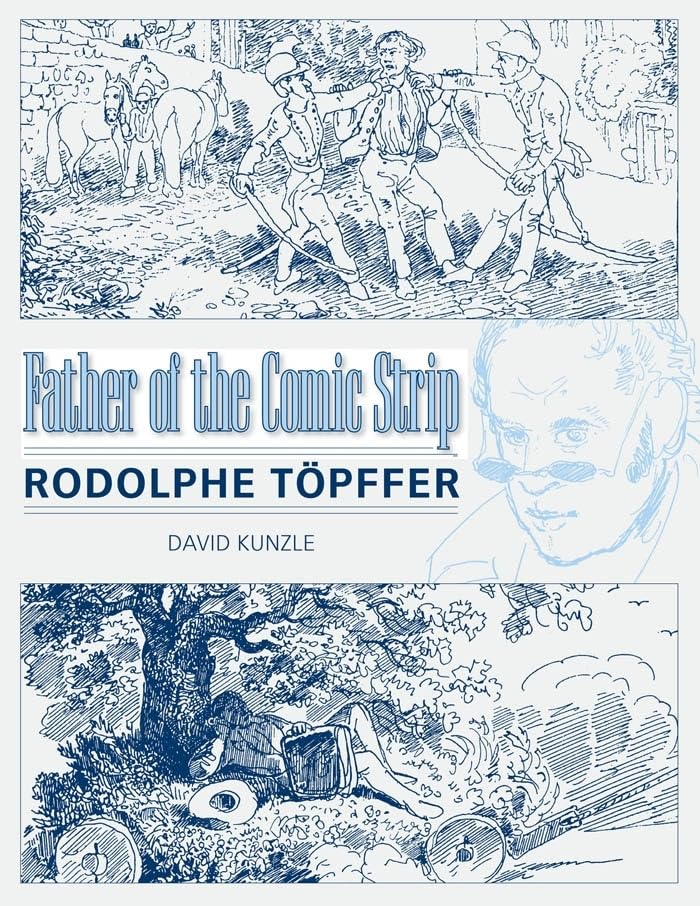
Father of the Comic Strip: Rodolphe Töpffer (Great Comics Artists Series)
$25.00
| Brand | David Kunzle |
| Merchant | Amazon |
| Category | Books |
| Availability | In Stock Scarce |
| SKU | 1578069483 |
| Age Group | ADULT |
| Condition | NEW |
| Gender | UNISEX |
| Google Product Category | Media > Books |
| Product Type | Books > Subjects > Literature & Fiction > History & Criticism > Genres & Styles > Comics & Graphic Novels |
About this item
Father of the Comic Strip: Rodolphe Töpffer (Great Comics Artists Series)
Sixty years before the comics entered the American newspaper press, Rodolphe Töpffer of Geneva (1799–1846), schoolmaster, university professor, polemical journalist, art critic, landscape draftsman, and writer of fiction, travel tales, and social criticism, invented a new art form: the comic strip, or “picture story,” that is now the graphic novel. At first he resisted publishing what he called his “little follies.” When he did, they became instantly popular, plagiarized, and imitated throughout Europe and the United States. Töpffer developed a graphic style suited to his poor eyesight: the doodle, which he systematized and also theorized. The drawings, with their “modernist” spontaneous, flickering, broken lines, forming figures in mad hyperactivity, run above deft, ironic captions and propel narratives of surreal absurdity. The artist's maniacal protagonists mix social satire with myth. By the mid-nineteenth century, Messrs. Jabot, Festus, Cryptogame, and other members of the crazy family, comprising eight picture stories in all, were instant folk heroes. In a biographical framework, Kunzle situates the comic strips in the Genevan and European culture of the time as well as in relation to Töpffer's other work, notably his hilarious travel tales, and recounts their curious genesis (with an initial imprimatur from Goethe, no less) and their controversial success. Kunzle's study, the first in English on the writer-artist, accompanies Rodolphe Töpffer: The Complete Comic Strips , a facsimile edition of the strips themselves, with the first-ever translation of these into English. Frequently cited as the inventor of the comic strip, Töpffer, a Swiss teacher whose artistic vocation had been thwarted by poor eyesight, started producing his whimsical pictorial narratives, in 1827, for the enjoyment of friends. But, after Goethe praised the strips, Töpffer was emboldened to publish them, and they became wildly popular. The strips develop from satire"Monsieur Jabot" concerns the disastrous affectations of a would-be dandyto something far more bizarre: in "Monsieur Pencil," a dog trapped atop a telegraph pole brings Europe to the brink of war. As David Kunzle notes in his accompanying biography, the apparently casual style of the drawings masks considerable sophistication. Late in life, Töpffer produced an essay expounding a theory of the doodle, and demonstrating that, to a viewer, even an approximately drawn face seems to possess character. Copyright © 2007 Click here to subscribe to The New Yorker The recent legitimization of the comic strip has brought plenty of vintage-strip reprintings and analyses of the medium. David Kunzle offers volumes of both devoted to the nineteenth-century Swiss artist who may have invented the comic strip. Father of the Comic Strip reveals that Rodolphe Töpffer's protocomics were but a sideline. He founded a successful boarding school, became a university professor, and achieved success as an author and a painter. He was encouraged to publish his picture stories, originally drawn for his students' amusement, by none other than Goethe, who saw them shortly before his death in 1832. Kunzle places Töpffer's pictorial satires in the cultural and political context of the era and shows how Töpffer influenced the next generation of artists in France (notably, Gustave Doré) and elsewhere, arguing his probable inspiration of English illustrator George Cruickshank and novelist W. M. Thackeray, who, like Töpffer, fulfilled a youthful desire to become an artist by illustrating his own stories. -- Gordon Flagg ― Booklist Kunzle’s books bring the comics of yesteryear magically back to life. If you take the time to read them, you’ll be transported to a nineteenth-century playground where painters, illustrators, and early cartoonists built an industry that continues to thrive today. -- Michael Taube, syndicated columnist and Washington Times contributor ― TroyMedia.com This critical study of the Swiss artist who invented the comic strip ---Provides the first English-language study of Rodolphe Topffer's comics and illustrations, written by a noted comics scholar ---Features over 100 of Topffer's illustrations, as well as the source material for some of his work ---Expands the Great Comics Artists Series A critical study of the Swiss artist who created the comic strip David Kunzle (1936–2024) was professor emeritus of art history at the University of California and author or editor of Rebirth of the English Comic Strip: A Kaleidoscope, 1847-1870 ; Cham: The Best Comic Strips and Graphic Novelettes, 1839–1862 ; Father of the Comic Strip: Rodolphe Töpffer ; Gustave Doré: Twelve Comic Strips ; and Rodolphe Töpffer: The Complete Comic Strips , all published by University Press of Mississippi.
| Brand | David Kunzle |
| Merchant | Amazon |
| Category | Books |
| Availability | In Stock Scarce |
| SKU | 1578069483 |
| Age Group | ADULT |
| Condition | NEW |
| Gender | UNISEX |
| Google Product Category | Media > Books |
| Product Type | Books > Subjects > Literature & Fiction > History & Criticism > Genres & Styles > Comics & Graphic Novels |
Similar Products










Compare with similar items

Vancouver Like a Local: By the People Wh... |

The Bull Rider's Second Chance (Rodeo Ro... |

DEMENTIA DENIED: One Woman's True Story ... |

Thrive: Maximizing Well-Being in the Age... |
|
|---|---|---|---|---|
| Price | $15.53 | $10.99 | $16.99 | $24.95 |
| Brand | Jacqueline Salome | Leah Vale | S. R. HATTON | Ravi Bapna |
| Merchant | Amazon | Amazon | Amazon | Amazon |
| Availability | In Stock Scarce | In Stock | In Stock | Preorder |