
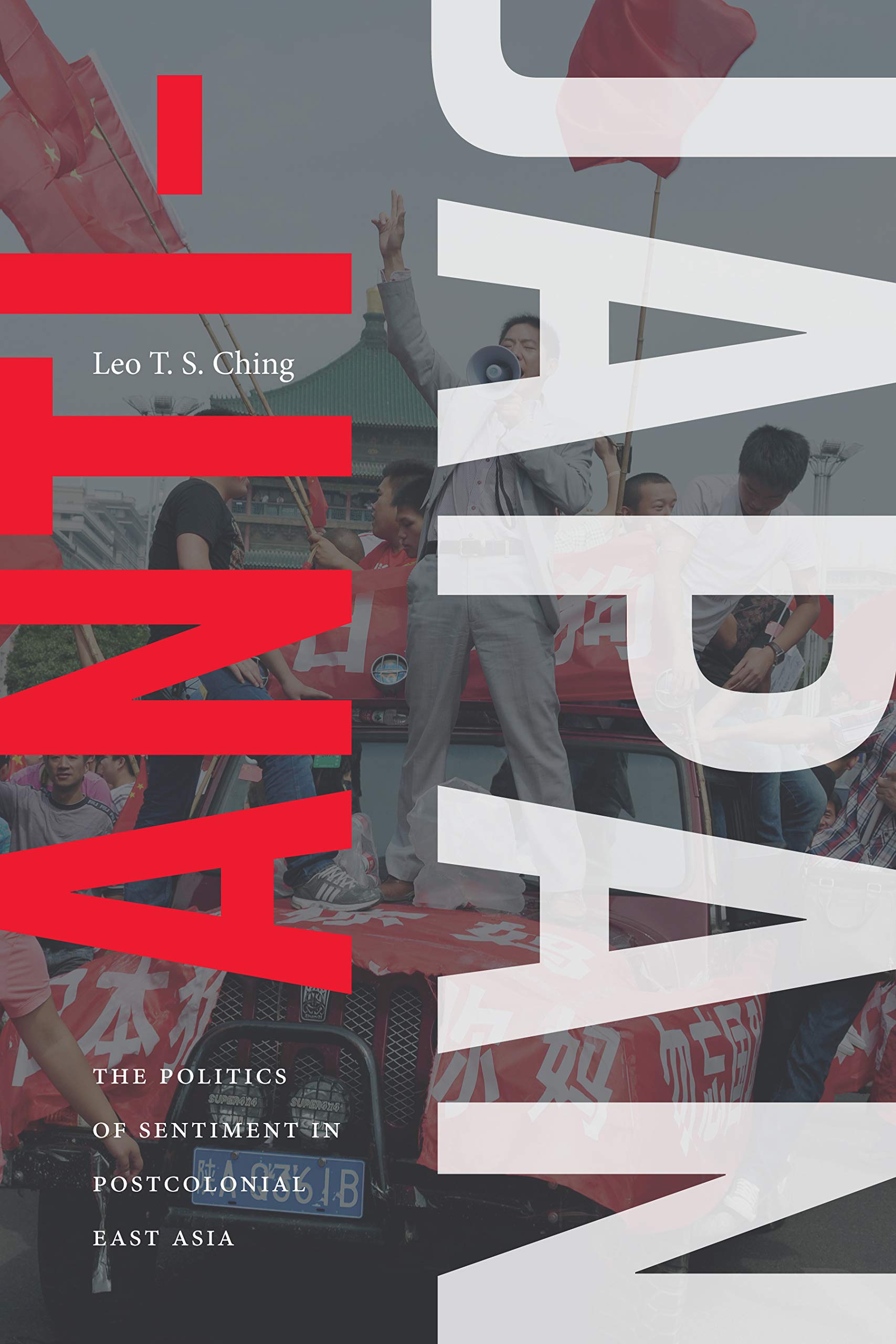
Anti-Japan: The Politics of Sentiment in Postcolonial East Asia
$29.95
| Brand | Leo T. S. Ching |
| Merchant | Amazon |
| Category | Books |
| Availability | Available Date |
| SKU | 1478002891 |
| Age Group | ADULT |
| Condition | NEW |
| Gender | UNISEX |
| Google Product Category | Media > Books |
| Product Type | Books > Subjects > History > Asia > Japan |
About this item
Anti-Japan: The Politics of Sentiment in Postcolonial East Asia
Although the Japanese empire rapidly dissolved following the end of World War II, the memories, mourning, and trauma of the nation's imperial exploits continue to haunt Korea, China, and Taiwan. In Anti-Japan Leo T. S. Ching traces the complex dynamics that shape persisting negative attitudes toward Japan throughout East Asia. Drawing on a mix of literature, film, testimonies, and popular culture, Ching shows how anti-Japanism stems from the failed efforts at decolonization and reconciliation, the Cold War and the ongoing U.S. military presence, and shifting geopolitical and economic conditions in the region. At the same time, pro-Japan sentiments in Taiwan reveal a Taiwanese desire to recoup that which was lost after the Japanese empire fell. Anti-Japanism, Ching contends, is less about Japan itself than it is about the real and imagined relationships between it and China, Korea, and Taiwan. Advocating for forms of healing that do not depend on state-based diplomacy, Ching suggests that reconciliation requires that Japan acknowledge and take responsibility for its imperial history. " Anti-Japan is a timely analysis of the complex relationships among countries in East Asia as the political and economic power relationship in the region is rapidly reconstructed." -- Linda Wang ― International Social Science Review “This creative, thought-provoking, and deeply insightful book speaks to multiple cross-disciplinary audiences, including specialists and general readers in East Asian history, culture, and politics. It would also be of interest to anyone interested in memory, postcolonial studies, nationalism, and postconflict resolution and reconciliation.” -- Seo-Hyun Park ― Journal of Asian Studies “Leo Ching’s book Anti-Japan is a timely and relevant addition to the discussions surrounding the recent developments in Northeast Asia.” -- Joon Oh ― China Report “This thought-provoking book will help readers reevaluate and contextualize various literary works, films, testimonies, music videos, video games, and other aspects of popular culture.... [T]his book provokes readers to reevaluate issues related to historical reconciliation in East Asia.” -- Takashi Yoshida ― Journal of Japanese Studies “What Ching’s book does to set it apart from what is a fairly crowded field is to situate his analysis across the disciplinary boundaries of cultural studies, postcolonial studies, and the burgeoning studies of affect and emotions.... This is a thoughtful and thought-provoking book and deserves to be read widely.” -- Caroline Rose ― Pacific Affairs “Filled with innovative, unique, and sensitive insights, Anti-Japan offers a brilliantly crafted critique of nationalist responses to the incomplete decolonization of East Asia following World War II. Leo T. S. Ching interrogates the historicity and limits of these responses while painstakingly excavating the possibilities of reckoning with the violence and trauma produced by Japanese colonialism, imperialism, and militarism. Ching's work is transnational and postnationalist in the best sense.” -- Takashi Fujitani, author of ― Race for Empire: Koreans as Japanese and Japanese as Americans during World War II Leo T. S. Ching is Associate Professor of Japanese and East Asian Cultural Studies at Duke University and author of Becoming "Japanese": Colonial Taiwan and the Politics of Identity Formation . Anti-Japan The Politics of Sentiment in Postcolonial East Asia By Leo T. S. Ching Duke University Press Copyright © 2019 Duke University Press All rights reserved. ISBN: 978-1-4780-0289-5 Contents Acknowledgments, INTRODUCTION. Anti-Japanism (and Pro-Japanism) in East Asia, ONE. When Bruce Lee Meets Gojira: Transimperial Characters, Anti-Japanism, Anti-Americanism, and the Failure of Decolonization, TWO. "Japanese Devils": The Conditions and Limits of Anti-Japanism in China, THREE. Shameful Bodies, Bodily Shame: "Comfort Women" and Anti-Japanism in South Korea, FOUR. Colonial Nostalgia or Postcolonial Anxiety: The Dosan Generation In-Between "Retrocession" and "Defeat", FIVE. "In the Name of Love": Critical Regionalism and Co-Viviality in Post–East Asia, SIX. Reconciliation Otherwise: Intimacy, Indigeneity, and the Taiwan Difference, EPILOGUE. From Anti-Japanism to Decolonizing Democracy: Youth Protests in East Asia, Notes, References, Index, CHAPTER 1 When Bruce Lee Meets Gojira: Transimperial Characters, Anti-Japanism, Anti-Americanism, and the Failure of Decolonization As far as I know, the famed martial artist never fought the scaly monster. Neither has the nuclear-infected beast stomped and destroyed the homeland of the fictionalized Chinese patriot. Their closest encounter appears briefly in the World Martial Arts Tournament in the episode "Milk Delivery" in Dragon Ball, the popular Japanese manga and anime series. In the brief combat scene, Bruce Lee at first easily defeats what appears to be a giant gorilla (an
| Brand | Leo T. S. Ching |
| Merchant | Amazon |
| Category | Books |
| Availability | Available Date |
| SKU | 1478002891 |
| Age Group | ADULT |
| Condition | NEW |
| Gender | UNISEX |
| Google Product Category | Media > Books |
| Product Type | Books > Subjects > History > Asia > Japan |
Similar Products










Compare with similar items

The Bollywood Lovers' Club... |

Pug Lover Notebook and Journal: 120-Page... |

Wisdom of the Owl,'Handcrafted Recycled ... |

Retro Valentine Sweethearts Coloring Boo... |
|
|---|---|---|---|---|
| Price | $16.99 | $9.99 | $19.99 | $11.99 |
| Brand | James Goldberg | Amber Ashley | NOVICA | Cloudix Studio |
| Merchant | Amazon | Amazon | Novica | Amazon |
| Availability | In Stock | In Stock | In Stock | In Stock |