
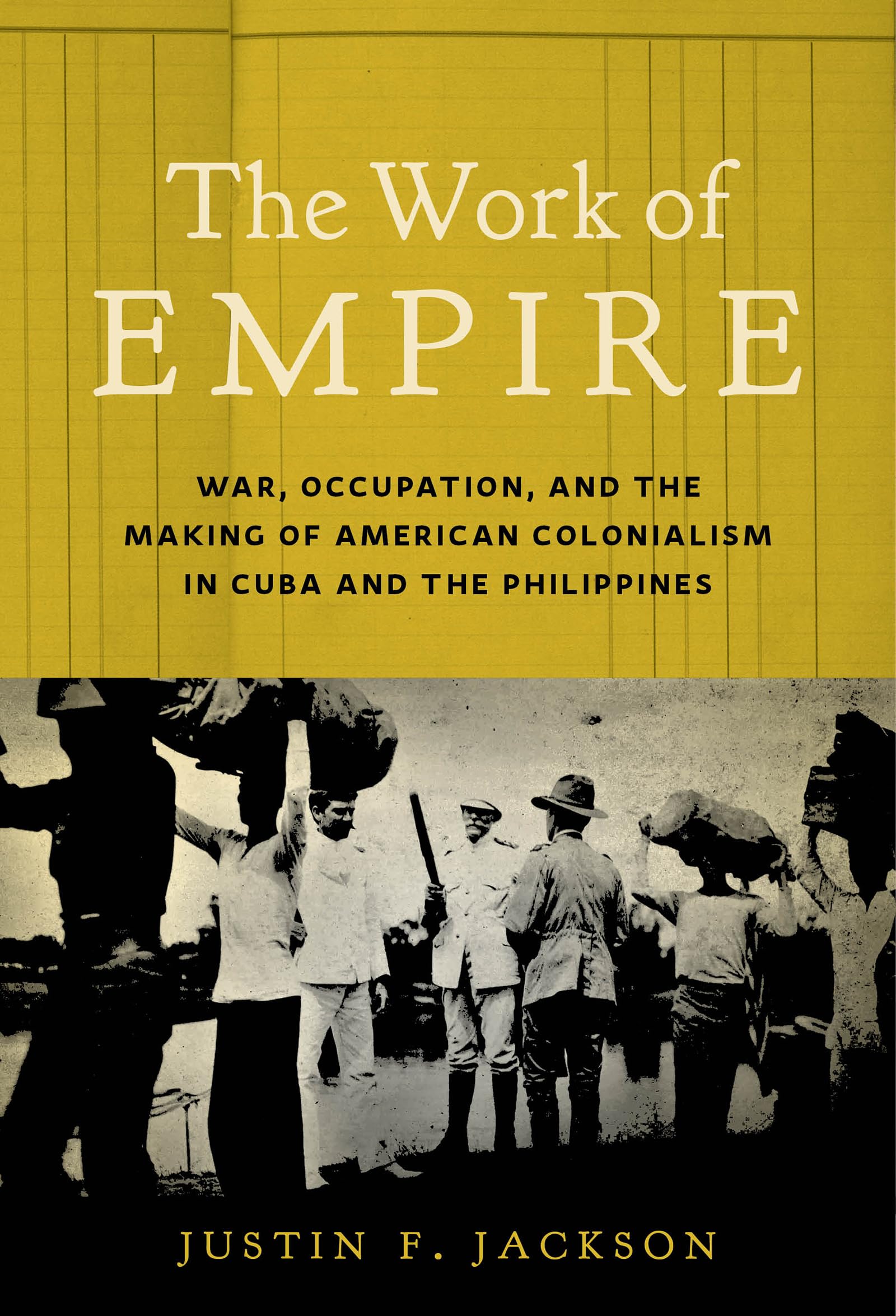
The Work of Empire: War, Occupation, and the Making of American Colonialism in Cuba and the Philippines
$103.20
| Brand | Justin F. Jackson |
| Merchant | Amazon |
| Category | Books |
| Availability | In Stock Scarce |
| SKU | 1469660318 |
| Age Group | ADULT |
| Condition | NEW |
| Gender | UNISEX |
About this item
The Work of Empire: War, Occupation, and the Making of American Colonialism in Cuba and the Philippines
In 1898, on the eve of the Spanish-American War, the US Army seemed minuscule and ill-equipped for global conflict. Yet over the next fifteen years, its soldiers defeated Spain and pacified nationalist insurgencies in both Cuba and the Philippines. Despite their lack of experience in colonial administration, American troops also ruled and transformed the daily lives of the 8 million people who inhabited these tropical islands. How was this relatively small and inexperienced army able to wage wars in Cuba and the Philippines and occupy them? American soldiers depended on tens of thousands of Cubans and Filipinos, both for military operations and civil government. Whether compelled to labor for free or voluntarily working for wages, Cubans and Filipinos, suspended between civilian and soldier status, enabled the making of a new US overseas empire by interpreting, guiding, building, selling sex, and many other kinds of work for American troops. In The Work of Empire , Justin Jackson reveals how their labor forged the politics, economics, and culture of American colonialism in Cuba and the Philippines and left an enduring imprint on these islands and the US Army itself. Jackson offers new ways to understand the rise of American military might and how it influenced a globalizing imperial world. “Jackson’s expansive new book . . . shows how the United States’ military colonialism at the turn of the century was realized, in no small part, through the efforts of Cuban, Filipino, and Chinese workers. The US empire was articulated through various forms of subaltern labor in crucial ways, but it was also contested, challenged, and destabilized in the process, often to the chagrin of soldiers seeking to impose a modernizing, technocratic efficiency. . . . Jackson’s deep engagement with a transnational set of archives merges with a thoughtful exploration of more conceptual questions around labor, difference, and the ways in which imperial power is mobilized.“— Diplomatic History “A fascinating exploration of the critically important role played by labour in the creation of an empire. . . . Jackson provides an extremely valuable new focus on US imperialism that orients our attention to the role of workers themselves in empire-building—as well as instances in which they asserted the power to change it.”— Latin American Review of Books “Jackson’s work is an insightful and engaging look at the nature of colonial occupation and the ways in which the US experience was one of negotiation and contestation rather than a simplistic picture of dominance. . . . As Jackson concludes, noting that the US efforts in Afghanistan and Iraq championed public works alongside deep reliance on local workers and knowledge, The Work of Empire is a subject that remains highly relevant.”— Journal of Military History “ Work of Empire highlights that American forces must be open and receptive to the requirements and differences of another country, and that a lack of understanding and detailed knowledge can lead to significant issues down the road, for both American forces and those living under the authority of those forces.”— United States Air Force “This is an innovative study of military-colonial labor relations in the Philippines and Cuba. . . . Jackson’s perspective offers a fresh take on empire studies—truly top-tier research.”—Zach Fredman, author of The Tormented Alliance: American Servicemen and the Occupation of China, 1941–1949 “This is an innovative study of military-colonial labor relations in the Philippines and Cuba. . . . Jackson’s perspective offers a fresh take on empire studies—truly top-tier research.”—Zach Fredman, author of The Tormented Alliance: American Servicemen and the Occupation of China, 1941–1949 How workers in occupied Cuba and the Philippines enabled and resisted US imperialism Justin Jackson is associate professor of history at Bard College at Simon’s Rock.
| Brand | Justin F. Jackson |
| Merchant | Amazon |
| Category | Books |
| Availability | In Stock Scarce |
| SKU | 1469660318 |
| Age Group | ADULT |
| Condition | NEW |
| Gender | UNISEX |
Similar Products








Compare with similar items

Cut Out And Collage Vintage Halloween Bo... |

MANAGING GASTROPARESIS WITH SPECIAL RECI... |
Becoming HeartMath Practitioner... |

Vision Board Book: Inspirational Images ... |
|
|---|---|---|---|---|
| Price | $11.99 | $15.99 | $8.81 | $12.99 |
| Brand | Marmottly Publishing | Frederick G. Sanderson | Dragana Dj. Jeremic | Sarah Barney |
| Merchant | Amazon | Amazon | Amazon | Amazon |
| Availability | In Stock | In Stock | In Stock | In Stock |