
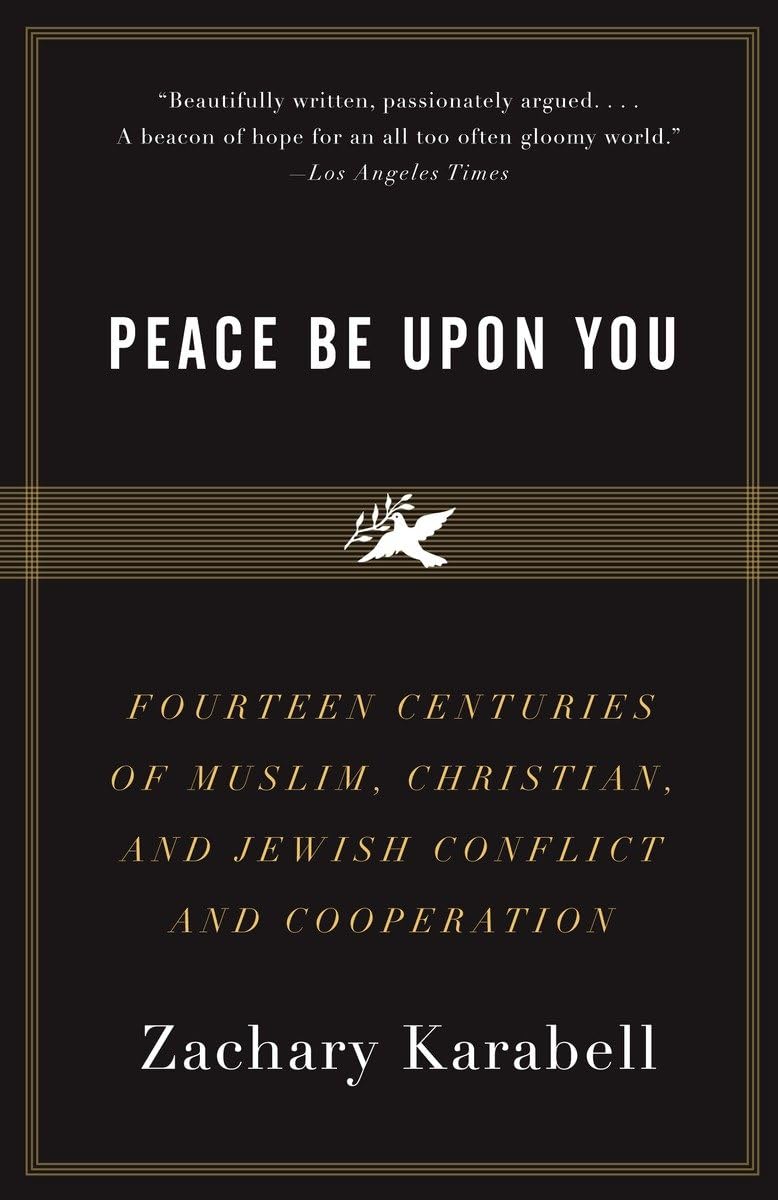
Peace Be Upon You: Fourteen Centuries of Muslim, Christian, and Jewish Conflict and Cooperation
$16.95
| Brand | Zachary Karabell |
| Merchant | Amazon |
| Category | Books |
| Availability | In Stock |
| SKU | 1400079217 |
| Color | Black |
| Age Group | ADULT |
| Condition | NEW |
| Gender | UNISEX |
About this item
Peace Be Upon You: Fourteen Centuries of Muslim, Christian, and Jewish Conflict and Cooperation
In a narrative that is at once thoughtful and passionate, an award-winning historian reveals the history of peaceful coexistence between Muslims, Christians, and Jews over the course of fourteen centuries until the present day. The harsh reality of religious conflict is daily news, and the rising tensions between the West and Islam show no signs of abating. However, the relationship between Muslims, Christians, and Jews has not always been marked with animosity; there is also a deep and nuanced history of peace. From the court of caliphs in ancient Baghdad, where scholars engaged in spirited debate, to present-day Dubai, where members of each faith work side by side, Karabell traces the forgotten legacy of tolerance and cooperation these three monotheistic religions have enjoyed—a legacy that will be vital in any attempt to find common ground and reestablish peace. “Beautifully written, passionately argued. . . . [A] beacon of hope for an all too often gloomy world.”— Los Angeles Times “A hopeful, historical meditation. . . . Lucid, well written and persuasive.”— The Washington Post Book World “A fine, wise and important book. . . . It shows that Christians and Muslims have known prosperous, co-existent peace before-and could do so again.” — The Times, London “Reminds us of the possibility of a better future.” —Fareed Zakaria, editor, Newsweek International Zachary Karabell was educated at Columbia, Oxford, and Harvard, where he received his Ph.D. in 1996. He is the author of several books, including The Last Campaign , which won the Chicago Tribune 's Heartland Award, and Parting the Desert: The Creation of the Suez Canal . His essays and reviews have appeared in The New York Times , The Los Angeles Times , Foreign Policy , and Newsweek . He lives with his wife and two children in New York, where he is an executive vice president of a leading asset management firm. Chapter One: In the Name of the Lord Sometime around the year 570 in the Western calendar, Muhammad ibn Abdullah was born in the oasis town of Mecca, just off the western coast of the Arabian Peninsula. The town was separated from the Red Sea by a narrow, steep mountain range, and it sat at the edge of the vast desert that defined most of the Arabian Peninsula. The oasis was dominated by the Quraysh tribe, who controlled the camel trade that passed through Mecca between Yemen, in the south, and the more settled agrarian regions hundreds of miles north, which were divided between the Byzantine emperor and the Sasanian monarch of Persia. Though Muhammad was a member of the ruling tribe, his clan was not particularly prominent. His father died when Muhammad was a boy, and his uncle Abu Talib became his protector. For most of the next forty years, Muhammad lived an anonymous life like that of many others in Mecca; he established himself as a merchant and married an older widow named Khadija. Had he died before the age of forty, his would have been one of the countless lives invisible to history, and Mecca itself would have remained a small provincial town no more important than thousands of others throughout the world. But around the year 610, Muhammad began to hear the voice of God, and for the first time, God spoke in Arabic. Muhammad did not share these revelations with anyone other than his wife. Prophets were rarely welcome, and Muhammad did not have sufficient standing in the community to defend himself against adversaries who might not welcome the message he was being given. While the experience of receiving the revelations was physically wrenching for Muhammad, the substance was socially wrenching for the Meccans. Rather than a system anchored by tribe, clan, and family, Muhammad announced a new order, anchored by God’s will and human submission to it—hence the words islam , the Arabic word verb for “submit,” and muslim , the Arabic word for one who does. Muhammad began to share the content of what he was being told with a small circle of friends and family, and slowly the word spread. At first, the more powerful members of the Quraysh dismissed the sermons as irrelevant, but as more people started to turn to him for guidance, the Quraysh became concerned. From what they could glean, Muhammad’s message represented a challenge to the social order that they dominated. They were right to be concerned. In their Mecca of tribe and clan, they were supreme. Obeisance was given to the various gods and spirits known as jinn (the kindred English word is “genie”), but one’s tribe was more consequential than any god. At the time, there was a nascent sense of monotheism, though not much more developed than a vague notion that there was one god more powerful than the others. But the Quraysh of Mecca were not prepared to embrace him alone, because that would have upended the status quo. In their world, the tribe, not any god, determined social standing and marriage, and it was up to the tribe and the clan to avenge wrongs committe
| Brand | Zachary Karabell |
| Merchant | Amazon |
| Category | Books |
| Availability | In Stock |
| SKU | 1400079217 |
| Color | Black |
| Age Group | ADULT |
| Condition | NEW |
| Gender | UNISEX |
Similar Products










Compare with similar items

The Lighthouse on Plum Island (Cobble Be... |

Football Sketchbook for Boys and Teens, ... |

As a Kid Thinks: An Adaptation of the Cl... |

Crescent Kingdom (The Wolves of Crescent... |
|
|---|---|---|---|---|
| Price | $16.99 | $5.99 | $12.99 | $14.99 |
| Brand | Amy Rafferty | Meadows Publishing | Ollie D. Orwell | Tessa Hale |
| Merchant | Amazon | Amazon | Amazon | Amazon |
| Availability | In Stock | In Stock | In Stock | In Stock |