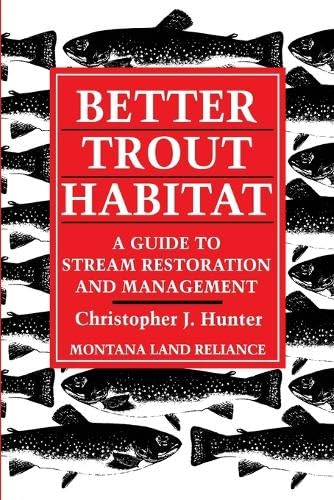
Better Trout Habitat: A Guide to Stream Restoration and Management
$50.00
| Brand | Montana Land Reliance |
| Merchant | Amazon |
| Category | Books |
| Availability | Leadtime |
| SKU | 0933280777 |
| Age Group | ADULT |
| Condition | NEW |
| Gender | UNISEX |
| Google Product Category | Media > Books |
| Product Type | Books > Subjects > Science & Math > Biological Sciences > Animals > Fish & Sharks |
About this item
Better Trout Habitat: A Guide to Stream Restoration and Management
Better Trout Habitat explains the physical, chemical, and biological needs of trout, and shows how climate, geology, vegetation, and flowing water all help to create trout habitat. Christopher J. Hunter is an aquatic ecologist, and past president of the Montana chapter of the American Fisheries Society. Better Trout Habitat A Guide to Stream Restoration and Management By Christopher J. Hunter, Tom Palmer, Ellen Meloy ISLAND PRESS Copyright © 1991 Montana Land Reliance All rights reserved. ISBN: 978-0-933280-77-9 Contents ABOUT ISLAND PRESS, ABOUT MONTANA LAND RELIANCE, SPONSORS, Title Page, Copyright Page, Dedication, FOREWORD, PREFACE, ACKNOWLEDGMENTS, INTRODUCTION, Chapter 1 - STREAM RESTORATION: CURRENT INTEREST AND HISTORICAL PERSPECTIVE, Chapters 2 - THE TROUT AND THE STREAM, Chapter 3 - HOW THE STREAM AND ITS VALLEY MAKE TROUT HABITAT, Chapter 4 - INVENTORY, MONITORING, AND EVALUATION, Chapter 5 - DETERMINING LIMITING FACTORS, DESIGNING, AND INITIATING THE PROJECT, Chapter 6 - THE ROLE AND FUNCTION OF IN-STREAM STRUCTURES, Chapter 7 - STREAMS AFFECTED BY AGRICULTURE, Chapter 8 - FORESTED STREAMS, Chapter 9 - URBAN STREAMS, Chapter 10 - A MISSION TO SET THINGS RIGHT, GLOSSARY, SPONSORS, ABOUT THE AUTHOR, ABOUT THE EDITOR, ABOUT THE ILLUSTRATOR, INDEX, ALSO AVAILABLE FROM ISLAND PRESS, ISLAND PRESS BOARD OF DIRECTORS, CHAPTER 1 STREAM RESTORATION: CURRENT INTEREST AND HISTORICAL PERSPECTIVE THE sport of trout fishing is growing and it is growing fast. By the year 2000, there will be 10 million trout anglers in North America. Many of them will simply take up rod and reel to escape the pressures of their daily lives and seek the solitude they expect trout fishing to offer. Thoreau said that many a man went fishing all of his life without ever realizing that it was not fish he was after. Modern surveys of trout anglers are showing that Thoreau was at least half right. Trout anglers are on an outdoor quest to lose themselves in the scenery and catch a wild trout in the process. Unfortunately, the number of streams capable of supporting wild trout—trout that are actually products of a natural stream system—is dwindling. Sadly, we are all to blame. In too many places the cost of economic prosperity has been the destruction of trout habitat. With that destruction go the natural environments trout anglers find such fine complements to their fishing trips. Our domestic and industrial wastes have polluted streams and eliminated wild-trout populations. The evidence can be found in West Virginia's Cranberry River, Oregon's Camp Creek, Pennsylvania's West Valley Creek, and other streams described in this book. Even the seemingly innocent removal of streamside vegetation by livestock, farming, logging, mining, and urban development has led to wide, shallow, and warm troutless streams. Straightening stream channels, a surprisingly common flood-control practice, has caused water to gouge wide, shallow channels, resulting in related changes in the streamside vegetation. Perhaps such streams in now-barren landscapes could still be stocked with hatchery trout, but, in the end, it would not take a lifetime to discover that wasn't what one was after. The growing population and increased interest in trout fishing, coupled with decreasing trout habitat, have heaped new pressures on fish and game agencies to provide quality trout-fishing opportunities. All of the fish and game agencies of trout-producing states have, at some time, developed programs of planting hatchery-reared trout to meet the increasing demand for trout fishing. In 1983 approximately 54 million catchable-sized trout were stocked in 43 states at a cost of $36 million. At the same time, our stream resources were dwindling, and by 1988 the U.S. General Accounting Office's study of streamside management on public rangelands showed that in some states as much as 90 percent of federally managed streams were in a degraded condition. The easily managed stocked fishery allows many anglers to catch and keep trout that are genetically programmed to die quickly in the wild from waters that need not be capable of supporting naturally reproducing wild-trout populations. But for many anglers, hatchery-reared trout are a poor substitute for wild trout. A hatchery trout doesn't look or fight as well as a wild trout, and, for growing numbers of anglers, much of the mystery and beauty of trout fishing is lost when the quarry is just another mass-produced product. RESTORATION—AN ALTERNATIVE SOLUTION One could look at it as a simple problem of supply and demand, but at the heart of the movement to restore degraded trout streams is a desire to set things right. As you shall see, stream restoration is not a simple process. It is often difficult and costly, but the benefits—such as gaining a deeper understanding and appreciation of the complex relationships among the trout, the stream, and the valley through which it fl
| Brand | Montana Land Reliance |
| Merchant | Amazon |
| Category | Books |
| Availability | Leadtime |
| SKU | 0933280777 |
| Age Group | ADULT |
| Condition | NEW |
| Gender | UNISEX |
| Google Product Category | Media > Books |
| Product Type | Books > Subjects > Science & Math > Biological Sciences > Animals > Fish & Sharks |
Similar Products










Compare with similar items

The Ten O'Clock Line... |

Young Adventurers Oahu Companion Activit... |

BASKETBALL WORD SEARCH FOR KIDS UP TO 12... |

Guest Book to sign (Hardback Cover): Gue... |
|
|---|---|---|---|---|
| Price | $10.95 | $7.99 | $7.99 | $17.95 |
| Brand | Marianne Coil | Ocean Breeze Adventures | Riddle Studio | Penelope Eton |
| Merchant | Amazon | Amazon | Amazon | Amazon |
| Availability | In Stock | In Stock | In Stock | In Stock |