
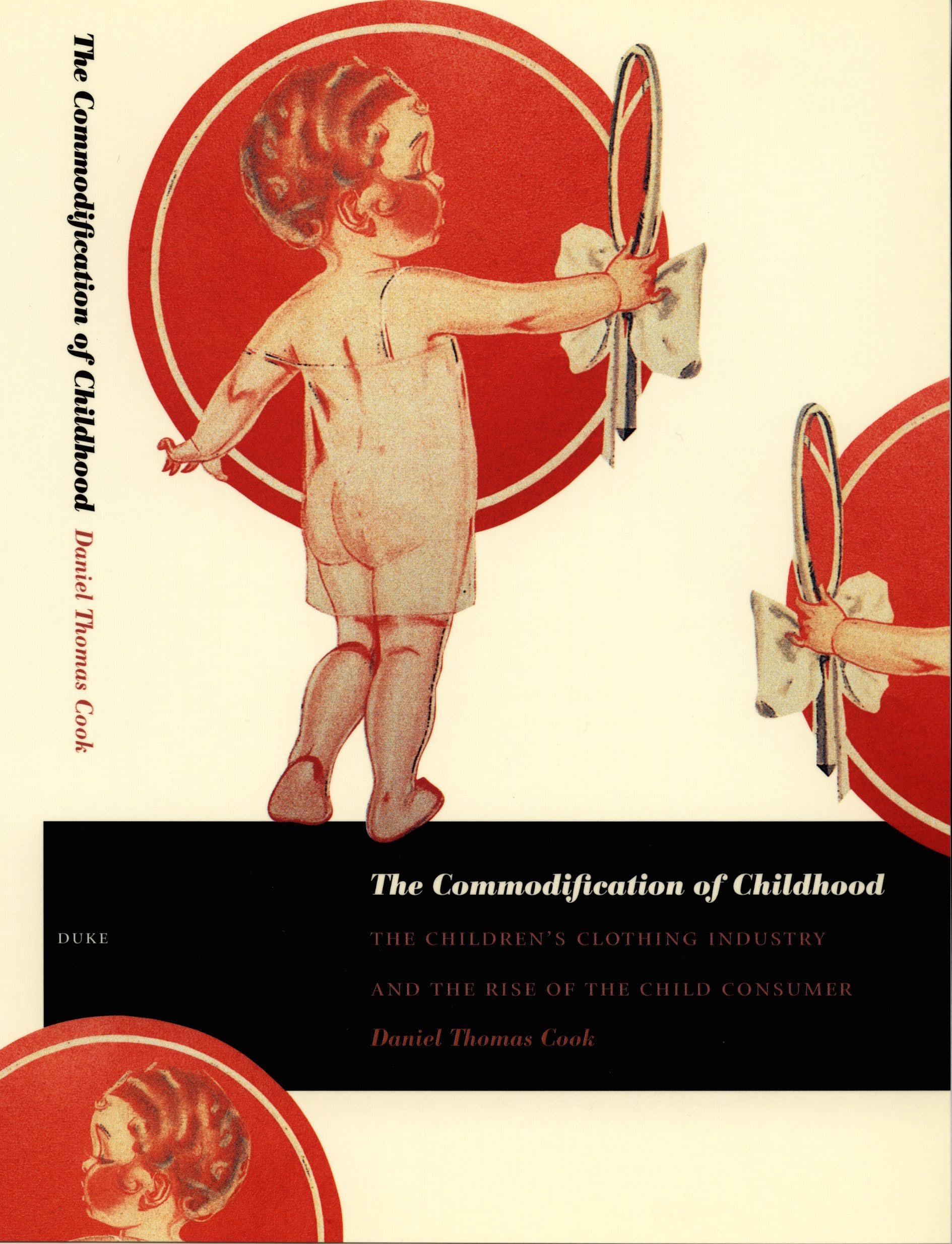
The Commodification of Childhood: The Children’s Clothing Industry and the Rise of the Child Consumer
$64.71
| Brand | Daniel Thomas Cook |
| Merchant | Amazon |
| Category | Books |
| Availability | Unknown Availability |
| SKU | 0822332795 |
| Age Group | ADULT |
| Condition | NEW |
| Gender | UNISEX |
About this item
The Commodification of Childhood: The Children’s Clothing Industry and the Rise of the Child Consumer
In this revealing social history, Daniel Thomas Cook explores the roots of children’s consumer culture—and the commodification of childhood itself—by looking at the rise, growth, and segmentation of the children’s clothing industry. Cook describes how in the early twentieth century merchants, manufacturers, and advertisers of children’s clothing began to aim commercial messages at the child rather than the mother. Cook situates this fundamental shift in perspective within the broader transformation of the child into a legitimate, individualized, self-contained consumer. The Commodification of Childhood begins with the publication of the children’s wear industry’s first trade journal, The Infants’ Department, in 1917 and extends into the early 1960s, by which time the changes Cook chronicles were largely complete. Analyzing trade journals and other documentary sources, Cook shows how the industry created a market by developing and promulgating new understandings of the “nature,” needs, and motivations of the child consumer. He discusses various ways that discursive constructions of the consuming child were made material: in the creation of separate children’s clothing departments, in their segmentation and layout by age and gender gradations (such as infant, toddler, boys, girls, tweens, and teens), in merchants’ treatment of children as individuals on the retail floor, and in displays designed to appeal directly to children. Ultimately, The Commodification of Childhood provides a compelling argument that any consideration of “the child” must necessarily take into account how childhood came to be understood through, and structured by, a market idiom. “Blending the sociologist’s theoretical rigor with the historian’s attention to detail and change, Daniel Thomas Cook offers us a striking and original explanation of how twentieth-century notions of childhood together with new marketing practices led to the modern autonomous child.”—Gary Cross, author of The Cute and the Cool: Wondrous Innocence and Modern American Children’s Culture “Daniel Thomas Cook’s The Commodification of Childhood is a pioneering and major contribution to our understanding of consumer culture. On the basis of his detailed and fascinating examination of children’s clothing marketing through the twentieth century, Cook constructs a larger template for understanding the complex and evolving relations between consumers and marketers. The theoretical discussions are a tour de force. A must-read for all scholars of consumer society.”—Juliet B. Schor, author of The Overspent American: Why We Want What We Don’t Need "Daniel Thomas Cook's "The Commodification of Childhood" is a pioneering and major contribution to our understanding of consumer culture. On the basis of his detailed and fascinating examination of children's clothing marketing through the twentieth century, Cook constructs a larger template for understanding the complex and evolving relations between consumers and marketers. The theoretical discussions are a tour de force. A must-read for all scholars of consumer society."--Juliet B. Schor, author of "The Overspent American: Why We Want What We Don't Need" Daniel Thomas Cook is a sociologist in the Department of Advertising at University of Illinois, Champaign-Urbana. He is the editor of Symbolic Childhood. The Commodification of Childhood The Children's Clothing Industry and the Rise of the Child Consumer By Daniel Thomas Cook Duke University Press Copyright © 2004 Daniel Thomas Cook All right reserved. ISBN: 9780822332794 Chapter One A Brief History of Childhood and Motherhood into the Twentieth Century As a social production, the child consumer is also necessarily a historical one. A number of historical trajectories converge in the early twentieth century to make the emergence of a nascent commercial world of childhood possible and viable. One trajectory speaks to the social identity of "the child" as an entity, as a being distinguishable from adults. Primary among this child's distinguishing characteristics are its naturalness, its innocence, and the naturalness of its innocence. Another historical strand configures the social location of the child within the sentimentalized, domestic sphere of the eighteenth and nineteenth centuries, directly implicating motherhood and its attendant morality in the formation of a children's culture. Middle-class mothers transformed their imputed status as moral caretakers into political action in the Progressive Era (roughly 1890-1920), mounting a number of campaigns and creating a number of institutions which sought to improve the health and well-being of mothers and children. A final historical thread to weave into this chapter addresses the rise of women as consumers, particularly in urban department stores in the early twentieth century-a development concurrent with the political action of women. These together provided some of the main supports for e
| Brand | Daniel Thomas Cook |
| Merchant | Amazon |
| Category | Books |
| Availability | Unknown Availability |
| SKU | 0822332795 |
| Age Group | ADULT |
| Condition | NEW |
| Gender | UNISEX |
Similar Products










Compare with similar items

Investir en Bourse avec les ETF: Constru... |

People over Profit... |

For 12.25" Books & Textbooks up to 23.5"... |

U.S. National Parks: Your Practical Road... |
|
|---|---|---|---|---|
| Price | $19.95 | $3.83 | $30.39 | $21.99 |
| Brand | Le Prince desETF | The People Of Acorn | ClearBags | Emma Anderson |
| Merchant | Amazon | Amazon | clearbags | Amazon |
| Availability | In Stock | In Stock Scarce | In Stock | In Stock |