
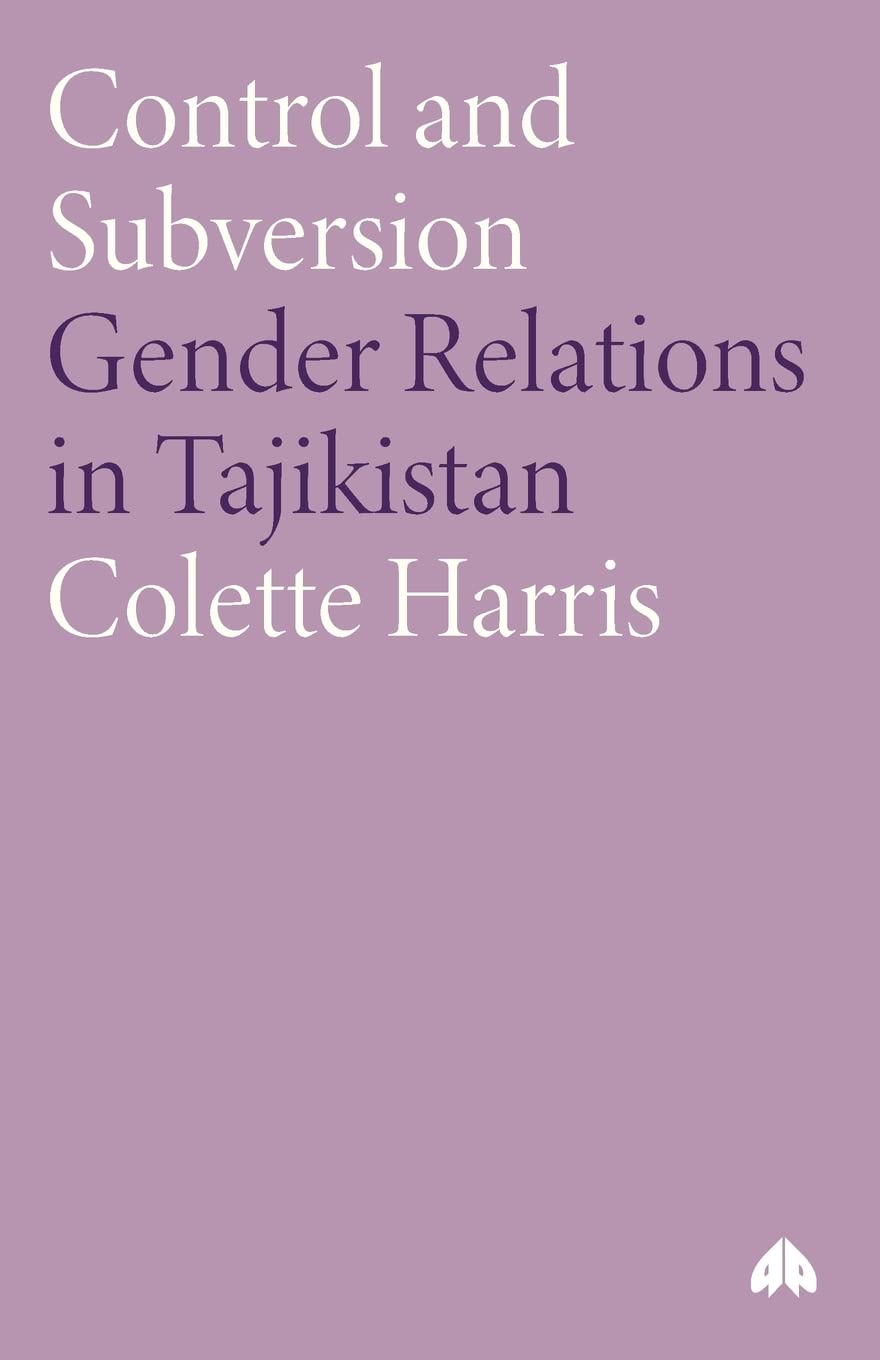
Control and Subversion: Gender Relations in Tajikistan (Anthropology, Culture and Society)
$18.45
| Brand | Colette Harris |
| Merchant | Amazon |
| Category | Books |
| Availability | In Stock |
| SKU | 0745321674 |
| Age Group | ADULT |
| Condition | NEW |
| Gender | UNISEX |
| Google Product Category | Media > Books |
| Product Type | Books > Subjects > Politics & Social Sciences > Social Sciences > Gender Studies > General |
About this item
Control and Subversion: Gender Relations in Tajikistan (Anthropology, Culture and Society)
Control and Subversion makes an important contribution to the study of Muslim societies in general, while also being a unique study of a neglected area - post-Soviet Tajikistan - a country gaining increasing importance in the international arena of Central Asia. The book presents an intimate view of this society, told through ethnographically collected life histories, unusually including men's as well as women's. Despite developing significant gender theories (notably reframing work of Judith Butler), and maintaining high academic standards, it remains as readable as a popular novel. Control and Subversion investigates the relationship of gender to the inner workings of social control, such as exposing ways in which Tajik society threatens men's masculinity, thereby bringing them to force family members into conformity, irrespective of the suffering this may cause. It examines how masculine and feminine gender characteristics influence personal relationships and explores gender relations at their most intimate - from the secret musings of adolescent girls, through the painful experiences of young men, to the trauma of sexual initiation. Although largely concentrating on contemporary life, the book also discusses historical materials and Soviet influence on Tajik society. Control and Subversion is essential reading for anyone interested in Central Asia, Muslim societies, the lives of Muslim women, or gender in a Muslim context. 'I am deeply impressed. This is a solid, original ethnography from a little studied part of the world' - Thomas Eriksen 'Colette is an amazing person and I cannot imagine how she did the work she reports on' - Professor Janet Momsen, Dept of Human & Community Development, Uni of California Colette Harris is a researcher specialising in gender and development, with particular interests in family relations, sexuality and domestic violence. She is currently program director, women in international development at the Office of International Research, Education and Development of Virginia Tech University in the States. Control and Subversion Gender Relations in Tajikistan By Colette Harris Pluto Press Copyright © 2004 Colette Harris All rights reserved. ISBN: 978-0-7453-2167-7 Contents Acknowledgements, viii, Dramatis Personae, xii, Introduction: The Research Setting and Methodology, 1, 1. Conceptual Background, 12, 2. The Bolsheviks Attack but the Tajiks Resist, 42, 3. Community Control, 67, 4. Intergenerational Family Control, 92, 5. The Individual Unmasked, 114, 6. The Couple Relationship: Love, Sex and Marriage, 134, Conclusion: Control and Subversion, 170, Technical Information and Terminology, 177, Glossary, 179, Notes, 182, Bibliography, 188, Index, 196, CHAPTER 1 CONCEPTUAL BACKGROUND THEORETICAL FRAMEWORK Power relations Zora is from the town of Uroteppa in the north, while her husband, Fayziddin, is from a village near Qurghonteppa in the south. They met and married at university and afterwards stayed on in Dushanbe. They have two children, a daughter Dila, and a son, Ali. Although Fayziddin earned much less than Zora he considered himself the head of the family and insisted everyone obey him, so that, despite the fact that his wife held a taxing job, he always refused to help in the house. It was not his business to do 'women's' work. On the contrary Zora must wait on him. If she protested he would beat her. Zora was often very tired and could not cope with all the housework by herself. With only one daughter to help her she found herself forced to co-opt her son into assisting her. Fayziddin, however, was concerned with the effect this was having on his children's upbringing and especially on the family image. It made him very nervous to imagine the neighbours' comments. Therefore, whenever he came home and found Ali helping his mother he would beat her and threaten to repeat this if he caught her encouraging his son to behave in 'womanly' ways again. 'Boys do not do housework', Fayziddin told Ali repeatedly, while also beating him for greater emphasis. Eventually Ali learned his lesson, so that even in his father's absence he would refuse to do any work in the home, including taking out the refuse, ignoring his mother's plaint that this was a man's job. Fayziddin never laid a finger on Dila because her upbringing was her mother's responsibility. He did, however, check how Zora was fulfilling this task. He was a strict father and wanted his children to behave as he and his siblings had done in his native village. Although they lived in Dushanbe, he would have preferred Dila to dress in traditional clothes all the time, even at university. In Soviet times all students had to wear Russian dress. Dila had been allowed to comply with this but by the time she started university the Soviet Union had ended, and with it such rules. Fayziddin was determined his daughter would wear ezor to cover her legs. Dila wanted to protest, but she c
| Brand | Colette Harris |
| Merchant | Amazon |
| Category | Books |
| Availability | In Stock |
| SKU | 0745321674 |
| Age Group | ADULT |
| Condition | NEW |
| Gender | UNISEX |
| Google Product Category | Media > Books |
| Product Type | Books > Subjects > Politics & Social Sciences > Social Sciences > Gender Studies > General |
Similar Products









Compare with similar items

Greek Alphabet Letter Tracing & Coloring... |

Carnage: Book #1 The Story of Us... |

Macaco da Noite (Contos de Santa Esperan... |

Flames & Feasts: BBQ & Grilling Recipe B... |
|
|---|---|---|---|---|
| Price | $6.99 | $28.00 | $6.00 | $35.00 |
| Brand | Bilingual Kiddos Press | Lesley Jones | Marcelo Tinoco | Scotty Boxa |
| Merchant | Amazon | Amazon | Amazon | Amazon |
| Availability | In Stock | In Stock | In Stock | In Stock |