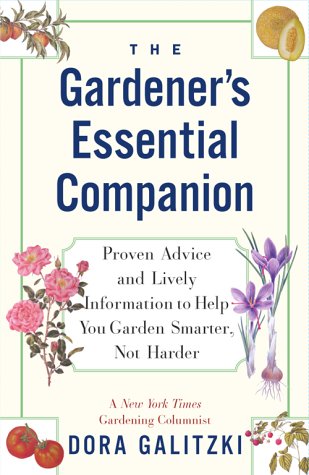
The GARDENER'S ESSENTIAL COMPANION: Proven Advice and Lively Information to Help You Garden Smarter, Not Harder
$12.87
| Brand | Dora Galitzki |
| Merchant | Amazon |
| Category | Books |
| Availability | In Stock Scarce |
| SKU | 0684863219 |
| Age Group | ADULT |
| Condition | NEW |
| Gender | UNISEX |
| Google Product Category | Media > Books |
| Product Type | Books > Subjects > Crafts, Hobbies & Home > Gardening & Landscape Design > Reference |
About this item
The GARDENER'S ESSENTIAL COMPANION: Proven Advice and Lively Information to Help You Garden Smarter, Not Harder
Hundreds of Ideas on Improving Your Garden "Since a garden is an attempt to impose our human sense of order and beauty on nature, it is also the perfect place to discover what a ridiculous idea that really is." As readers of her popular New York Times column know, Dora Galitzki seamlessly combines solid gardening how-to with wry and knowing observations about the gardener's life. Organized in an easy-to-useformat, The Gardener's Essential Companion provides tips on what to do when plants succumb to disease or weather; the basics of selecting the best plants for a garden and keeping them healthy; great ideas for growing unusual plants (like chicory for coffee or night-fragrant flowers); creating a garden to attract butterflies; and much more. Galitzki's gardening-with-an-attitude approach encourages readers to improve their skills, to find creative solutions to gardening problems, and to learn what works best in their own garden or yard. Beautifully illustrated, The Gardener's Essential Companion is an invaluable reference and an inspiring guide for novice and experienced gardeners alike. "Heloise's Helpful Hints" meets "Dear Abby" for the gardening set, The Gardener's Essential Companion will quickly become dog-eared and dirty from repeated referencing. The combination of solid how-to's, practical advice, and wry observations makes for easy, entertaining reading. Galitzki, a gardening columnist for The New York Times and a contributor to Martha Stewart Living , advocates finding pleasure in getting down in the dirt--because the resulting garden doesn't always turn out as you intended. Ah, nature! Filled with spittlebugs, powdery mildew, and overly wet springtimes. These variables are out of the gardener's control and the sooner you accept that, Galitzki says, the sooner you will be serenely puttering in your little patch of earth. Whether you need help with a traveling yellow slime mold on new mulch (keep scooping it off; it'll disappear when the mulch dries--it's not harmful, just disgusting) or want to grow your own gingerroot (it's tough, time-consuming, and not really worth it), you'll find Galitzki a humorous, no-nonsense voice of reason. The chapters are organized straightforwardly and succinctly cover a large variety of questions and situations. Later chapters explore being green in the city and people's need to touch the earth. Since Galitzki is based in the Northeast, many of her examples are specific to that region; nonetheless, her "get out there and garden" attitude and homespun advice are inspiring and will ring true no matter where you live. --Dana Van Nest Jamaica Kincaid Ms. Galitzki¹s columns in The New York Times are such a great pleasure to read; she applies her formidable horticultural intelligence to her subject with good sense and style. -- Review Dora Galitzki is a gardening columnist for The New York Times. For more than ten years she was also the Plant Information Officer at The New York Botanical Garden. She is a horticultural consultant for Garden Design magazine, and her work appears in Martha Stewart Living. She lives in Rockport, Maine. Chapter One: Animal Appetites We would like to think that a garden is composed of magnificent plants in a pleasing arrangement, perhaps complemented by stone or brick, wood and water -- the way they are in photographs in coffee table books. But they are not. Real gardens are composed of plants, of course, but also insects, viruses, mice, deer, and woodchucks. As beautiful as a plant may be, something would like to eat it, infect it, or curl its leaves up for shelter. Far from gentle Edens, gardens are small jungles, with battles happening everywhere, just out of sight. We see the results: chewed leaves, keeled-over tender transplants, stunted growth, gnawed stems, and trunks with neat patterns of holes. But it's not all one-sided. Plants have their defenses, and every predator faces enemies. It is fair, or at least even-handed, in the larger scheme of nature, but to the gardener it sometimes feels like a very personal attack. Somehow it's all a little less overwhelming when you realize that every gardener faces a similar cast of characters. Spruce Spider Mites When the needles on your spruce are flecked with a yellow-tan color or completely turning brown, your spruce is being attacked by spruce spider mites. Whether to treat them in spring or summer can be confusing. Mites are usually associated with hot and dry conditions, but some, including southern red mites (which attack holly, azalea, and rhododendron) and spruce spider mites (which attack spruce, hemlock, pine, and arborvitae), are active in cool seasons. Spruce spider mites feed on older needles and reproduce during spring and fall. They take the summer off. If left untreated, they can cause serious injury. Rayanne Lehman, an entomologist at the Pennsylvania Agriculture Department in Harrisburg, says that mite eggs spend the winter at the base of needles and on
| Brand | Dora Galitzki |
| Merchant | Amazon |
| Category | Books |
| Availability | In Stock Scarce |
| SKU | 0684863219 |
| Age Group | ADULT |
| Condition | NEW |
| Gender | UNISEX |
| Google Product Category | Media > Books |
| Product Type | Books > Subjects > Crafts, Hobbies & Home > Gardening & Landscape Design > Reference |
Similar Products







Compare with similar items

Stopping Negative Self-Talk: Step by Ste... |

Variety Puzzle Book: 1980s: Rad and Bad!... |

Where Do We Go From Here?: Helping Adopt... |

Soltar para amar (Spanish Edition)... |
|
|---|---|---|---|---|
| Price | $12.99 | $11.95 | $4.95 | $17.99 |
| Brand | Antony Felix | Brenda Gates Sloan | Scotty Aemis | Sojhán Castilla Mejía |
| Merchant | Amazon | Amazon | Amazon | Amazon |
| Availability | In Stock | In Stock | In Stock | In Stock |