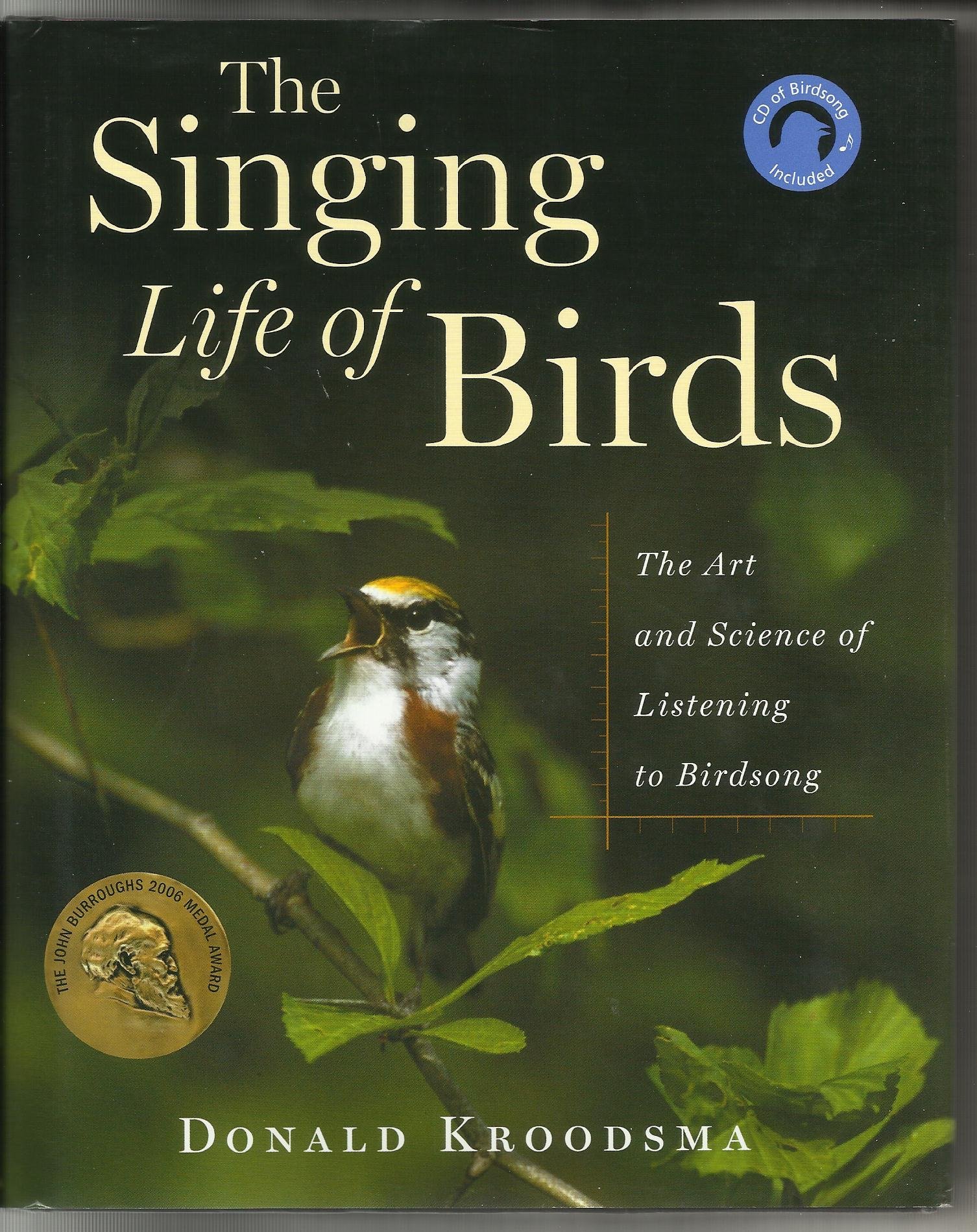
The Singing Life Of Birds: The Art And Science Of Listening To Birdsong
$31.15
| Brand | Donald Kroodsma |
| Merchant | Amazon |
| Category | Books |
| Availability | In Stock Scarce |
| SKU | 0618405682 |
| Age Group | ADULT |
| Condition | NEW |
| Gender | UNISEX |
| Google Product Category | Media > Books |
| Product Type | Books > Subjects > Science & Math > Nature & Ecology > Birdwatching |
About this item
The Singing Life Of Birds: The Art And Science Of Listening To Birdsong
Listen to birds sing as youve never listened before, as the world-renowned birdsong expert Donald Kroodsma takes you on personal journeys of discovery and intrigue. Read stories of wrens and robins, thrushes and thrashers, warblers and whip-poor-wills, bluebirds and cardinals, and many more bird. Learn how each acquires its songs, how songs vary from bird to bird and place to place, how some birds' singing is especially beautiful or ceaseless or complex, how some do not sing at all, how the often quiet female has the last word, and why. Hear a baby wren and the authors own daughter babble as each learns its local dialect. Listen to the mockingbird by night and by day and count how many different songs he can sing. Marvel at the exquisite harmony in the duet of a wood thrush as he uses his two voice boxes to accompany himself. Feel the extraordinary energy in the songs just before sunrise as dawns first light sweeps across this singing planet. Hear firsthand the unmistakable evidence that there are not one but two species of marsh wrens and two species of winter wrens in North America. Learn not only to hear but to see birds sing in the form of sonagrams, as these visual images dance across the pages while you listen to the accompanying CD. Using your trained ears and eyes, you can begin your own journeys of discovery. Listen anew to birds in your backyard and beyond, exploring the singing minds of birds as they tell all that they know. Join Kroodsma not only in identifying but in identifying with singing birds, connecting with natures musicians in a whole new way. Just as the colors and patterns of the feathers that birds wear show tremendous variation, so, too, do the songs that they broadcast--but much more so. Songs may be absent, or they may range from a few simple genetically encoded notes endlessly repeated, to virtuosos of variety resulting from copying and learning, and even to seemingly endless improvisation. In The Singing Life of Birds, Donald E. Kroodsma, an emeritus professor of biology at the University of Massachusetts Amherst, celebrates the diversity through carefully chosen examples, one for each of the 30 years that he has studied birdsong. The book is best described by its subtitle, The Art and Science of Listening to Birdsong. Kroodsma shares his secrets--solid, practical advice on how to record bird sounds and how to "see" the sounds in sonagrams, visual representations of the recordings of songs. A compact disc that accompanies the text aids readers in this task. He concludes: "There's no longer any mystique to what I have done all these years. Anyone can do this kind of stuff. And anyone should." His infatuation started with a single male Bewick's wren in his backyard in Oregon. Kroodsma discovered that this one wren sang 16 different songs, and in any singing bout it poured forth 40 to 50 renditions of one of them before switching to another, and then to another, and on and on. Meanwhile neighboring wrens hearing the song replied with the same one, while distant males sang other songs. Why? The proximal answers to why birds sing and what they sing run from the trivial to the fascinating: they enjoy it, they are primed by hormones that activate neuronal pathways, they respond to neighbors. But the ultimate, evolutionary question of why they sing and what they sing can be answered only by the comparative study of many species. Sometimes the anomalies provide a clue. For example, most individual wrens of different species learn many songs, and neighboring birds have similar songs--that is, they have dialects. The sedge wren of North America is an exception, however. Unlike other wrens and the sedge wrens of Central and South America, it has lost the ability to learn songs; it can only improvise on songs that are inscribed on its DNA. It is therefore unable to "match" the songs of its neighbors, and no dialects are found. So what is different about the North American sedge wrens in respect to other wrens? They are nomads that live in unpredictable habitat--meadows that can quickly dry up. As a consequence, these birds can never predict who their neighbors will be from one season to the next; hence, learning songs as youngsters for later use in song matching is pointless. Contrast this to the bellbird, a long-lived tropical bird in which individuals come to know one another well. These birds listen to one another all year long and learn the changes in others' songs throughout life. The young birds learn the latest of these variations, and the dialect of the population changes from year to year. Kroodsma takes us repeatedly into the field, into the birds' world. He shares an all-night vigil with a whip-poor-will, tallying 20,898 identical repetitions of its one song for the entire night. He describes a brown thrasher that in one two-hour session sang 4,654 songs, 1,800 of them different (many borrowed from neighbors of other species). We enter the mind of the researcher as he tries
| Brand | Donald Kroodsma |
| Merchant | Amazon |
| Category | Books |
| Availability | In Stock Scarce |
| SKU | 0618405682 |
| Age Group | ADULT |
| Condition | NEW |
| Gender | UNISEX |
| Google Product Category | Media > Books |
| Product Type | Books > Subjects > Science & Math > Nature & Ecology > Birdwatching |
Similar Products









Compare with similar items

WOODY HARRELSON: The Man Who Wouldn’t Pl... |

Graphic Image Golf Courses Coffee Table ... |

Horse Meets Dog: A Clever Comedy About A... |

The Environmental Compliance Handbook... |
|
|---|---|---|---|---|
| Price | $12.99 | $118.00 | $11.38 | $24.99 |
| Brand | Mollie Moran | Graphic Image | Elliott Kalan | Corey R Bailey |
| Merchant | Amazon | bedbathbeyond | Amazon | Amazon |
| Availability | In Stock | In Stock | In Stock | In Stock |