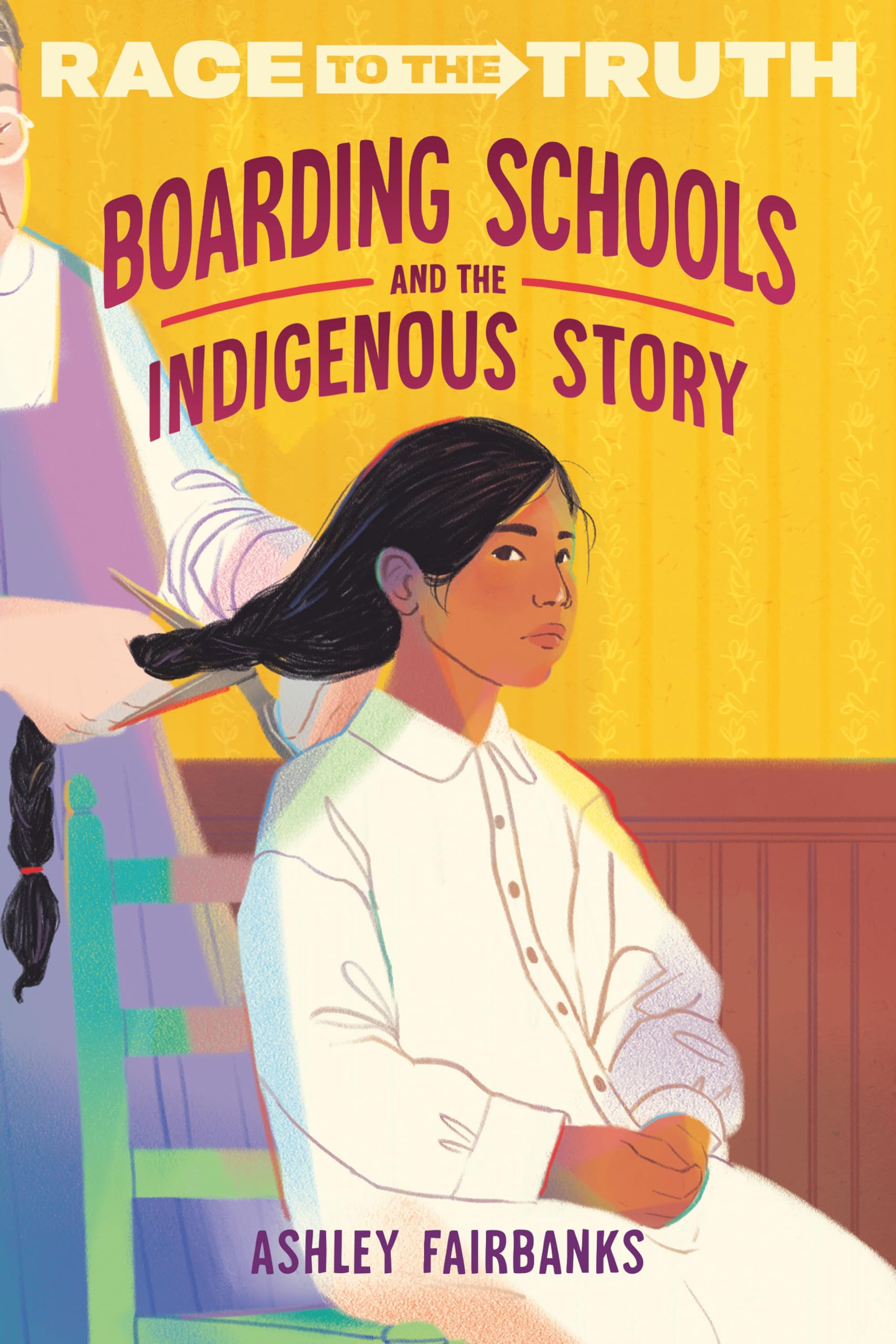
Boarding Schools and the Indigenous Story (Race to the Truth)
$12.99
| Brand | Ashley Fairbanks |
| Merchant | Amazon |
| Category | Books |
| Availability | Preorder |
| SKU | 0593811402 |
| Color | Multicolor |
| Age Group | ADULT |
| Condition | NEW |
| Gender | UNISEX |
| Google Product Category | Media > Books |
| Product Type | Books > Subjects > Children's Books > History > United States > 1900s |
About this item
Boarding Schools and the Indigenous Story (Race to the Truth)
Created in collaboration with Race2Dinner, here's the harrowing true story of America's history with boarding schools, and the forced assimilation of Indigenous kids and families. Education is a powerful tool, one that allows us to better understand the world around us. But these same tools can also be used to mislead people, and to exert control with ulterior motives. For nearly 100 years, the U.S. Government used boarding schools to remove Indigenous kids from their families and erase their traditions—to attempt to replace their culture with white, European cultures. Children were often taking by force, and were punished for speaking their native languages. The practice was not discontinued until the 1940s, and survivors of these schools have been speaking out about their experience for decades. This painful history and the resilience of Indigenous communities who persist despite this widespread attempt at their erasure show us what the U.S. Government was willing to do to gain total power, and only by learning the true history of boarding schools can we truly understand the history of our country. Ashley Fairbanks is an Anishinaabe artist, writer, organizer, and digital strategist. She has her own design practice, trains people on anti-racist work, does strategic communications and design, and runs social media and narrative work for campaigns and nonprofits. She is also the author of This Land , which People.com called "an adorable primer on the history of the land." Chapter 1 Life Before Colonization Up until very recently, and still today in some places, students have been taught that Christopher Columbus, an explorer from Italy, “discovered” America. This is not true. While Columbus was the first European to arrive in the Caribbean, Indigenous people had already been here since time immemorial, or before anyone remembers. According to the creation stories of many Indigenous people, from Alaska to Chile, they have always been here. At places like Cactus Hill in Virginia or Huaca Prieta in Peru, there is evidence of settlement that goes back fifteen thousand to twenty thousand years. Indigenous people have been in the Americas for a very, very long time. Still, despite the evidence, and the vibrant and rich oral histories from many tribes, a lot of people don’t really think about the story of America as starting before Columbus. This isn’t an accident. It can be hard to accept the scale of the destruction during the initial colonization of the Americas, so many of us are never taught the real history of what happened to Indigenous people. Prior to the arrival of European colonizers, America wasn’t just an empty land waiting to be stumbled upon. The land we now know as the United States was inhabited by hundreds of tribes of Indigenous peoples. These distinct tribes and nations boasted a diverse array of cultures, languages, traditions, and ways of life. It would take a lot of paper to tell you what all their lives were like before colonization began. So, in this chapter, I’ll briefly tell you about some of the shared culture, values, and history of many Indigenous people. But as you read, it’s important to remember that all tribes are different. While this is a chapter about life before colonization, much of it is still true today. Many very, very terrible things have been done to Indigenous people, but we have survived. While we have faced unimaginable losses, our cultures, languages, and the ways that we see the world persist. We are still here. It Starts with the Land Almost all Indigenous cultures, both long ago and today, have a strong connection to our homelands—the lands that we come from and have lived on. From generation to generation, Indigenous elders have passed on important knowledge of the world around us, knowledge that has been shaped by generations of living on the land and interacting with the animals that live on it as well. Indigenous people across the continent skillfully utilized the resources offered by their different environments for food, shelter, tools, and clothing. Tribes relied on hunting, trapping, and fishing, and used various techniques to harvest an assortment of fruits, nuts, and plants. Many tribes also migrated seasonally, following animals and food where they were abundant at different times of year. Their deep understanding of the land and its offerings, combined with worldviews that often promoted respect of the interconnectedness of all creatures, allowed tribes to thrive. Indigenous people in the Americas were able to maintain a sustainable way of life for tens of thousands of years before Europeans arrived. Many tribes across the Americas practiced agriculture, growing crops such as local varieties of corn, beans, and squash. For the tribes that farmed, growing food was vital to their survival and allowed for the development of more-permanent settlements. While many of these agricultural practices were nearly lost in the face of land theft
| Brand | Ashley Fairbanks |
| Merchant | Amazon |
| Category | Books |
| Availability | Preorder |
| SKU | 0593811402 |
| Color | Multicolor |
| Age Group | ADULT |
| Condition | NEW |
| Gender | UNISEX |
| Google Product Category | Media > Books |
| Product Type | Books > Subjects > Children's Books > History > United States > 1900s |
Similar Products




Compare with similar items
Never Call Me a Hero: A Legendary Americ... |
Dot Markers Activity Book Numbers and Sh... |

A Mighty Fortress: A New History of the ... |

A Moving Account of the Struggles and Ac... |
|
|---|---|---|---|---|
| Price | $14.39 | $6.91 | $11.69 | $11.62 |
| Brand | N. Jack "Dusty" Kleiss | Wutigerr | Steven Ozment | Mike Rose |
| Merchant | Amazon | Amazon | Amazon | Amazon |
| Availability | Available Date | In Stock | In Stock Scarce | In Stock |