
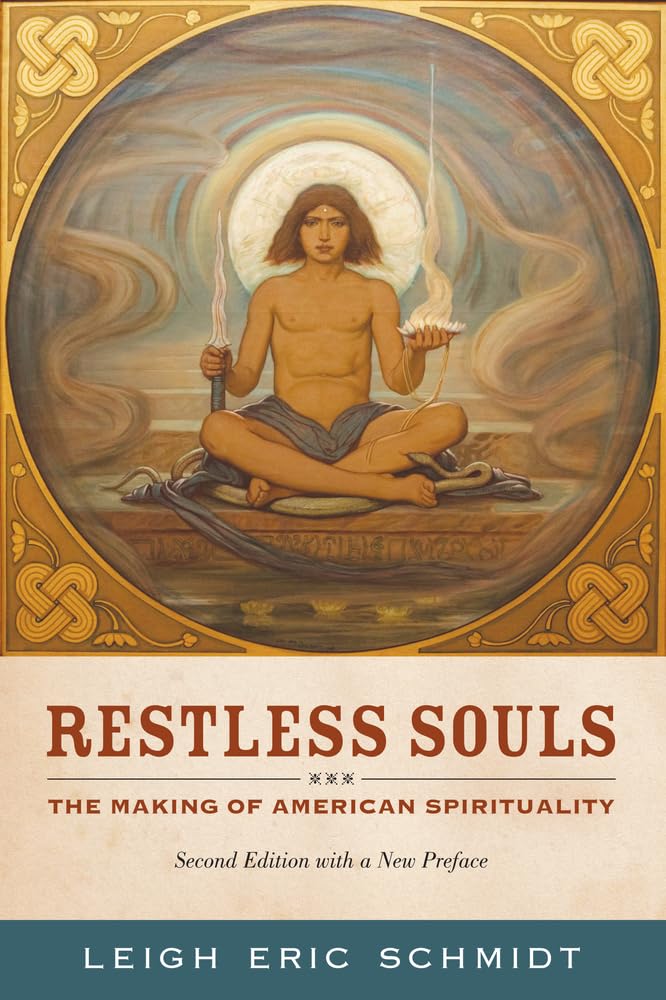
Restless Souls: The Making of American Spirituality
$29.43
| Brand | Leigh Eric Schmidt |
| Merchant | Amazon |
| Category | Books |
| Availability | In Stock |
| SKU | 0520273672 |
| Age Group | ADULT |
| Condition | NEW |
| Gender | UNISEX |
About this item
Restless Souls: The Making of American Spirituality
Yoga classes and Zen meditation, New-Age retreats and nature mysticism―all are part of an ongoing religious experimentation that has surprisingly deep roots in American history. Tracing out the country’s Transcendentalist and cosmopolitan religious impulses over the last two centuries, Restless Souls explores America’s abiding romance with spirituality as religion’s better half. Now in its second edition, including a new preface, Leigh Eric Schmidt's fascinating book provides a rich account of how this open-road spirituality developed in American culture in the first place as well as a sweeping survey of the liberal religious movements that touted it and ensured its continued vitality. Leigh Eric Schmidt is Edward C. Mallinckrodt University Professor at Washington University in St. Louis. He is the author of numerous books, including Heaven’s Bride: The Unprintable Life of Ida C. Craddock, American Mystic, Scholar, Sexologist, Martyr, and Madwoman , Hearing Things: Religion, Illusion, and the American Enlightenment , and Consumer Rites: The Buying and Selling of American Holidays . Restless Souls The Making of American Spirituality By Leigh Eric Schmidt UNIVERSITY OF CALIFORNIA PRESS Copyright © 2012 Leigh Eric Schmidt All rights reserved. ISBN: 978-0-520-27367-2 Contents Preface to the Second Edition, xi, INTRODUCTION Spirituality in the Making, 1, CHAPTER ONE Mystic Club, 25, CHAPTER TWO Solitude, 63, CHAPTER THREE The Piety of the World, 101, CHAPTER FOUR Meditation for Americans, 143, CHAPTER FIVE Freedom and Self-Surrender, 181, CHAPTER SIX Seekers, 227, EPILOGUE Be Gentle with Yourself, 269, Notes, 291, Index, 323, CHAPTER 1 MYSTIC CLUB A ONE-TIME SPY FOR THE DANISH military, Carl H. A. Bjerregaard (1845–1922) hastily left Denmark in 1873, a twenty-eight-year-old lieutenant absent without leave, and headed for New York. In the United States Bjerregaard started a new life, first as a factory worker in New Jersey, and then through employment at the Astor Library (soon to form the core of the New York Public Library). In Denmark he had briefly helped curate a natural history museum, so his joining the library staff in 1879 to classify books and recatalog them was not wholly out of character. Soon his military service faded into the past; he spent the rest of his career with the New York Public, eventually heading up the main reading room. That was only his day job, though. In his spare time, with all the library's resources at his fingertips, Bjerregaard fashioned himself into a philosopher, artist, and mystic. By the 1890s, he was lecturing widely on mysticism, nature worship, and kindred topics. "I address you as Pilgrims of the Infinite," Bjerregaard told an audience in Chicago in 1896, "for you are pilgrims; I can see that on your faces. You are not pilgrims either from or to the Infinite, but you are of the Infinite. From and to indicate space and time relations, but in the Infinite we recognize neither time nor space; there is no to-day and to-morrow; no here and no there. Eternity is no farther off from the Mystic, than the moment in which he speaks. You are Pilgrims OF the Infinite." Bjerregaard's summons to explore the "Mystic Life" was heady stuff. It was, among other things, an affirmation of the supreme freedom of spiritual aspirants to seek the truth for themselves and within themselves. The call seemed to resound everywhere: Bible passages, Taoist sayings, pine trees and cones, Jewish Kabbalah, Zoroastrian fire imagery, yoga, Sufi poetry, American Transcendentalism, and the Christian mythology of the Holy Grail. Bjerregaard's spirituality, like the faith of Ralph Waldo Emerson (1803–1882), was especially in synchrony with the American lecture circuit. Bjerregaard's favorite place to speak was Greenacre, the summer community that the visionary Sarah Farmer (1847–1916) founded in Eliot, Maine, in 1894. He saw Farmer's experiment as a realization of his ideas about a universal mysticism and was lavish in his praise of its design. When he gave personal examples of his own exalted experiences, they almost always circled back to Greenacre, whether to a sunrise worship service led by the Zoroastrian Jehanghier Cola or to barefoot walks on the dew-drenched grass. "Greenacre is a revelation," Bjerregaard remarked. "When you rise from the cool waves of the Piscataqua [River], you rise out of the quiet place of your own soul." As a lecturer, Bjerregaard believed in presentations that were personal and experiential; like Emerson, he did not want to offer secondhand news or disinterested scholarship. Make lecturers, he said, "give their own experiences and not something they have read in books and only poorly digested.... In soul life no abstract teachings are worth much." His time at Greenacre in the 1890s provided him with that firsthand material. Of one glistening experience there in 1896, Bjerregaard was especially jubilant: The first even
| Brand | Leigh Eric Schmidt |
| Merchant | Amazon |
| Category | Books |
| Availability | In Stock |
| SKU | 0520273672 |
| Age Group | ADULT |
| Condition | NEW |
| Gender | UNISEX |
Similar Products










Compare with similar items

Fashion Week: A wonderful fashion sketch... |

DIY Magic Watercolor Painting Book For K... |

100 Amazing Facts about Pirates: Discove... |

Matty The Batty in "Stormy Weather"... |
|
|---|---|---|---|---|
| Price | $5.95 | $17.97 | $12.90 | $8.99 |
| Brand | Fash avenue prod | DynamicDeals | Marc Dresgui | Rick McDuffy |
| Merchant | Amazon | Inspire Uplift | Amazon | Amazon |
| Availability | In Stock | In Stock | In Stock | In Stock |