
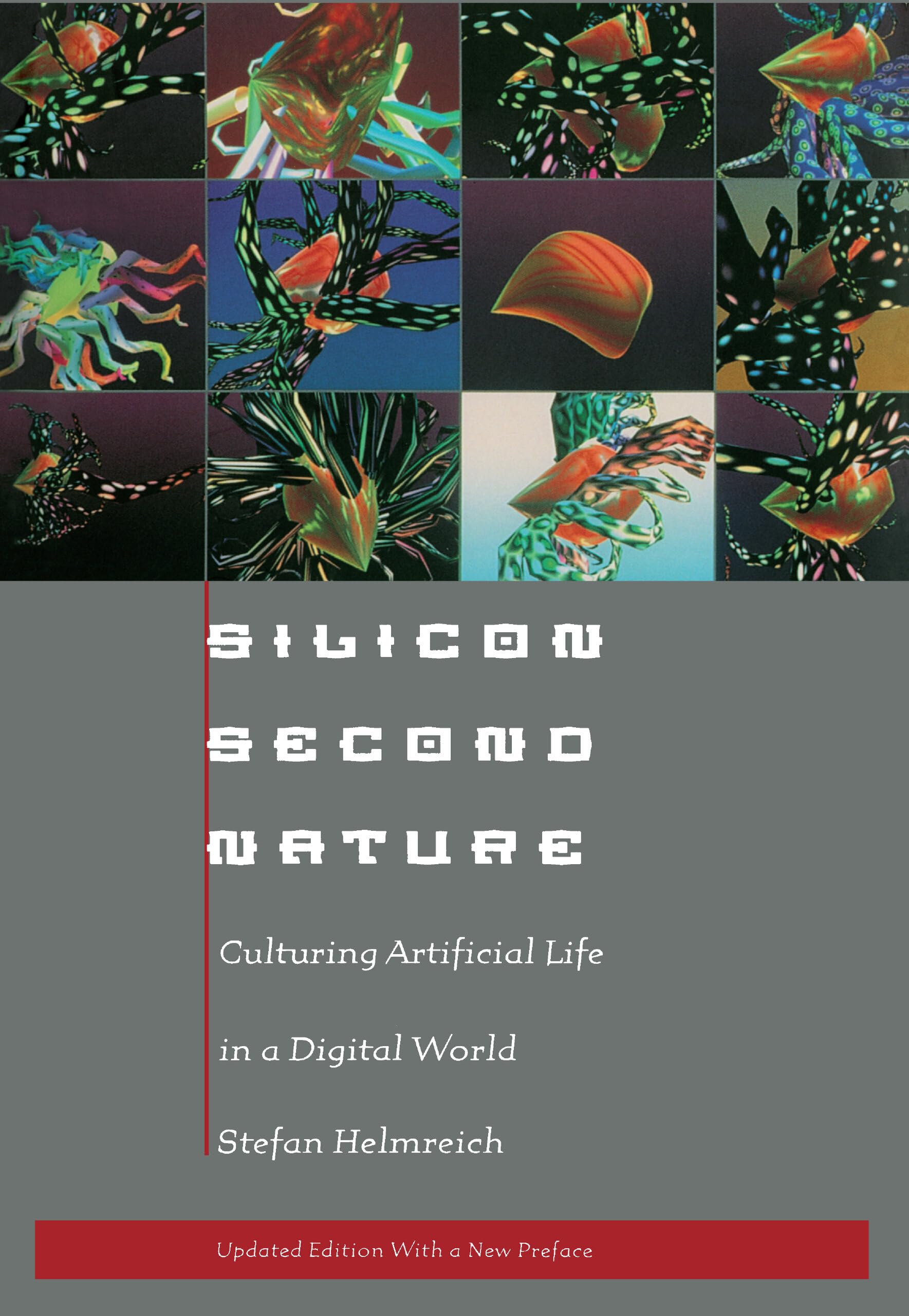
Silicon Second Nature: Culturing Artificial Life in a Digital World, Updated With a New Preface
$31.95
| Brand | Stefan Helmreich |
| Merchant | Amazon |
| Category | Books |
| Availability | In Stock |
| SKU | 0520208005 |
| Color | Multicolor |
| Age Group | ADULT |
| Condition | NEW |
| Gender | UNISEX |
| Google Product Category | Media > Books |
| Product Type | Books > Subjects > Computers & Technology > Computer Science > AI & Machine Learning > Intelligence & Semantics |
About this item
Silicon Second Nature: Culturing Artificial Life in a Digital World, Updated With a New Preface
Silicon Second Nature takes us on an expedition into an extraordinary world where nature is made of bits and bytes and life is born from sequences of zeroes and ones. Artificial Life is the brainchild of scientists who view self-replicating computer programs―such as computer viruses―as new forms of life. Anthropologist Stefan Helmreich's look at the social and simulated worlds of Artificial Life―primarily at the Santa Fe Institute, a well-known center for studies in the sciences of complexity―introduces readers to the people and programs connected with this unusual hybrid of computer science and biology. When biology becomes an information science, when DNA is downloaded into virtual reality, new ways of imagining "life" become possible. Through detailed dissections of the artifacts of Artifical Life, Helmreich explores how these novel visions of life are recombining with the most traditional tales told by Western culture. Because Artificial Life scientists tend to see themselves as masculine gods of their cyberspace creations, as digital Darwins exploring frontiers filled with primitive creatures, their programs reflect prevalent representations of gender, kinship, and race, and repeat origin stories most familiar from mythical and religious narratives. But Artificial Life does not, Helmreich says, simply reproduce old stories in new software. Much like contemporary activities of cloning, cryonics, and transgenics, the practice of simulating and synthesizing life in silico challenges and multiplies the very definition of vitality. Are these models, as some would claim, actually another form of the real thing? Silicon Second Nature takes Artifical Life as a symptom and source of our mutating visions of life itself. "Helmreich's study is a startling, cutting-edge look at the emerging field of Artificial Life (an offshoot of Artificial Intelligence), many of whose practitioners believe that the self-replicating computer programs they create are not mere representations of life but actual life-forms.... His sophisticated inquiry challenges the underpinnings -- philosophical, scientific, financial, political -- of the Artificial Life enterprise". Publishers Weekly "Helmreich's analysis extensive, imaginative, rigorous, and insightful promises to establish him as the cultural authority on A-Life. . . . He shows that, in the age of complexity, science simultaneously disenchants and re-enchants the world. . . . The book is written in a personal and engaging style . . . so full of ideas and interesting asides [that] Helmreich takes on the persona of a smart and well-informed tour guide of the A-Life world [with] an enviable ability to take very complex ideas and discuss them comprehensibly without simplifying them." Hugh Gusterson, author of Nuclear Rites "Helmreich's analysis―extensive, imaginative, rigorous, and insightful―promises to establish him as the cultural authority on A-Life. . . . He shows that, in the age of complexity, science simultaneously disenchants and re-enchants the world. . . . The book is written in a personal and engaging style . . . so full of ideas and interesting asides [that] Helmreich takes on the persona of a smart and well-informed tour guide of the A-Life world [with] an enviable ability to take very complex ideas and discuss them comprehensibly without simplifying them."―Hugh Gusterson, author of Nuclear Rites Stefan Helmreich is Assistant Professor of Science and Society at New York University. Silicon Second Nature Culturing Artificial Life in a Digital World By Stefan Helmreich University of California Press Copyright © 2000 Stefan Helmreich All right reserved. ISBN: 9780520208001 Chapter One Computing is still very much a frontier science. GREGORY J. E. RAWLINS, Slaves of the Machine Simulation in Santa Fe SANTA FE IS a small city in northern New Mexico, and it unfolds atthe base of the Sangre de Cristo mountains. A pedestrian-friendly knotof buildings sits in the downtown area, and most of the rather dispersedcity fans out from there. During the time of my fieldwork, the Santa FeInstitute (SFI) rested three miles out of the center of town. Each day Itook the Santa Fe Trails city bus to a nearby hospital. From there, Itraipsed across the low desert brush between office buildings of lawyers,doctors, and insurance companies to arrive at the unassuming fauxadobe complex in which the Institute was housed. The Institute was theanchor point for my study of Artificial Life, the site from which I beganmy voyages into worlds social and virtual. Traditional ethnographies often open with a description of the surroundingsin which subjects live. This device has the purpose of groundingthe ethnography, showing how peoples' lifeways are constrained andenabled by their environment. I mean to use this device self-consciously,to locate people who sometimes feel they belong to an aterritorial?evenacultural?community. In what follows, I describe
| Brand | Stefan Helmreich |
| Merchant | Amazon |
| Category | Books |
| Availability | In Stock |
| SKU | 0520208005 |
| Color | Multicolor |
| Age Group | ADULT |
| Condition | NEW |
| Gender | UNISEX |
| Google Product Category | Media > Books |
| Product Type | Books > Subjects > Computers & Technology > Computer Science > AI & Machine Learning > Intelligence & Semantics |
Similar Products









Compare with similar items

Learning to Live in the World: Earth Poe... |

A Colonial Gingerbread Boy... |

Blue Skies Blue Skies... |

The Garden of Secrets (Dean Steele Myste... |
|
|---|---|---|---|---|
| Price | $26.23 | $11.00 | $19.09 | $13.99 |
| Brand | William Stafford | Carol Young | Robyn Carr | A.J. Rivers |
| Merchant | Amazon | Amazon | Amazon | Amazon |
| Availability | Available Date | In Stock | In Stock | In Stock |