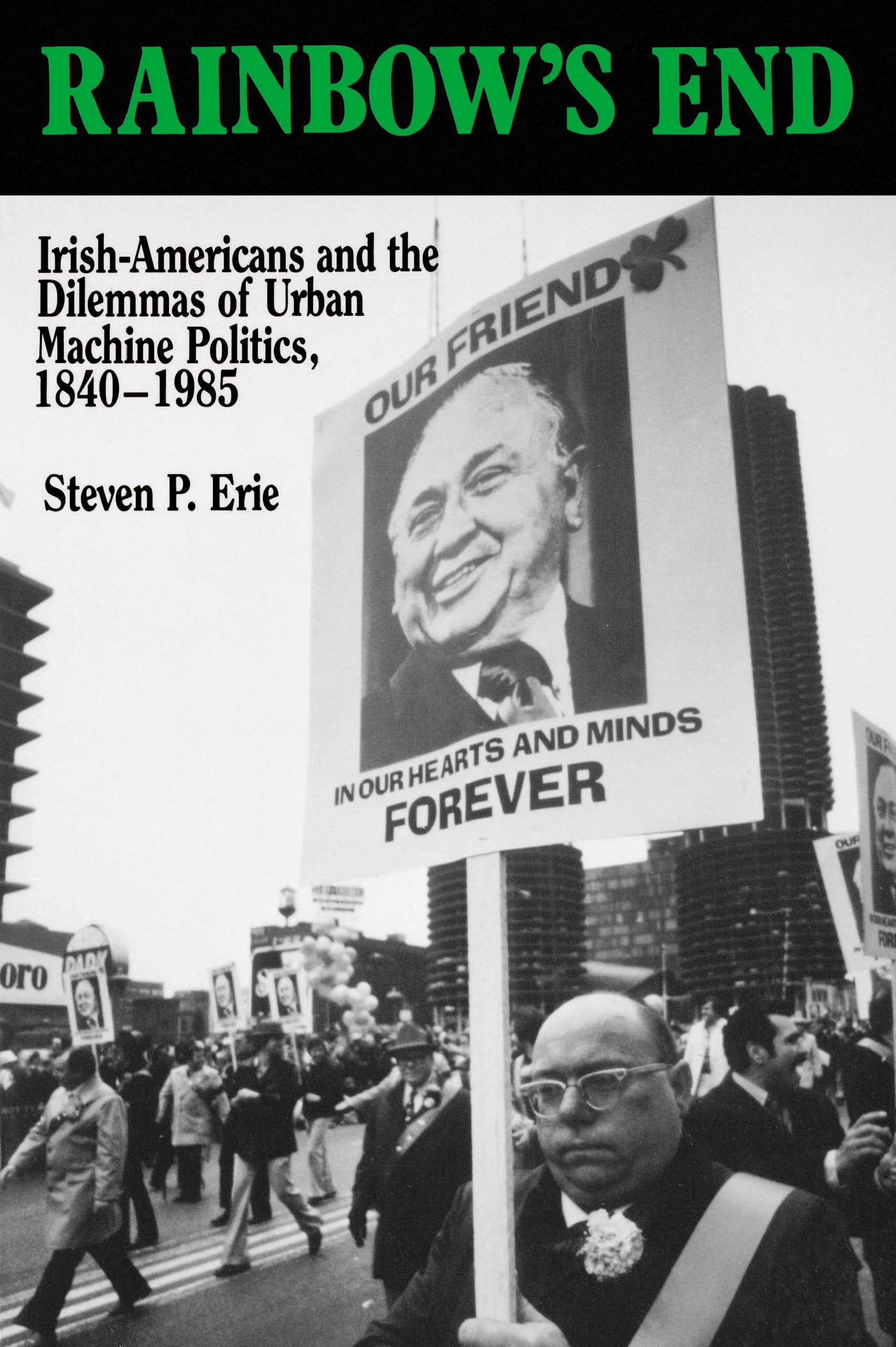
Rainbow's End: Irish-Americans and the Dilemmas of Urban Machine Politics, 1840-1985 (California Series on Social Choice and Political Economy) (
$23.44
| Brand | Steven P. P. Erie |
| Merchant | Amazon |
| Category | Books |
| Availability | In Stock Scarce |
| SKU | 0520071832 |
| Age Group | ADULT |
| Condition | NEW |
| Gender | UNISEX |
| Google Product Category | Media > Books |
| Product Type | Books > Subjects > History > Americas > United States > State & Local |
About this item
Rainbow's End: Irish-Americans and the Dilemmas of Urban Machine Politics, 1840-1985 (California Series on Social Choice and Political Economy) (
Unprecedented in its scope, Rainbow's End provides a bold new analysis of the emergence, growth, and decline of six classic Irish-American political machines in New York, Jersey City, Chicago, San Francisco, Pittsburgh and Albany. Combining the approaches of political economy and historical sociology, Erie examines a wide range of issues, including the relationship between city and state politics, the manner in which machines shaped ethnic and working-class politics, and the reasons why centralized party organizations failed to emerge in Boston and Philadelphia despite their large Irish populations. The book ends with a thorough discussion of the significance of machine politics for today's urban minorities. "...a provocative reinterpretation of the rise and fall of the Irish bosses. . . there is [a] great deal to chew on in Mr. Erie's iconoclastic book. One after the other, he challenges views of the old machines that sentimentality has erected into verities." ― New York Times "Theoretically, historically and comparatively Rainbow's End is a significant and provocative contribution to this double process. Future books will surely depend on it as they draw on political economy and urban sociology to explain the machine and its opponents." ― American Journal of Sociology "This book should be read and used by those who teach courses with sections on machine politics in the United States. . . . Erie draws on a broad literature and effectively challenges some going interpretations of machines." ― American Political Science Review "... Rainbow's End provides a handy and comprehensible review of the literature on the life cycle of urban machines. By exploring the varying historical contexts of machine activity, Erie's study also modifies the conventional wisdom which suggests that the machine experience offers a feasible option for minorities interested in transforming the nature of political representation in many American cities." ― Pennsylvania History Steven P. Erie is Professor Emeritus of Political Science at the University of California, San Diego. Rainbow's End: Irish-Americans and the Dilemmas of Urban Machine Politics, 1840-1985 By Steven P. Erie University of California Press Copyright 1990 Steven P. Erie All right reserved. ISBN: 0520071832 Chapter One The Irish and the Big-City Machines Rainbow's End is a study of Irish-American machine politics from the mid-nineteenth century to the present in eight once heavily Irish cities: New York, Philadelphia, Chicago, Boston, San Francisco, Pittsburgh, Jersey City, and Albany. Daniel Patrick Moynihan has observed that the Irish-American genius has been organizational rather than entrepreneurial or intellectual.1 Displaying a "distaste for commerce" and ideas, the Irish labored to build the American Catholic church and the big-city Democratic machines. Arguably the largest section in the pantheon of Irish-American heroes is reserved for the big-city party bosses, from Tammany Hall's "Honest John" Kelly in the 1870s to Chicago's Richard Daley in the 1970s. Notwithstanding the demise of the old-time big-city machines, Irish-American politicos are still larger-than-life figures. The departed Celtic party bosses continue to cast a long shadow over contemporary urban minority groups, particularly blacks and Hispanics, who search for routes of group economic advancement. The Irish are reputed to have used a political route to travel from rags to riches, capturing the patronage-laden machines and turning public employment into an Irish preserve. Before today's ethnic groups emulate the Irish, however, they would do well to carefully examine the Irish experience with the big-city machines, separating historical fact from fiction. This study attempts such a task. The machine emerged as the major urban political institution in the late nineteenth century; the Irish were among its leading architects and practitioners. A form of clientele politics, the party machine organized the electorate in order to control the tangible benefits of public officepatronage, services, contracts, and franchises. The machine employed these resources to maintain power. Bosses purchased voter support with offers of public jobs and services rather than by appeals to traditional loyalties or to class interests. With roots in the second or Jacksonian party system of the 1820s and 1830s, the full-fledged or mature urban machine did not emerge until the third party system entered an advanced stage in the 1870s and 1880s. By 1890 centralized machines controlled one-half of the nation's twenty largest cities. Tammany Hall finally had consolidated its hold over Manhattan. Hugh McLaughlin's Democratic organization ruled neighboring Brooklyn. In Philadelphia, the McManes's Republican machine, which had governed the
| Brand | Steven P. P. Erie |
| Merchant | Amazon |
| Category | Books |
| Availability | In Stock Scarce |
| SKU | 0520071832 |
| Age Group | ADULT |
| Condition | NEW |
| Gender | UNISEX |
| Google Product Category | Media > Books |
| Product Type | Books > Subjects > History > Americas > United States > State & Local |
Similar Products






Compare with similar items
Basket Case!: A Coloring Book for Crazy ... |

Stardust Pals. A Magical Coloring Book... |

Lo que dijo la elefanta (Spanish Edition... |

My Korean Dic: Learn Korean Alongside it... |
|
|---|---|---|---|---|
| Price | $5.95 | $5.99 | $15.00 | $24.70 |
| Brand | John Stephan | Zara Lark | Constanza Bade | Leonardo Kim |
| Merchant | Amazon | Amazon | Amazon | Amazon |
| Availability | In Stock | In Stock | In Stock | In Stock |