
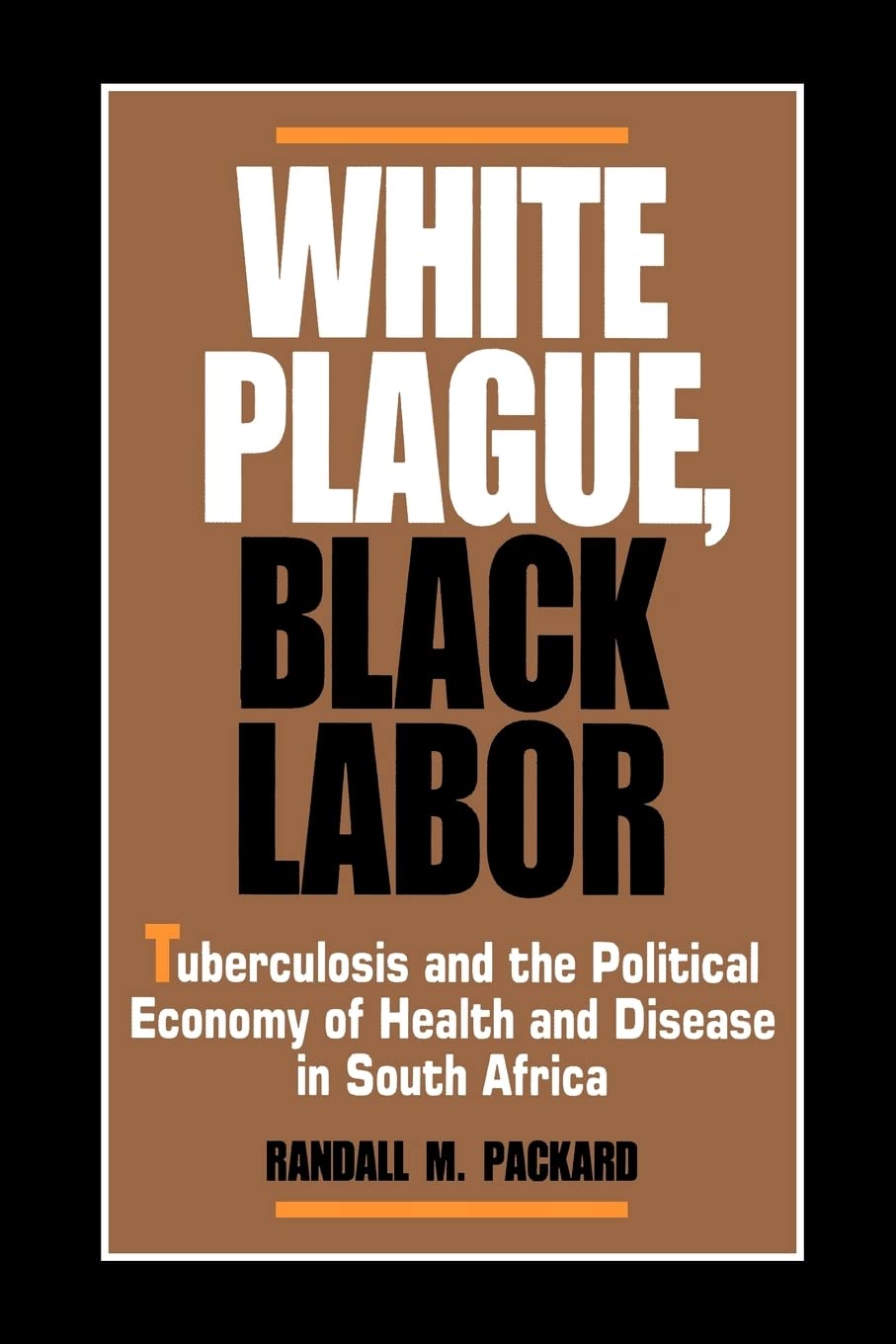
White Plague, Black Labor: Tuberculosis and the Political Economy of Health and Disease in South Africa (Comparative Studies of Health Systems and
$33.95
| Brand | Randall M. M. Packard |
| Merchant | Amazon |
| Category | Books |
| Availability | In Stock |
| SKU | 0520065751 |
| Color | Brown |
| Age Group | ADULT |
| Condition | NEW |
| Gender | UNISEX |
| Google Product Category | Media > Books |
| Product Type | Books > Subjects > Medical Books > Medicine > Internal Medicine > Epidemiology |
About this item
White Plague, Black Labor: Tuberculosis and the Political Economy of Health and Disease in South Africa (Comparative Studies of Health Systems and
Why does tuberculosis, a disease which is both curable and preventable, continue to produce over 50,000 new cases a year in South Africa, primarily among blacks? In answering this question Randall Packard traces the history of one of the most devastating diseases in twentieth-century Africa, against the background of the changing political and economic forces that have shaped South African society from the end of the nineteenth century to the present. These forces have generated a growing backlog of disease among black workers and their families and at the same time have prevented the development of effective public health measures for controlling it. Packard's rich and nuanced analysis is a significant contribution to the growing body of literature on South Africa's social history as well as to the history of medicine and the political economy of health. "After reading this book, no one should fail to see tuberculosis in South Africa in the light of social policies and interests which have prevented its control. In turn, it shows tuberculosis to be one measure of the cost in suffering of the emergence of a modern capitalist society in South Africa."Rodney Ehrlich, Mount Sinai Medical Center, New York "At almost every point, the author has something fresh to say about previous analyses of the origins, nature and spread of the disease. His subtle exposition of the ideological interpretations of the medical professionfrom their adherence to a 'virgin soil' theory to more recent notions of relating to the social and biological aetiology of the diseaseis particularly original and thought-provoking. . . . Well researched, effectively organised, and wholly readable."Shula Marks, Institute of Commonwealth Studies, University of London "After reading this book, no one should fail to see tuberculosis in South Africa in the light of social policies and interests which have prevented its control. In turn, it shows tuberculosis to be one measure of the cost in suffering of the emergence of a modern capitalist society in South Africa."―Rodney Ehrlich, Mount Sinai Medical Center, New York "At almost every point, the author has something fresh to say about previous analyses of the origins, nature and spread of the disease. His subtle exposition of the ideological interpretations of the medical profession―from their adherence to a 'virgin soil' theory to more recent notions of relating to the social and biological aetiology of the disease―is particularly original and thought-provoking. . . . Well researched, effectively organised, and wholly readable."―Shula Marks, Institute of Commonwealth Studies, University of London Randall M. Packard is Asa G. Chandler Professor and Chair of the History Department at Emory College. He is the author of Chiefship and Cosmology. White Plague, Black Labor Tuberculosis and the Political Economy of Health and Disease in South Africa By Randall M. Packard University of California Press Copyright © 1989 Randall M. Packard All right reserved. ISBN: 9780520065758 Introduction: Industrialization and the Political Economy of Tuberculosis Tuberculosis was the number one cause of death in Europe and America from the late eighteenth to the early twentieth century.1 Although the disease was by no means unknown before this time, its impact on human populations increased tremendously during the early years of the industrial revolution. The rise of industrial development and the growth of cities in both Europe and America produced ideal conditions for the spread of the disease. The men and women who flocked from rural communities to find employment in the factories and mills of Manchester and Birmingham, Lowell and Fall River had little prior contact with tuberculosis and as a group possessed limited resistance to it. To this inherent disability was added the physical insults of industrial life. Long hours, intolerable working conditions, atmospheric pollution, overcrowded living quarters, the absence of sanitation, and inadequate diets composed largely of bread, cheap tea, and "drippings," marked the daily lives of the newly industrialized workforce. These conditions undermined the ability of workers and their families to resist TB and facilitated the rapid dissemination of infection among them. Though the disease recognized no class lines, attacking some of the most gifted intellectuals and artistic talents of the day including Keats, Shelley, Emily and Charlotte Bronte, and Chopin, it clearly took its heaviest toll among the laboring classes. The spread of the disease was so great and hope of recovery so small that tuberculosis became known as the "great white plague," an allusion to both theblack plague of earlier centuries and the characteristic pallor of victims of the disease. As industrialization spread from its early centers in Europe and America, so too the white plague found new populations to attack. The correlation between early industrialization and tubercu
| Brand | Randall M. M. Packard |
| Merchant | Amazon |
| Category | Books |
| Availability | In Stock |
| SKU | 0520065751 |
| Color | Brown |
| Age Group | ADULT |
| Condition | NEW |
| Gender | UNISEX |
| Google Product Category | Media > Books |
| Product Type | Books > Subjects > Medical Books > Medicine > Internal Medicine > Epidemiology |
Similar Products










Compare with similar items

Pox (The Alt Apocalypse)... |

Ozzy Osbourne Biography: The Story of Su... |

2025 Codeword Puzzle Book For Adults: La... |

Bartending for Beginners: Mastering the ... |
|
|---|---|---|---|---|
| Price | $13.24 | $14.99 | $8.99 | $9.99 |
| Brand | Tom Abrahams | Mauricio Guevara | PuzzleHouse Media Press | Finlay Parker |
| Merchant | Amazon | Amazon | Amazon | Amazon |
| Availability | In Stock | In Stock | In Stock | In Stock |