
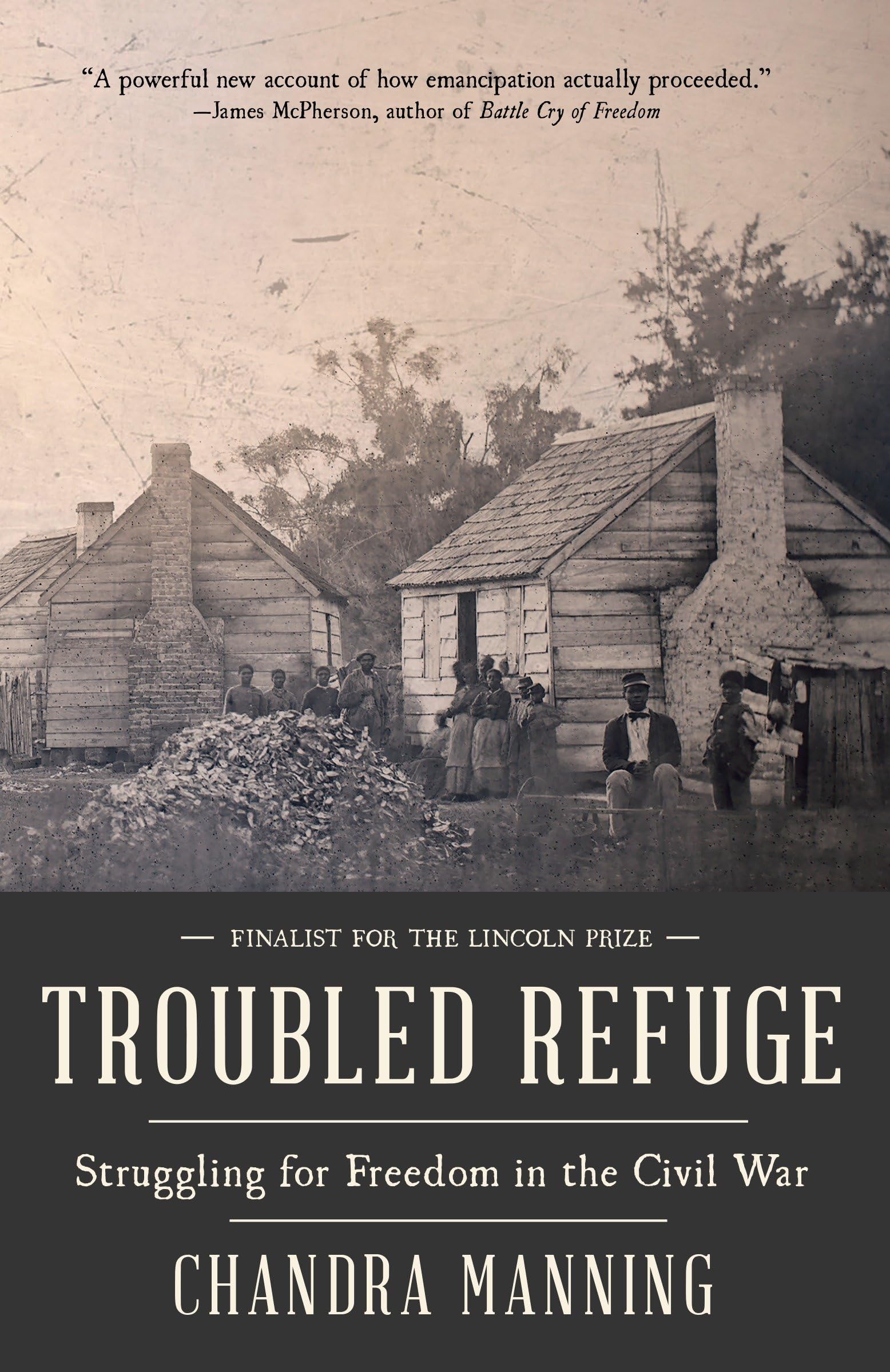
Troubled Refuge: Struggling for Freedom in the Civil War (Vintage Books)
$14.89
| Brand | Chandra Manning |
| Merchant | Amazon |
| Category | Books |
| Availability | In Stock |
| SKU | 0307456374 |
| Color | Multicolor |
| Age Group | ADULT |
| Condition | NEW |
| Gender | UNISEX |
| Google Product Category | Media > Books |
| Product Type | Books > Subjects > History > Americas > United States > Civil War > Campaigns & Battlefields > Gettysburg |
About this item
Troubled Refuge: Struggling for Freedom in the Civil War (Vintage Books)
From the author of What This Cruel War Was Over, a vivid portrait of the Union army’s escaped-slave refugee camps and how they shaped the course of emancipation and citizenship in the United States. Chandra Manning casts in a wholly original light what it was like to escape slavery, how emancipation happened, and how citizenship in the United States was transformed. This reshaping of hard structures of power would matter not only for slaves turned citizens, but for all Americans. Integrating a wealth of new findings, this vivid portrait of the Union army’s escaped-slave refugee camps shows how they shaped the course of emancipation and citizenship in the United States. Drawing on records of the Union and Confederate armies, the letters and diaries of soldiers, transcribed testimonies of former slaves, and more, Manning allows us to accompany the black men, women, and children who sought out the Union army in hopes of achieving autonomy for themselves and their communities. It also raised, for the first time, humanitarian questions about refugees in wartime and legal questions about civil and military authority with which we still wrestle, as well as redefined American citizenship, to the benefit, but also to the lasting cost of, African Americans. “Striking. . . . Manning’s highly engaging narrative tells a sobering yet uplifting story of the journey toward freedom. In her superb telling we learn something invaluable about the fragile and chaotic nature of the coming of freedom and the enduring dignity and courage of the people who secured it.” –Mark Smith, The Wall Street Journal “A vitally important book [that] settles the long-standing issue of the freedmen’s own role in exiting slavery. . . . Manning’s emphasis on the camps is novel . . . and [her] research is extraordinary. . . . An essential contribution to the history of the Civil War and its aftermath.” – Booklist (starred review) “Manning offers a vivid, compelling view of the struggles undertaken by escaped slaves during the Civil War [and] conveys in gritty detail the fraught alliance between refugees and their military protectors” – Kirkus (starred review) “Excellent. . . . [A] refreshing work . . . in great detail, the author successfully proves that the road from slavery to freedom was both complex and personal.” –Library Journal “The end of slavery came through an unplanned alliance between the Union army and black refugees from slavery who came within the army's lines during the Civil War. Digging deeply into a wealth of sources, Chandra Manning has provided a powerful new account of how emancipation actually proceeded on the ground and how former slaves and the army forged a new order of freedom and black citizenship.” – James M. McPherson CHANDRA MANNING graduated summa cum laude from Mount Holyoke College, received the M.Phil. from the National University of Ireland, Galway, and took her Ph.D. at Harvard University. She has taught at Pacific Lutheran University in Tacoma, Washington, and served as Special Advisor to the Dean of the Radcliffe Institute for Advanced Study at Harvard University for two years. She is Professor of History at Georgetown University, and divides her time between there and Braintree, Massachusetts, where she lives with her husband and children. Prelude As the story goes, Old Point Comfort at the tip of the peninsula formed by the James and York Rivers, about midway down the Atlantic coast of North America, got its name from weary, grateful travelers who had spent months at sea in a seventeenth-century ship guaranteed to make any landfall look like a refuge. To judge by first appearances, the spot is in fact beautiful, girded by the Atlantic Ocean and the Chesapeake Bay, with sandy beaches and rocky outcroppings, and the breeze that blows on a summer day brings cool relief. The oysters that once littered its shores even added a touch of luxury. Certainly compared with a reeking, disease-ridden seventeenth-century ship, Old Point Comfort must have seemed a haven or even a paradise . . . until sojourners noticed that it had, in the pithy quip of Benjamin Butler, “plenty of oysters, but no water,” no matter how deep they dug. In the 1860s, U.S. soldiers set out to drill a well; they dug nine hundred feet into the ground without finding a drop, realized the futility, and gave up. Without massive human intervention, the refuge Fort Monroe could provide was neither healthful nor permanent, for in the absence of freshwater no place can sustain human life for long. So, too, was the case with Civil War contraband camps, the first one of which took root at a U.S. Army installation at Old Point Comfort called Fort Monroe. Fort Monroe was the first of many contraband camps, for camps spread wherever the Union army went throughout the occupied South. They were the specific places in which emancipation began for nearly half a million former slaves. In contraband camps, black men, women, and children
| Brand | Chandra Manning |
| Merchant | Amazon |
| Category | Books |
| Availability | In Stock |
| SKU | 0307456374 |
| Color | Multicolor |
| Age Group | ADULT |
| Condition | NEW |
| Gender | UNISEX |
| Google Product Category | Media > Books |
| Product Type | Books > Subjects > History > Americas > United States > Civil War > Campaigns & Battlefields > Gettysburg |
Similar Products








Compare with similar items

Krampus Night Kiss (Holiday Hearts & Hau... |

中国书法与绘画全书 书法绘画历史概论 书法技法毛笔字教材 技法... |

Current Psychotherapies... |

Tracing letter and sight word with color... |
|
|---|---|---|---|---|
| Price | $13.33 | $22.60 | $105.20 | $6.99 |
| Brand | L.L. Sparrow | 无 | Raymond J. Corsini | COLR KID PUBLISH |
| Merchant | Amazon | Amazon | Amazon | Amazon |
| Availability | In Stock | In Stock Scarce | In Stock Scarce | In Stock |