
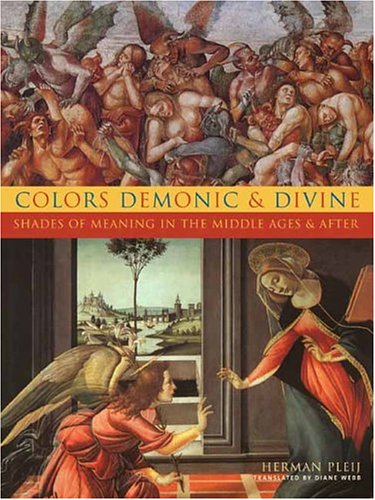
Colors Demonic and Divine: Shades of Meaning in the Middle Ages and After
$38.68
| Brand | Herman Pleij |
| Merchant | Amazon |
| Category | Books |
| Availability | Leadtime |
| SKU | 0231130228 |
| Age Group | ADULT |
| Condition | NEW |
| Gender | UNISEX |
About this item
Colors Demonic and Divine: Shades of Meaning in the Middle Ages and After
Color has been a subject of heated debate for as long as anyone can remember. Is it an innate part of material objects or a trick of perception and light? Is it merely superficial and decorative, or does it reveal deeper meaning? Is it the manifestation of divine presence on Earth or evidence of Satan's cunning? This debate captured the medieval imagination and influenced every aspect of life in the Middle Ages -- an era that was truly obsessed with color. Unlike the drab images popularized in films and television programs, parades of vibrant color were on display at every level of medieval European society. Not only did clothing sport gaudy and often clashing colors, but food, statues, animals, and even hair and beards flaunted the most brazen coloration. Yet not everyone revered color; many believed it to be an ephemeral, worldly deception and a symptom of immorality. As the Middle Ages drew to a close, perceptions of color gradually became emblematic of broader cultural issues. Black and blue -- which were primarily associated with asceticism, sorrow, and humility -- became the colors of choice for royalty and the urban aristocracy, while bright, flashy colors came to be associated with the devil -- who, it was believed, had painted the world in tempting hues to lure humanity into sin and away from the path to eternal salvation. As a result, every God-fearing person began to avoid colorful displays, choosing instead more somber shades, a preference still seen today in the blacks and dark blues of evening wear and business attire. Colors Demonic and Divine ranges over painting, fashion, poetry, heraldry, religion, and history to tell the story of medieval attitudes toward color and the profound and pervasive influence they still have on modern society. Pleij's book will serve as a useful tool in the recreation of life and experience in medieval and early modern Europe. ( Comitatus 1900-01-00) Herman Pleij lectures on Dutch historical literature at the University of Amsterdam. He is the author of the Dutch best-seller Het Gilde van de Blauwe Schuit (The guild of the blue barge), an account of the rituals surrounding the celebration of Carnival in the Middle Ages, and the critically acclaimed book De sneeuwpoppen van 1511 (The snowmen of 1511), a study of the rise of urban culture and middle-class morality in the Netherlands during the Middle Ages. His last book, Dreaming of Cockaigne: Medieval Fantasies of the Perfect Life , was published by Columbia in 2001.Diane Webb, a professional musician and translator, lives in the Netherlands and Italy. She specializes in the translation of historical and art-historical literature.
| Brand | Herman Pleij |
| Merchant | Amazon |
| Category | Books |
| Availability | Leadtime |
| SKU | 0231130228 |
| Age Group | ADULT |
| Condition | NEW |
| Gender | UNISEX |









Compare with similar items

INTEGRITY FIRST: America’s Desperate Nee... |

Photoshop Elements 2025 User Guide: A St... |

LIBRO PARA COLOREAR (Spanish Edition)... |

Crossword and Word Search Puzzles about ... |
|
|---|---|---|---|---|
| Price | $14.99 | $19.99 | $5.00 | $7.90 |
| Brand | J. Stark Davis | Matt Vic | BY KARLA JUAREZ SOLIS | Enigma |
| Merchant | Amazon | Amazon | Amazon | Amazon |
| Availability | In Stock | In Stock | In Stock | In Stock |