
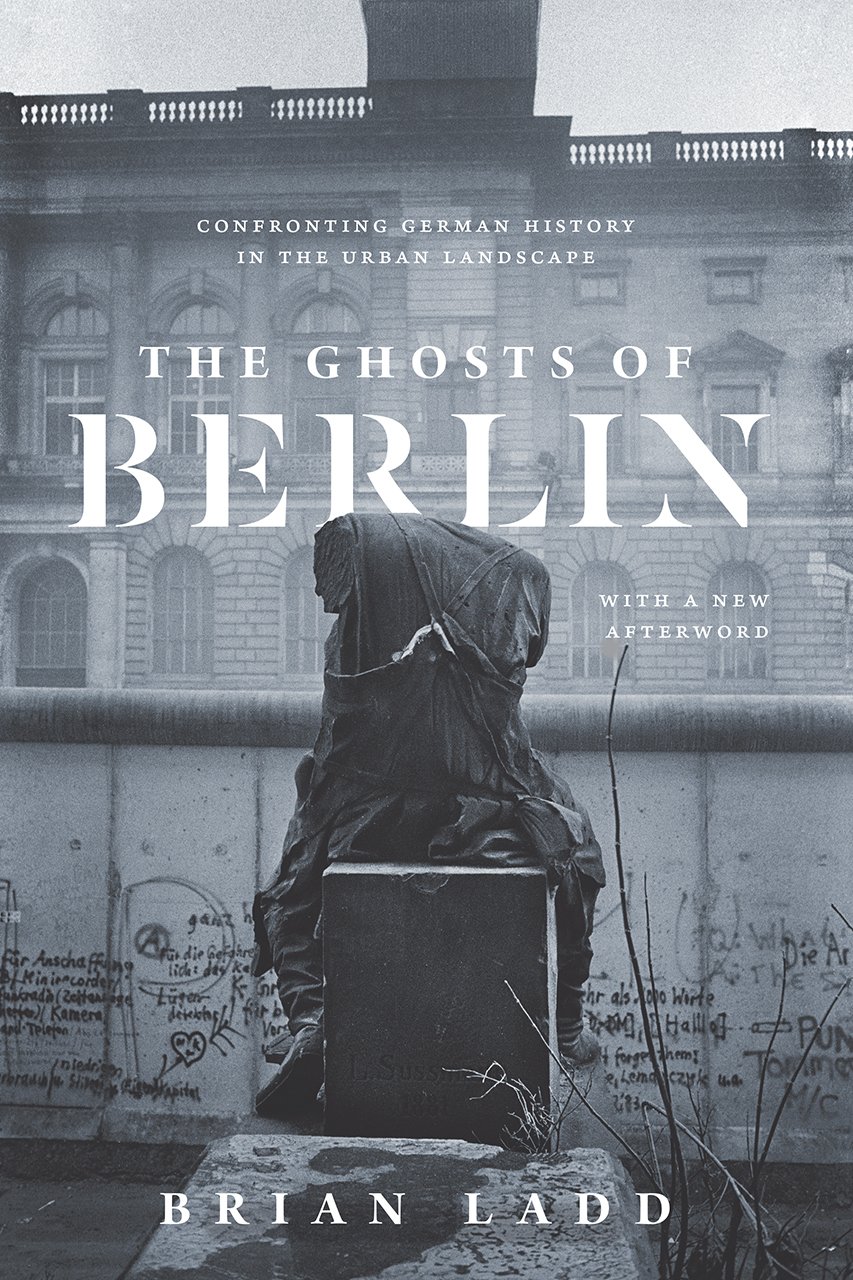
The Ghosts of Berlin: Confronting German History in the Urban Landscape
$25.03
| Brand | Brian Ladd |
| Merchant | Amazon |
| Category | Books |
| Availability | Unknown Availability |
| SKU | 022655872X |
| Age Group | ADULT |
| Condition | NEW |
| Gender | UNISEX |
| Google Product Category | Media > Books |
| Product Type | Books > Subjects > Travel > Europe > Germany > Berlin |
About this item
The Ghosts of Berlin: Confronting German History in the Urban Landscape
In the twenty years since its original publication, The Ghosts of Berlin has become a classic, an unparalleled guide to understanding the presence of history in our built environment, especially in a space as historically contested—and emotionally fraught—as Berlin. Brian Ladd examines the ongoing conflicts radiating from the remarkable fusion of architecture, history, and national identity in Berlin. Returning to the city frequently, Ladd continues to survey the urban landscape, traversing its ruins, contemplating its buildings and memorials, and carefully deconstructing the public debates and political controversies emerging from its past. "A superb guide to this process of urban self-definition, both past and present.” ― Wall Street Journal “With erudition, insight, and restraint, Brian Ladd carries off the dangerous task of analyzing architecture and urbanism in Berlin in terms of its horrific political past. He convincingly argues that architecture embodies ideological meaning more powerfully than other artifacts of a society.” ― New York Times Book Review “[Ladd’s] well-written and well-illustrated book amounts to a brief history of the city as well as a guide to its landscape.” -- Anthony Grafton ― New York Review of Books “Ladd examines the conflicts radiating from [Berlin’s] remarkable fusion of architecture, history and national identity.” ― History Today “Ladd’s balanced, sensitive chronicle of the Berlin’s traumatized topography brings the past into focus.” ― Harvard Design Magazine “Ladd’s book is absorbing. More than a portrait of a fraught city, it is a reminder that not just ‘good design’ is at stake in the built world and its traces." ― Architects' Journal Brian Ladd is an independent historian who received his Ph.D. from Yale University. He has taught history at the Rensselaer Polytechnic Institute and is a research associate in the history department at the University of Albany, State University of New York. The Ghosts of Berlin Confronting German History in the Urban Landscape By Brian Ladd The University of Chicago Press Copyright © 1997 The University of Chicago All rights reserved. ISBN: 978-0-226-55872-1 Contents Illustrations, Acknowledgments, Introduction, 1. Berlin Walls, 2. Old Berlin, 3. Metropolis, 4. Nazi Berlin, 5. Divided Berlin, 6. Capital of the New Germany, Afterword: Two Decades Later, Chronology of Berlin's History, Notes, Bibliography, Index, CHAPTER 1 Berlin Walls The Monument In a rarely visited corner of northern Berlin, piles of concrete debris fill a vast lot. This is not an unusual sight in what geographers call the "gray zones" of a city, those tracts of land somehow disqualified from more valued uses. Here, where the district of Pankow meets neighboring Wedding, machines are grinding the huge slabs of mangled concrete into smaller pieces, freeing up the land for some other use and turning the concrete into usable gravel. This ordinary industrial scene turns extraordinary when a closer look at the concrete reveals an unexpected sight: the famous spray-painted graffiti of the Berlin Wall. In 1991, this lot is a graveyard for a few of the one hundred miles of Wall that had enclosed West Berlin two years before. It is indeed located in a "gray zone" of Berlin, one of many fringe areas created by the presence of the Wall that is now reduced to rubble (fig. 1). The Berlin Wall had been one of the city's premier tourist attractions. More than that, it was probably the most famous structure that will ever stand in Berlin. The Pankow lot, and a few others, contained what was left of it (with a few exceptions, as we shall see). Yet such boneyards were not tourist attractions. Indeed, they were scarcely known at all. If a monument can be decommissioned, that is apparently what has happened with the Berlin Wall. Did the concrete lose its aura when it was removed from its original location? Or did that happen earlier, when it lost its power to kill, so to speak — that is, when the guards stepped aside and let the crowds through on November 9, 1989? The Wall retained a strange kind of magic in the days and months that followed, as Berliners and tourists hacked away at the concrete. Pieces of the Wall did indeed have a special aura: they were treated as holy relics that bespoke our deliverance from the Cold War. For that brief moment, the Wall was in demand precisely because it was disappearing. Detached pieces of it were valued as evidence of an apparently spontaneous will to destroy the Wall. The cold night air during that winter of 1989 — 90 was filled with the sound of pik-pik-pik. First Berliners, then tourists hacked away at the Wall. They contributed in a minuscule way to the removal of the concrete, but more significant was their ritual participation in the removal of the symbolic barrier. It was in this carnival atmosphere that the concrete was divested of its murderous aura and invested with mag
| Brand | Brian Ladd |
| Merchant | Amazon |
| Category | Books |
| Availability | Unknown Availability |
| SKU | 022655872X |
| Age Group | ADULT |
| Condition | NEW |
| Gender | UNISEX |
| Google Product Category | Media > Books |
| Product Type | Books > Subjects > Travel > Europe > Germany > Berlin |
Similar Products








Compare with similar items

Pairs Trading and Statistical Arbitrage:... |

Ariette... |

HAPPINESS EXISTS: Poems from the Heart (... |

The Rewarding Retirement Workbook: Six E... |
|
|---|---|---|---|---|
| Price | $29.99 | $14.99 | $14.99 | $19.95 |
| Brand | Steven Johnson | Miranda Moeller | Lilia Yermak | Aaron Kirsch |
| Merchant | Amazon | Amazon | Amazon | Amazon |
| Availability | In Stock | In Stock | In Stock | In Stock |