
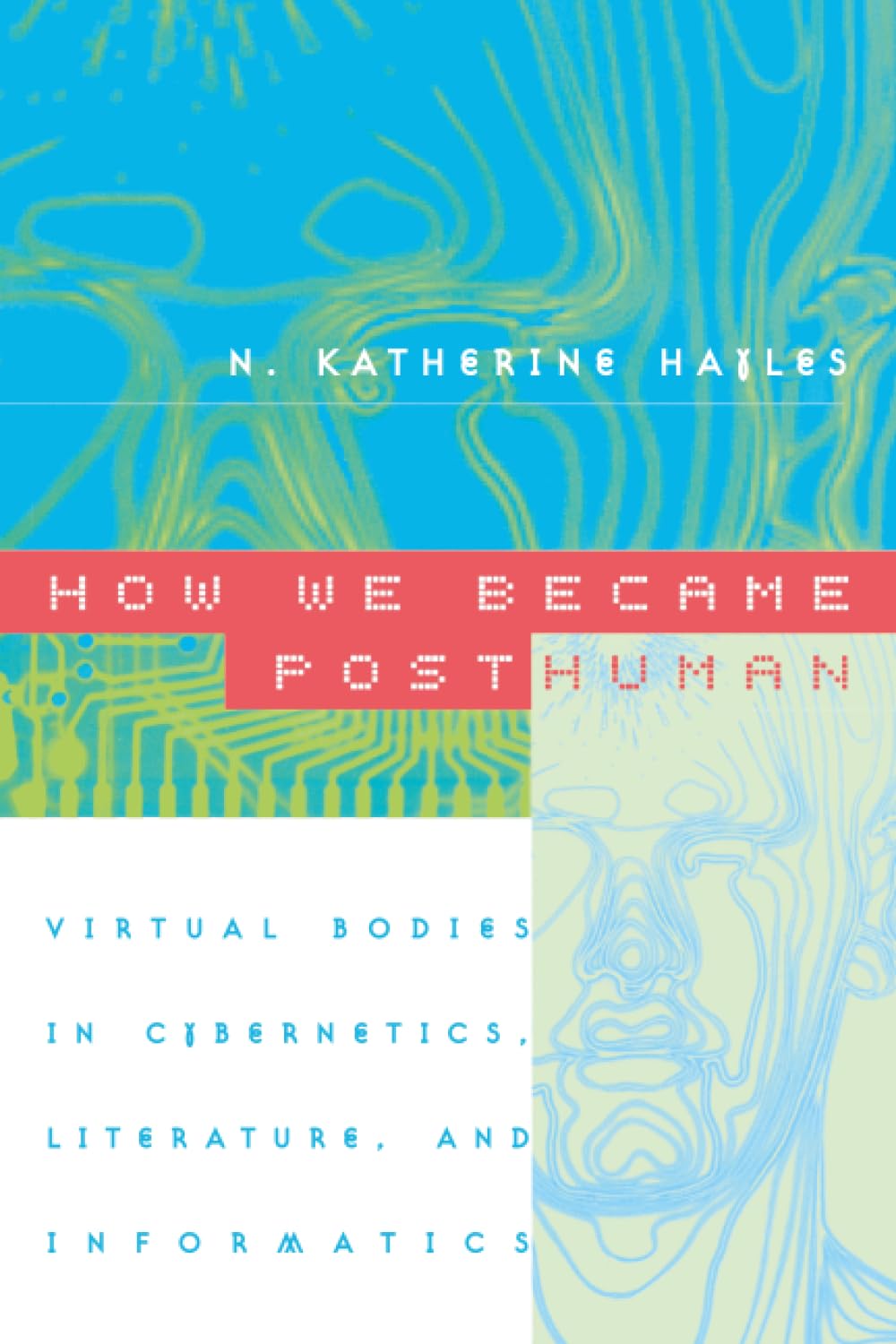
How We Became Posthuman: Virtual Bodies in Cybernetics, Literature, and Informatics
$20.99
| Brand | N. Katherine Hayles |
| Merchant | Amazon |
| Category | Books |
| Availability | In Stock |
| SKU | 0226321460 |
| Age Group | ADULT |
| Condition | NEW |
| Gender | UNISEX |
| Google Product Category | Media > Books |
| Product Type | Books > Subjects > Literature & Fiction > History & Criticism > Movements & Periods > Modern > 20th Century |
About this item
How We Became Posthuman: Virtual Bodies in Cybernetics, Literature, and Informatics
In this age of DNA computers and artificial intelligence, information is becoming disembodied even as the "bodies" that once carried it vanish into virtuality. While some marvel at these changes, envisioning consciousness downloaded into a computer or humans "beamed" Star Trek -style, others view them with horror, seeing monsters brooding in the machines. In How We Became Posthuman, N. Katherine Hayles separates hype from fact, investigating the fate of embodiment in an information age. Hayles relates three interwoven stories: how information lost its body, that is, how it came to be conceptualized as an entity separate from the material forms that carry it; the cultural and technological construction of the cyborg; and the dismantling of the liberal humanist "subject" in cybernetic discourse, along with the emergence of the "posthuman." Ranging widely across the history of technology, cultural studies, and literary criticism, Hayles shows what had to be erased, forgotten, and elided to conceive of information as a disembodied entity. Thus she moves from the post-World War II Macy Conferences on cybernetics to the 1952 novel Limbo by cybernetics aficionado Bernard Wolfe; from the concept of self-making to Philip K. Dick's literary explorations of hallucination and reality; and from artificial life to postmodern novels exploring the implications of seeing humans as cybernetic systems. Although becoming posthuman can be nightmarish, Hayles shows how it can also be liberating. From the birth of cybernetics to artificial life, How We Became Posthuman provides an indispensable account of how we arrived in our virtual age, and of where we might go from here. The title of this scholarly yet remarkably accessible slice of contemporary cultural history has a whiff of paradox about it: what can it mean, exactly, to say that we humans have become something other than human? The answer, Katherine Hayles explains, lies not in ourselves but in our tools. Ever since the invention of electronic computers five decades ago, these powerful new machines have inspired a shift in how we define ourselves both as individuals and as a species. Hayles tracks this shift across the history of avant-garde computer theory, starting with Norbert Weiner and other early "cyberneticists," who were the first to systematically explore the similarities between living and computing systems. Hayles's study ends with artificial-life specialists, many of whom no longer even bother to distinguish between life forms and computers. Along the way she shows these thinkers struggling to reconcile their traditional, Western notions of human identity with the unsettling, cyborg directions in which their own work seems to be leading humanity. This is more than just the story of a geek elite, however. Hayles looks at cybernetically inspired science fiction by the likes of Philip K. Dick, William Gibson, and Neal Stephenson to show how the larger culture grapples with the same issues that dog the technologists. She also draws lucidly on her own broad grasp of contemporary philosophy both to contextualize those issues and to contend with them herself. The result is a fascinating introduction--and a valuable addition--to one of the most important currents in recent intellectual history. --Julian Dibbell N. Katherine Hayles is distinguished research professor of English at the University of California, Los Angeles and James B. Duke Distinguished Professor Emerita of literature at Duke University. She is the author of many books, most recently Postprint: Books and Becoming Computational . How We Became Posthuman Virtual Bodies in Cybernetics, Literature, and Informatics By N. Katherine Hayles University of Chicago Press Copyright © 1999 N. Katherine Hayles All right reserved. ISBN: 9780226321462 Prologue You are alone in the room, except for two computer terminals flickering in the dim light. You use the terminals to communicate with two entities in another room, whom you cannot see. Relying solely on their responses to your questions, you must decide which is the man, which the woman. Or, in another version of the famous "imitation game" proposed by Alan Turing in his classic 1950 paper "Computer Machinery and Intelligence," you use the responses to decide which is the human, which the machine. One of the entities wants to help you guess correctly. His/her/its best strategy, Turing suggested, may be to answer your questions truthfully. The other entity wants to mislead you. He/she/it will try to reproduce through the words that appear on your terminal the characteristics of the other entity. Your job is to pose questions that can distinguish verbal performance from embodied reality. If you cannot tell the intelligent machine from the intelligent human, your failure proves, Turing argued, that machines can think. Here, at the inaugural moment of the computer age, the erasure of embodiment is performed so that "in
| Brand | N. Katherine Hayles |
| Merchant | Amazon |
| Category | Books |
| Availability | In Stock |
| SKU | 0226321460 |
| Age Group | ADULT |
| Condition | NEW |
| Gender | UNISEX |
| Google Product Category | Media > Books |
| Product Type | Books > Subjects > Literature & Fiction > History & Criticism > Movements & Periods > Modern > 20th Century |
Similar Products







Compare with similar items
Rapport sur la santé dans le monde 2004 ... |
SketchUp Pro 2026 for Landscape Engineer... |

Murder Mystery Word Search: 100 True Cri... |

Betty Crocker's Cookbook - Tenth Printin... |
|
|---|---|---|---|---|
| Price | $36.00 | $38.99 | $6.99 | $94.99 |
| Brand | World Health Organization | ANTHENA J. THOMPSON | MysterySearch Publishing | unknown author |
| Merchant | Amazon | Amazon | Amazon | Amazon |
| Availability | Unknown Availability | In Stock | In Stock | In Stock Scarce |