
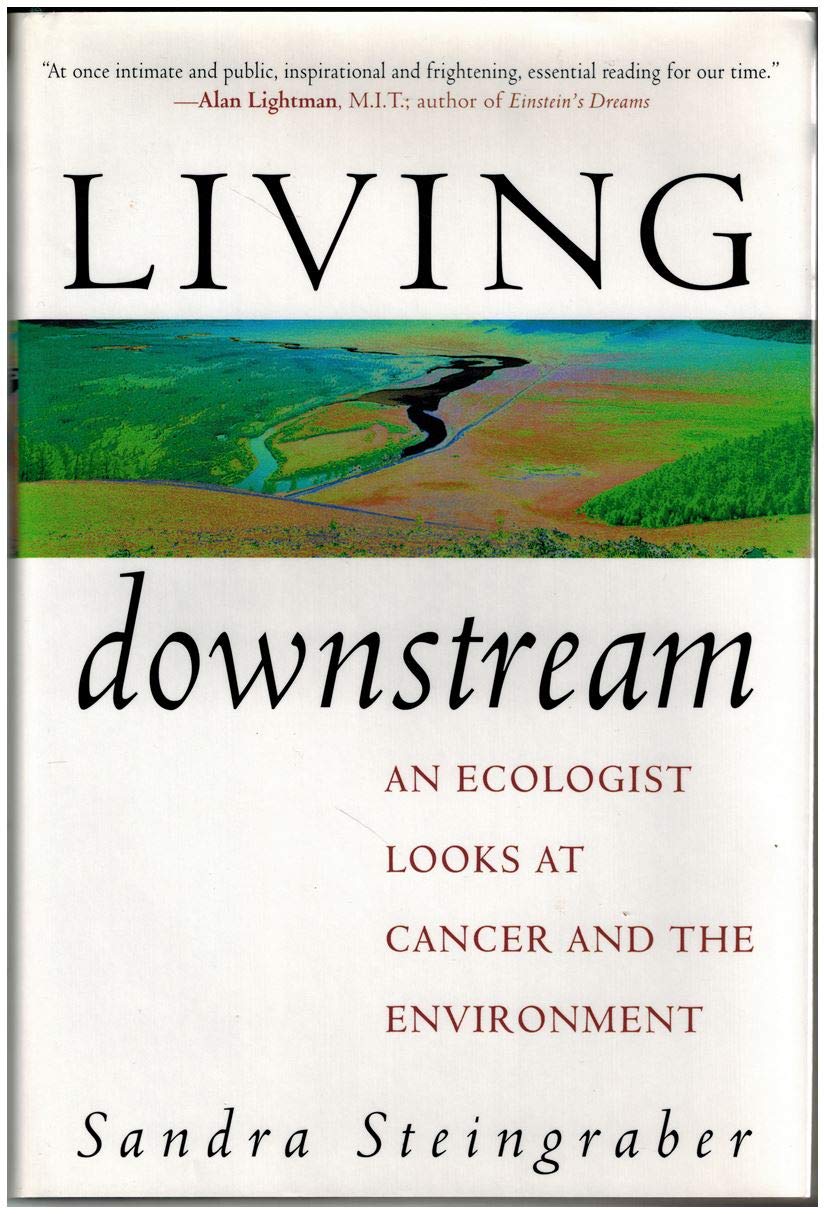
Living Downstream: An Ecologist Looks At Cancer And The Environment
$20.33
| Brand | Sandra Steingraber |
| Merchant | Amazon |
| Category | Books |
| Availability | In Stock Scarce |
| SKU | 0201483033 |
| Age Group | ADULT |
| Condition | NEW |
| Gender | UNISEX |
| Google Product Category | Media > Books |
| Product Type | Books > Subjects > Health, Fitness & Dieting > Diseases & Physical Ailments > Cancer |
About this item
Living Downstream: An Ecologist Looks At Cancer And The Environment
Sandra Steingraber, biologist, poet, and survivor of cancer in her twenties, brings all three perspectives to bear on the most important health and human rights issue of our time: the growing body of evidence linking cancer to environmental contaminations. Her scrupulously researched scientific analysis ranges from the alarming worldwide patterns of cancer incidence to the sabotage wrought by cancer-promoting substances on the intricate workings of human cells. In a gripping personal narrative, she travels from hospital waiting rooms to hazardous waste sites and from farmhouse kitchens to incinerator hearings, bringing to life stories of communities in her hometown and around the country as they confront decades of industrial and agricultural recklessness. Living Downstream is the first book to bring together toxics-release datanow finally made available through under the right-to-know lawsand newly released cancer registry data. Sandra Steingraber is also the first to trace with such compelling precision the entire web of connections between our bodies and the ecological world in which we eat, drink, breathe, and work. Her book strikes a hopeful note throughout, for, while we can do little to alter our genetic inheritance, we can do a great deal to eliminate the environmental contributions to cancer, and she shows us where to begin. Living Downstream is for all readers who care about the health of their families and future generations. Sandra Steingraber's brave, clear, and careful voice is certain to break the paralyzing silence on this subject that persists more than three decades after Rachel Carson's great early warning. Sandra Steingraber, a poet and biologist, writes with extraordinary grace and clarity about that most depressing of subjects: cancer, a disease that sends you into an unfamiliar territory where all the rules of human conduct are alien. That territory, she suggests, is expanding as chemically poisoned environments begin to take their toll on their human inhabitants. This interaction between the disease and compromised natural zones takes her text into fascinating arguments. Along the way, Steingraber looks at community efforts to reverse the effects of carcinogenic toxins, such as an Iowa farming group's decision to replace chemical herbicides with natural methods of pest control, following the principle of the least toxic alternative. She also suggests that with proper foresight we can do much to make our environments less dangerous. In this "scientific narrative" on the environmental causes of cancer, biologist Steingraber weaves a compelling story that blends personal experience (her friend Jeannie died of a rare cancer of the spinal cord; she herself is a victim of bladder cancer), with a passion for scientific detail. She examines cancer registry data, the rise of the West's petrochemical-based economy, and the effects of substances such as DDT, dioxins, and other endocrine-disrupting chemicals on human health and ecosystems. Steingraber uses data and stories from her native state of Illinois to illustrate the overuse of incineration as a treatment technology for the "reduction" of hazardous waste and the misuse and misapplication of pesticides. She asks "why so much silence still surrounds questions about cancer's connection to the environment, and why so much scientific inquiry into this issue is still considered preliminary." This question is critical to Steingraber's argument; at least 60 different occupations have elevated death rates from cancer. While not easy reading, her work is a powerful addition to the literature on cancer's relationship to environmental exposure. Strongly recommended.?Susan Mart, Univ. of Colorado Lib., Denver Copyright 1997 Reed Business Information, Inc. When in college, Steingraber had bladder cancer, and as most cancers do, it changed her life. She was struck, though, by the fact that no one who spoke of her illness asked about environmental conditions where she grew up. Tazewell County and its seat, Pekin, in central Illinois have a long, continuous history of agricultural and industrial pollution that badly contaminated the Illinois River, the surrounding farmland, and the major aquifer. This book is not a screeching tirade. It is the account of a young woman who has a deep feeling for the land and its crops. Her descriptions of soybean and corn fields throughout the year show an imaginative and deep appreciation for growing plants. The book also contains much information not easily available elsewhere, a series of tight and logical arguments, a large number of pointed, fair, thought-provoking questions, and 63 pages of references and notes documenting the text and directing the curious to sources for further examination. William Beatty A graceful, precise delineation of the ugly marriage between synthetic chemicals in the environment and rising cancer rates, from poet/biologist Steingraber. Steingraber tracks the distribution of cancer ac
| Brand | Sandra Steingraber |
| Merchant | Amazon |
| Category | Books |
| Availability | In Stock Scarce |
| SKU | 0201483033 |
| Age Group | ADULT |
| Condition | NEW |
| Gender | UNISEX |
| Google Product Category | Media > Books |
| Product Type | Books > Subjects > Health, Fitness & Dieting > Diseases & Physical Ailments > Cancer |
Similar Products






Compare with similar items
Learning to Live in the World: Earth Poe... |
A Colonial Gingerbread Boy... |
Blue Skies Blue Skies... |

The Garden of Secrets (Dean Steele Myste... |
|
|---|---|---|---|---|
| Price | $26.23 | $11.00 | $19.09 | $13.99 |
| Brand | William Stafford | Carol Young | Robyn Carr | A.J. Rivers |
| Merchant | Amazon | Amazon | Amazon | Amazon |
| Availability | Available Date | In Stock | In Stock | In Stock |