
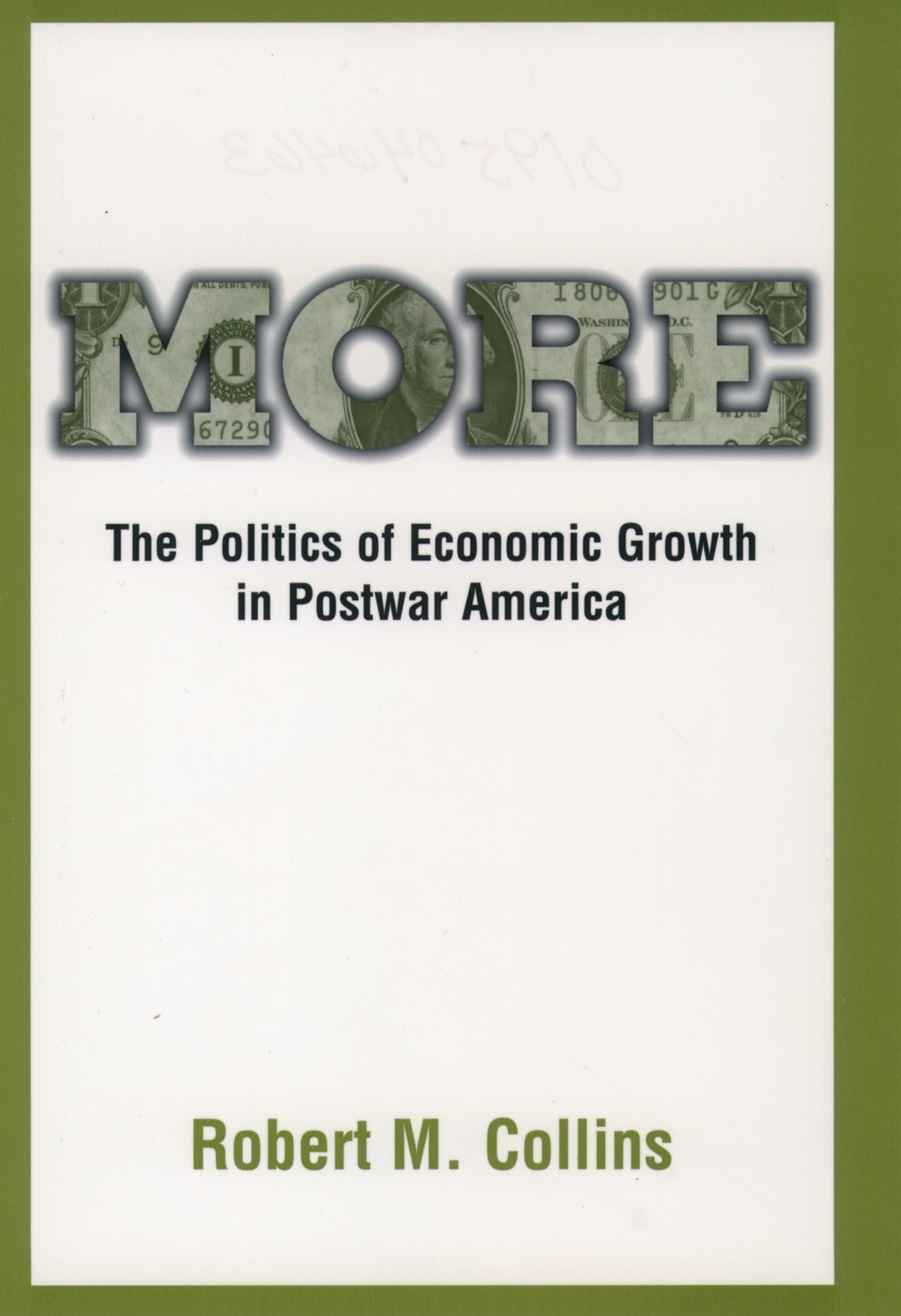
More: The Politics of Economic Growth in Postwar America
$39.29
| Brand | Robert M. Collins |
| Merchant | Amazon |
| Category | Books |
| Availability | In Stock Scarce |
| SKU | 0195046463 |
| Age Group | ADULT |
| Condition | NEW |
| Gender | UNISEX |
| Google Product Category | Media > Books |
| Product Type | Books > Subjects > Politics & Social Sciences > Politics & Government > Specific Topics > Political Economy |
About this item
More: The Politics of Economic Growth in Postwar America
James Carville famously reminded Bill Clinton throughout 1992 that "it's the economy, stupid." Yet, for the last forty years, historians of modern America have ignored the economy to focus on cultural, social, and political themes, from the birth of modern feminism to the fall of the Berlin Wall. Now a scholar has stepped forward to place the economy back in its rightful place, at the center of his historical narrative. In More , Robert M. Collins reexamines the history of the United States from Franklin Delano Roosevelt to Bill Clinton, focusing on the federal government's determined pursuit of economic growth. After tracing the emergence of growth as a priority during FDR's presidency, Collins explores the record of successive administrations, highlighting both their success in fostering growth and its partisan uses. Collins reveals that the obsession with growth appears not only as a matter of policy, but as an expression of Cold War ideology--both a means to pay for the arms build-up and proof of the superiority of the United States' market economy. But under Johnson, this enthusiasm sparked a crisis: spending on Vietnam unleashed runaway inflation, while the nation struggled with the moral consequences of its prosperity, reflected in books such as John Kenneth Galbraith's The Affluent Society and Rachel Carson's Silent Spring . More continues up to the end of the 1990s, as Collins explains the real impact of Reagan's policies and astutely assesses Clinton's "disciplined growthmanship," which combined deficit reduction and a relaxed but watchful monetary policy by the Federal Reserve. Writing with eloquence and analytical clarity, Robert M. Collins offers a startlingly new framework for understanding the history of postwar America. What was the defining characteristic of the most recent period of U.S. history? What lens best brings the past half-century into focus? For history professor Collins, postwar U.S. history can be seen "in terms of a succession of growth regimes," which would include "the initial formulation of growthmanship in the 1940s through the ascendancy of a full-blown growth liberalism in the 1960s," and on to "national rejuvenation in the aftermath of the 1960s, the retreat from growth under both economic and cultural pressures in the 1970s, the reassertion and partisan domestication of growth by Ronald Reagan and the Republicans in the 1980s, and the emergence of a diluted but still influential, technocratic brand of growthmanship in the 1990s." More goes back to the New Deal and World War II to trace the roots of the growth ideas dominant in the late 1940s; those ideas shift and change and serve very different goals over the next five decades. Demanding but insightful. Mary Carroll More offers a thoughtful, balanced, clearly written, and entertaining account of post-World War II America's love affair with the blessings of economic growth. In the process we learn much about federal efforts, sometimes successful, sometimes not, to sustain it. I learned a great deal about policymaking and economic ideas from Collins' thoroughly researched analysis."--James T. Patterson, author of Grand Expectations: The United States, 1945-1974 More is one of those rare books that will actually change how historians perceive the past. Through the prism of government attitudes toward abundance, Robert Collins finds fresh things to say about American presidents from Franklin D. Roosevelt to Bill Clinton, challenges current perceptions of Richard Nixon and Ronald Reagan, and raises searching questions about how we should evaluate economic policy today."--William E. Leuchtenburg, University of North Carolina at Chapel Hill "In More , Robert Collins provides a thoroughly historicized account of how American attitudes toward economic growth have evolved in the latter half of the twentieth century. This project, altogether unusual and sorely needed, prompts us to examine critically a vast array of deeply-held beliefs concerning the virtues and costs of economic expansion in a fashion that is as welcome as it is necessary. Moreover, it allows Collins to provide us with a novel and most thought-provoking consideration of the social and political forces that paved the way for the 'Supply-Side Revolution' of the Reagan years. A fine achievement and a most important contribution."--Michael A. Bernstein, University of California, San Diego " More is a brilliant and fascinating examination of the postwar 'politics of growth' from its liberal heyday between the late 1940s and the late 1960s, through its trials in the 1970s, and into its antistatist reincarnation in the 1980s and beyond. 'Growthmanship,' in Robert Collins' engaging account, is at once an economic panacea, a political compromise, and a cultural consensus--a tangle of aspirations and anxieties that confounded policymakers both when it paid off and when it did not. This is economic history at its best, offering both a subtle and ac
| Brand | Robert M. Collins |
| Merchant | Amazon |
| Category | Books |
| Availability | In Stock Scarce |
| SKU | 0195046463 |
| Age Group | ADULT |
| Condition | NEW |
| Gender | UNISEX |
| Google Product Category | Media > Books |
| Product Type | Books > Subjects > Politics & Social Sciences > Politics & Government > Specific Topics > Political Economy |
Similar Products










Compare with similar items

Unbound Justice (The Australian Sandston... |

Reindeer Games Word Search Puzzle: 55 La... |

Aphelion... |

The Second Man: Examining the Dynamic of... |
|
|---|---|---|---|---|
| Price | $13.95 | $6.99 | $28.00 | $12.99 |
| Brand | Michael Beashel | Abacus Book Sellers | Daniel Stern | REV John P Worrall |
| Merchant | Amazon | Amazon | Amazon | Amazon |
| Availability | In Stock | In Stock | In Stock | In Stock |