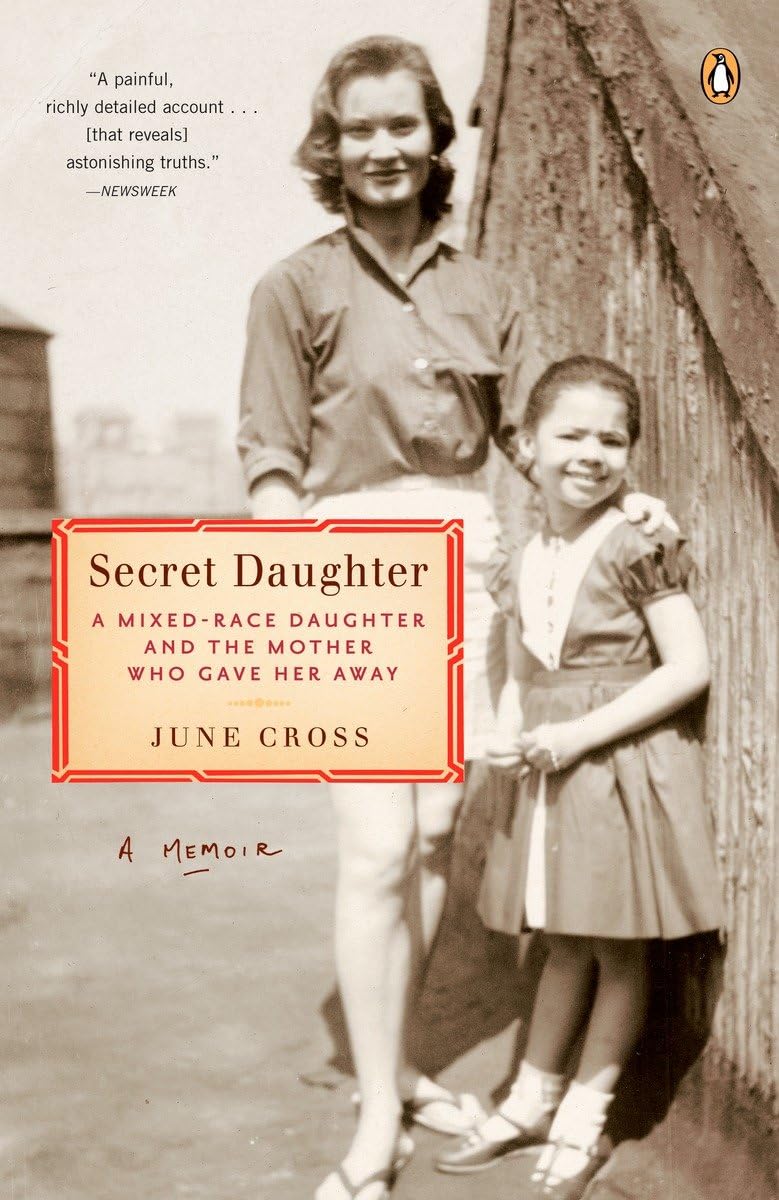
Secret Daughter: A Mixed-Race Daughter and the Mother Who Gave Her Away
$13.38
| Brand | June Cross |
| Merchant | Amazon |
| Category | Books |
| Availability | In Stock |
| SKU | 0143112112 |
| Color | Multicolor |
| Age Group | ADULT |
| Condition | NEW |
| Gender | UNISEX |
About this item
Secret Daughter: A Mixed-Race Daughter and the Mother Who Gave Her Away
June Cross was born in 1954 to Norma Booth, a glamorous, aspiring white actress, and James “Stump” Cross, a well-known black comedian. Sent by her mother to be raised by black friends when she was four years old and could no longer pass as white, June was plunged into the pain and confusion of a family divided by race. Secret Daughter tells her story of survival. It traces June’s astonishing discoveries about her mother and about her own fierce determination to thrive. This is an inspiring testimony to the endurance of love between mother and daughter, a child and her adoptive parents, and the power of community. A painful, richly detailed account . . . [that reveals] astonishing truths. ( Newsweek ) Searing, revelatory à mind-boggling in its rich and complex interplay of personalities [and] social and racial pressures. ( Elle ) June Cross is assistant professor of journalism at Columbia University. She has been a television producer for Frontline and the CBS Evening News and was a reporter, producer, and correspondent for PBS's MacNeil/Lehrer NewsHour . Chapter 1 I search for my mother's face in the mirror and see a stranger. Her face is toffee-colored and round; her eyes, the eyes of a foreigner, slanted and brown. They are not my mother's eyes: irises of brilliant green, set obliquely in almond-shaped sockets above high cheekbones. They said I looked exotic, she classic. Together-a bamboo-colored redhead carrying her olive-sinned, curly-haired toddler-together, we seemed alien. Skin fractured our kinship. When I was young, riding in the supermarket cart's basket, strangers looked from me to her and back again. "She's so cute! Is she yours?" they'd ask. "Yes, she's mine," Mommie would answer before turning the basket in another direction. Looking behind her, sometimes I saw their faces turn sour. I learned to recognize the expression well before I knew what it meant. At night, before she put me to bed, Mommie and I would find our likenesses. She would ask, 'Who's got a perfect little forehead?" I'd point above my brows. "You do!" She'd say with a nod. 'Who's got a perfect little nose?" "I do!" I'd say, and she would agree again. "Who's got perfect little hands?" "We do!" We laughed over this, our shared proportions: our hands shaped alike-the pinkie exactly half the length of the ring finger, the index and ring fingers each a half inch shorter than the second digit, our nails shaped the same. Even the arches of our feet arced in the same curve, and our toes, too, had a similar square outline. My mother was an aspiring actress. We lived in the orbit of show business and its backstage shenanigans, where races mixed out of sight of the public. She had separated from my father, a well-known song-and-dance man, shortly after I was born, in January 1954, six months before the Supreme Court's Brown v. Board of Education decision desegregated the country's schools. By the time I was three, Negroes in Montgomery, Alabama, had forced the city to integrate its city buses. In Manhattan the buses were already integrated, but an immutable social line nevertheless divided the races, even in the Upper West Side building where Mommie and I lived. African Americans worked there as elevator men but could not rent apartments. The civil-rights movement had not made a dent in our social sphere. "She looks Chinese," acquaintances guessed, considering the fold of my eyes, the pale olive cast of my skin, my full lips. Oriental-looking, said the middle-aged woman who took care of me much of the time, whom I would come to call "Aunt Peggy." Aunt Peggy was trying to soothe my feelings-"Oriental-looking Negro women were considered pretty back then-but I knew I wasn't Oriental. Wrapped in a bright yellow towel after my bath, I contemplated the women in the framed Gauguin prints on our walls: their seal-slick black manes, their knowing smiles. Even as a toddler, I somehow grasped that these women would not have considered me Oriental. My mother liked to call me "Tahitian June," but if I were really Tahitian, why wasn't my hair waist long like theirs? My skin had not yet fully darkened, and my mother lived in fear that we would be found out. 'She'd pass if it weren't for her hair," I overheard Mommie say one day, and my heart collapsed. I didn't know what she meant by that word 'pass" but the tone in her voice sounded the way the faces of the people in the supermarket looked. I went to the bathroom, climbed atop the toilet seat, and leaned over the sink to explore my short, soft, frizzy curls in the mirror. My mother's hair fell over her eyes in a bouncy auburn flip that flirted with the world. My hair didn't flip. My curls, soft when they were less than an inch long, frizzed straight out if they grew longer. Mommie made sure they didn't get that long. Cute, Aunt Peggy called my boyish cut. Unusual for a girl, she'd say as she smoothed her own wavy black hair into a French twist. She looked at me in a half-c
| Brand | June Cross |
| Merchant | Amazon |
| Category | Books |
| Availability | In Stock |
| SKU | 0143112112 |
| Color | Multicolor |
| Age Group | ADULT |
| Condition | NEW |
| Gender | UNISEX |
Similar Products







Compare with similar items

Bourbon Tasting Log Book: Keep Record wi... |

Hippie Bus Coloring Book: Dive Into Groo... |

The Complete Guide to Natural Cat Nutrit... |
Carving Nature at Its Joints: Mammalian ... |
|
|---|---|---|---|---|
| Price | $6.99 | $7.99 | $12.99 | $30.60 |
| Brand | Bourbon Collector SMMBYV | Colin Nicholson | Gabrielle P. Rose | Theodore I Grand |
| Merchant | Amazon | Amazon | Amazon | Amazon |
| Availability | In Stock | In Stock | In Stock | In Stock |