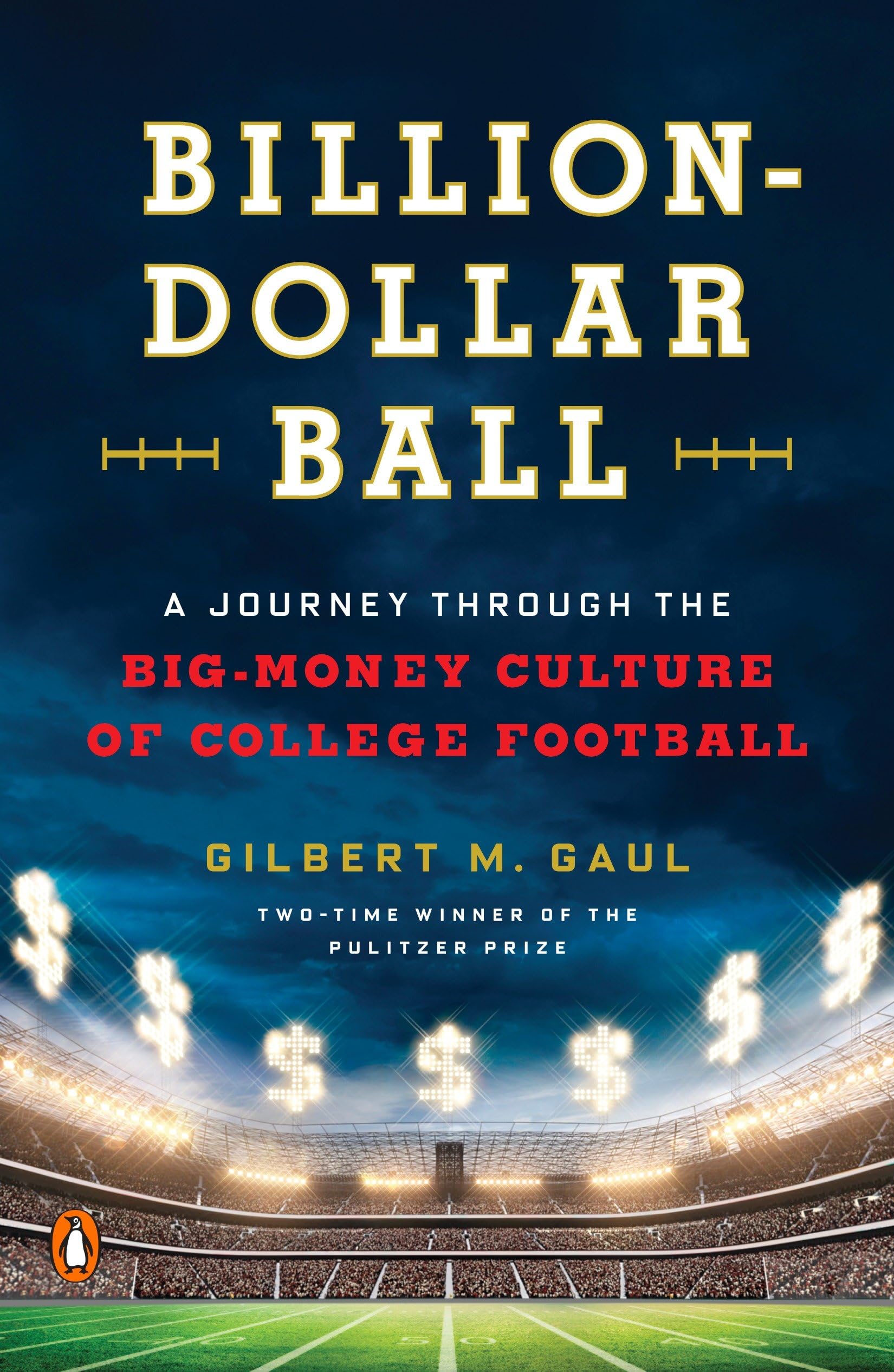
Billion-Dollar Ball: A Journey Through the Big-Money Culture of College Football
$18.00
| Brand | Gilbert M. Gaul |
| Merchant | Amazon |
| Category | Books |
| Availability | In Stock Scarce |
| SKU | 0143108638 |
| Color | Multicolor |
| Age Group | ADULT |
| Condition | NEW |
| Gender | UNISEX |
| Google Product Category | Media > Books |
| Product Type | Books > Subjects > Sports & Outdoors > Miscellaneous > Sociology of Sports |
About this item
Billion-Dollar Ball: A Journey Through the Big-Money Culture of College Football
“A penetrating examination of how the elite college football programs have become ‘giant entertainment businesses that happened to do a little education on the side.’” — Mark Kram , The New York Times Two-time Pulitzer-Prize-winning journalist Gilbert M. Gaul offers a riveting and sometimes shocking look inside the money culture of college football and how it has come to dominate a surprising number of colleges and universities. Over the past decade college football has not only doubled in size, but its elite programs have become a $2.5-billion-a-year entertainment business, with lavishly paid coaches, lucrative television deals, and corporate sponsors eager to slap their logos on everything from scoreboards to footballs and uniforms. Profit margins among the top football schools range from 60% to 75%—results that dwarf those of such high-profile companies as Apple, Facebook, and Microsoft—yet thanks to the support of their football-mad representatives in Congress, teams aren’t required to pay taxes. In most cases, those windfalls are not passed on to the universities themselves, but flow directly back into their athletic departments. College presidents have been unwilling or powerless to stop a system that has spawned a wildly profligate infrastructure of coaches, trainers, marketing gurus, and a growing cadre of bureaucrats whose sole purpose is to ensure that players remain academically eligible to play. From the University of Oregon’s lavish $42 million academic center for athletes to Alabama coach Nick Saban’s $7 million paycheck—ten times what the school pays its president, and 70 times what a full-time professor there earns—Gaul examines in depth the extraordinary financial model that supports college football and the effect it has had not only on other athletic programs but on academic ones as well. What are the consequences when college football coaches are the highest paid public employees in over half the states in an economically troubled country, or when football players at some schools receive ten times the amount of scholarship awards that academically gifted students do? Billion-Dollar Ball considers these and many other issues in a compelling account of how an astonishingly wealthy sports franchise has begun to reframe campus values and distort the fundamental academic mission of our universities. “College football is no longer just a game. Gilbert M. Gaul contends precisely that in his persuasive new book . . . . A penetrating examination of how the elite college football programs have become ‘giant entertainment businesses that happened to do a little education on the side.’” — Mark Kram Jr ., The New York Times “ Billion-Dollar Ball compels us to see . . . a moneymaking spectacle that ‘has challenged the notion of universities as places of learning and reflection.’ . . . [Gaul] casts a sober eye on the economic landscape of college football—the tax breaks, television deals and corporate sponsorships that create staggering revenues for powerhouse programs. . . . Gaul comes across like a bemused accountant trying to make sense of these absurd numbers. But occasionally, he’s more of a modern-day Twain, visiting college campuses and asking all sorts of people all sorts of questions.” —Ihsan Taylor, New York Times Book Review “A hard and challenging book, but one that I hope college football diehards will join me in reading. . . . When we cheer for our schools and our teams, we’re also supporting a powerful and autonomous entertainment business that monetizes every aspect of the game, an operation that is not only divorced from the mission of higher education but that often undermines it. . . . The book skillfully chronicles and quantifies the more mercenary aspects of the game that many fans have long avoided.” —Carlos Lozada, The Washington Post “Outside the United States, university is where you study. But for thousands of supersized American males, it is where you go to run into other men of similar proportions like particles in the Large Hadron Collider. . . . In recent years critics have accused American universities, which together earn $10 billion a year in athletic revenue, of exploiting an unpaid labour force. Moreover, numerous players have filed lawsuits demanding a piece of the pie. In Billion-Dollar Ball Gilbert Gaul, a journalist, eschews these criticisms in favour of a more fundamental angle of attack: that running such large entertainment businesses is incompatible with the core task of universities. . . . Mr. Gaul’s decision to shift the focus from the ‘narrative du jour’ of harm to players to the huge resources universities pour into football could conceivably provide a valuable contrarian perspective.” —The Economist “Innocents might wonder why a book on US college football—an amateur sport, they might think—belongs in a business books section. Americans, however, know it is a very big business, with a model, as Gilbert M Gaul explains in his
| Brand | Gilbert M. Gaul |
| Merchant | Amazon |
| Category | Books |
| Availability | In Stock Scarce |
| SKU | 0143108638 |
| Color | Multicolor |
| Age Group | ADULT |
| Condition | NEW |
| Gender | UNISEX |
| Google Product Category | Media > Books |
| Product Type | Books > Subjects > Sports & Outdoors > Miscellaneous > Sociology of Sports |
Similar Products








Compare with similar items

Dino Discovery... A Fun filled Preschool... |

The Everyday Gratitude Journal For Kids... |

Happy Hands Friendly Hearts: Coloring Bo... |

Traders Toolkit: Volume Analysis and VWA... |
|
|---|---|---|---|---|
| Price | $9.99 | $14.98 | $9.99 | $24.99 |
| Brand | Kristina Michelle Jaffe | SandZ Academy | Laura Williams | Mark Hudson |
| Merchant | Amazon | Amazon | Amazon | Amazon |
| Availability | In Stock | In Stock | In Stock | In Stock |